



**तस्य सञ्जनयन् हर्षं कुरुवृद्धः पितामहः ।
सिंहनादं विनद्योच्चैः शङ्खं दध्मौ प्रतापवान् ॥**
When Duryodhana was occupied with issuing instructions to his commanders, his outward confidence concealed a growing anxiety within. His words, rather than inspiring complete confidence, were beginning to place his officers in an uncomfortable state of tension. His repeated attempts to direct and remind the great warriors around him revealed something deeper: he was trying to overcome an uncertainty that had already begun to disturb his mind.
Bhishma, the venerable grandsire of the Kuru dynasty, stood nearby and observed the situation with the insight of a seasoned statesman and warrior. He could perceive what Duryodhana himself was unable to recognise. The silence of Dronacharya was particularly significant. Drona was not merely a commander; he was a man of knowledge, discipline, experience and action. His silence, therefore, could not be dismissed as indifference. It suggested that the atmosphere created by Duryodhana’s words had disturbed the natural composure of those upon whom the success of the Kaurava army depended.
Bhishma understood an important principle of leadership: an army does not become strong merely because it possesses numbers, weapons and celebrated warriors. Its real strength lies in the psychological unity of its commanders and soldiers. If the leaders begin to entertain conflicting thoughts, resentment or uncertainty, their physical strength may remain intact, but their collective effectiveness begins to diminish.
The longer such thoughts were allowed to remain unaddressed, the more deeply they could affect the Kaurava command. Bhishma therefore intervened—not through an argument with Duryodhana, but through an unmistakable act of symbolic leadership. The grandsire raised his conch and sounded it with immense force. The sound travelled across the battlefield like a declaration that hesitation had no place in the hour of war.
The Bhagavad Gita describes this moment with remarkable precision: Bhishma, the elder of the Kuru house, sought to generate joy and confidence in Duryodhana and then blew his conch with a lion-like roar. The verse is brief, yet its psychological meaning is profound. Bhishma was not merely producing a sound; he was attempting to restore the emotional balance of the army.
The conch therefore becomes more than a musical or ceremonial instrument. In the Mahabharata, sound itself becomes an instrument of psychological warfare. Before weapons are actually employed, the opposing armies communicate through their conches, drums, trumpets and war cries. These sounds announce intention, awaken courage, create apprehension and establish the emotional character of the battlefield.
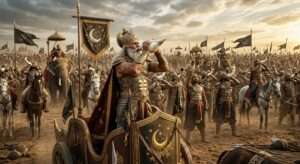
Bhishma’s action can consequently be understood as an attempt to transform uncertainty into confidence. Duryodhana’s nervous energy was becoming visible through his excessive instructions, whereas Bhishma answered that nervousness with a decisive demonstration of authority. The grandsire’s roar told the Kaurava forces that their supreme elder and commander remained resolute.
Yet there is an important irony in this episode. Bhishma’s conch blast strengthens the immediate morale of the Kaurava army, but it also marks the unmistakable transition from political confrontation to open warfare. Until that moment, the possibility of negotiation, restraint, and reconciliation had not entirely disappeared from the moral landscape of the conflict. Once the great commanders begin announcing themselves through their war instruments, the battlefield moves decisively toward violence.
In this sense, Bhishma’s lion-like roar may be regarded as one of the great psychological thresholds of the Mahabharata. It does not constitute the entire cause of the war, for the conflict had been developing through a long chain of political decisions, personal grievances, violations of trust and failures of reconciliation. Nevertheless, it provides the dramatic signal through which accumulated tension becomes military action.
The comparison with modern warfare is illuminating if understood symbolically rather than literally. In modern combat, the first shot can represent the moment when confrontation becomes irreversible armed conflict. At Kurukshetra, Bhishma’s resounding conch serves a comparable narrative function: it announces that the armies are no longer merely standing opposite one another in anticipation. The accumulated history of the Kuru family has now reached the battlefield.
There is also a deeper philosophical dimension. The Mahabharata repeatedly demonstrates that external conflict is preceded by an internal conflict. Before armies collide, minds have already become divided. Duryodhana’s insecurity, Drona’s silence, Bhishma’s responsibility and the conflicting loyalties of the Kuru warriors all represent different forms of that inner struggle. Kurukshetra is therefore not merely a geographical battlefield; it is the outward manifestation of unresolved human choices.
This is precisely why the Bhagavad Gita emerges from the battlefield rather than from a secluded hermitage. The eternal truth is revealed when human beings stand at the most difficult intersection of duty, affection, fear, responsibility and consequence. Krishna does not remove the battlefield from Arjuna’s life. Instead, He teaches Arjuna how to understand action, duty and the Self while standing within the battlefield.
Bhishma’s conch, therefore, has a significance that extends beyond the Kaurava camp. It announces the beginning of an external war, while the silence within Arjuna will soon reveal the beginning of an entirely different war—the struggle between emotional attachment and perceived duty, between personal sorrow and universal responsibility, and ultimately between confusion and knowledge.
The Mahabharata’s genius lies in this parallel. One conch awakens an army to physical battle; another dimension of the narrative awakens the human mind to spiritual inquiry. The roar of Bhishma prepares the field for war, while the wisdom of Krishna prepares Arjuna—and through him humanity—for the far greater battle within.
Thus, the grandsire’s lion-like declaration is not simply the opening sound of Kurukshetra. It represents the moment when accumulated history crosses the boundary into action. The weapons have not yet done their work, but the human decisions that will unleash them have already been made. The battlefield is ready, the warriors are assembled, and destiny has reached its decisive threshold.
And in that charged silence between the sounding of the conches and the release of the first weapons, the Bhagavad Gita begins to reveal its eternal truth: the most consequential battles are first fought within the human mind, and right action becomes possible only when confusion gives way to knowledge.



The Gita series of BR Madhavi is giving an excellent Psychological analysis of human conflict that too at the battle field!!!
The nature of each one and the decision making is narrated clearly.
The epic Mahabharata and Bhagavadgita in it must be known by every human being to lead a peaceful life