
Lakshmanrao Upadhyayula
The sage Vāmadeva, one of the illustrious seers of the Ṛgveda, invokes Lord Indra through the majestic Triṣṭubh Chandas, a poetic metre renowned for expressing grandeur, courage, and divine splendour. His prayer is not merely a request for worldly prosperity but a profound invocation seeking the presence of the supreme guardian of righteousness. Vāmadeva prays that Indra, endowed with immeasurable strength and radiant like the Sun, may come to his devotees, subdue hostile forces, and establish security, peace, and spiritual confidence. The hymn reflects the Vedic conviction that divine strength is inseparable from moral order and that victory belongs to those who uphold truth through sacred action.
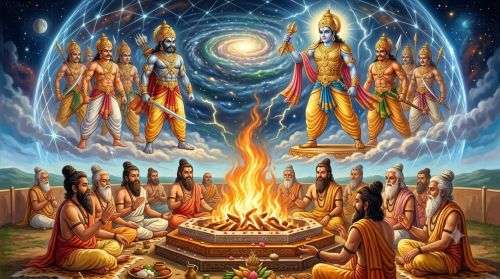
Indra is envisioned as the ever-youthful yet eternally mature warrior whose heroic spirit inspires courage among humanity. He is invited to rejoice with the sacrificers and preside over the yajña like a universal monarch. His companionship transforms the sacrificial arena into a meeting place of heaven and earth, where divine grace descends upon sincere worshippers. In Vedic understanding, yajña is not merely a ritual but the sustaining principle of cosmic harmony, linking human endeavour with the rhythm of the universe.
The hymn also glorifies the Maruts, the radiant storm deities who accompany Indra in his celestial expeditions. Born of a noble lineage, fearless in battle, immensely glorious, and unequalled in wealth and vigour, the Maruts symbolise the dynamic forces of nature. Their roaring movement through the skies represents the power of atmospheric energy, while their companionship with Indra illustrates the harmonious cooperation of natural forces under divine governance. The priests therefore chant sacred hymns inviting both Indra and the Maruts to the consecrated precincts of the yajña, recognising that prosperity emerges when cosmic powers function in perfect unity.
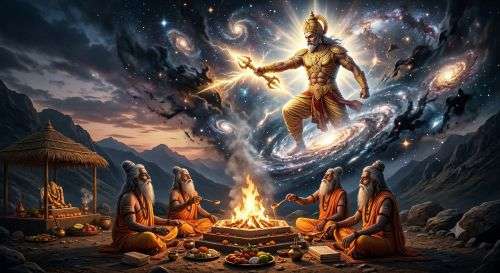
The invitation extended to Indra transcends geographical boundaries. The sages call upon him to arrive from heaven, earth, the intermediate space, the waters, the realm of the Ādityas, distant regions, cloud-filled skies, and every subtle abode of divine existence. This universal invocation reflects the Vedic perception that the Divine pervades every dimension of creation. Modern scientific thought similarly recognises that the forces governing the universe operate seamlessly across space, atmosphere, water, and energy. The Vedic seers poetically expressed this interconnectedness through sacred symbolism long before systematic scientific inquiry emerged.
Indra is praised as the sovereign of both visible and invisible wealth. Material abundance, intellectual brilliance, moral courage, and spiritual illumination are all considered manifestations of his divine power. His strength enables him to overcome destructive forces that obstruct the welfare of humanity. His confidence is not portrayed as arrogance but as the unwavering assurance of one who protects cosmic order. He generously rewards the priests who preserve sacred knowledge through the faithful recitation of the Ṛgvedic hymns and through the disciplined performance of yajña.
The tremendous roar of Indra symbolises the irresistible force of nature. It is likened to the thunder that reverberates across the heavens, energising the atmosphere and heralding life-giving rains. In the Vedic imagination, this celestial sound possesses the power to shake the worlds and awaken dormant energies. Scientifically, thunder accompanies atmospheric electrical activity that precedes rainfall, while spiritually it represents the awakening of consciousness and the triumph of order over chaos. Thus, natural phenomena become profound symbols of divine operation rather than objects of fear alone.
The sacred oblations offered into the yajña fire are believed to ascend through subtle channels to the celestial realms, where Indra receives them with delight. In return, he blesses the earth with nourishing rains that sustain crops, animals, and all forms of life. This imagery beautifully illustrates the Vedic understanding of ecological reciprocity. Human gratitude expressed through disciplined living and sacred offerings is answered by nature’s generosity, reminding humanity that prosperity depends upon maintaining harmony with the universal order rather than exploiting it.
The priests therefore invite Indra with melodious Vedic chanting into the sanctified halls of sacrifice. Sound itself occupies a sacred place in Vedic philosophy. Every correctly pronounced mantra generates subtle vibrations believed to harmonise the individual mind with cosmic intelligence. Contemporary studies on acoustics and resonance demonstrate that sound profoundly influences physical and psychological environments, offering an interesting parallel to the Vedic reverence for sacred recitation.
Indra is described as one who delights in sincere prayer and graciously resides, in subtle form, within the home of the yajamāna during the performance of the sacrifice. As the Ṛtvijas recite the sacred hymns with devotion, they invite his compassionate presence. The divine is therefore understood not as distant but as intimately connected with those who cultivate purity, discipline, and reverence. Indra’s guidance strengthens the community in times of conflict and inspires unwavering courage in the defence of righteousness.
Although celebrated as the unconquerable warrior, Indra also assumes the role of the protector and priestly guardian of the sacrificer. His righteous anger is directed only against forces that threaten truth and harmony. As the sovereign of the universe and the fulfiller of noble aspirations, he safeguards the patron who honours the sacred traditions with faith and integrity. His divine strength becomes firmly established in the heart of the worshipper, empowering every righteous action and ensuring that noble intentions mature into lasting happiness.
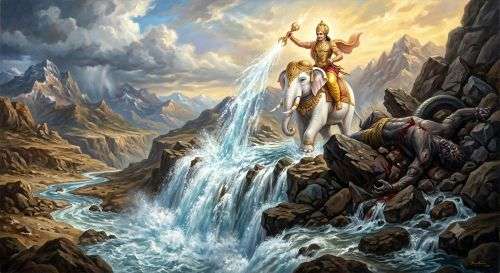
One of Indra’s most celebrated deeds is the opening of the celestial reservoirs by overcoming the forces that restrain the waters. This symbolic victory signifies the release of rivers, rains, fertility, and abundance. Scientifically, rainfall governs the continuity of ecosystems and agriculture, while spiritually it represents the liberation of hidden potential through divine grace. The yajamāna who faithfully offers oblations to Indra is therefore blessed with flourishing cattle, abundant harvests, and enduring prosperity, symbolised by the powerful and generous bull.
The hymn lovingly praises the auspicious hands of Indra as instruments of benevolence and righteous action. Through those gracious hands flow wealth, strength, wisdom, and protection. Yet the devotee also speaks with touching intimacy, asking why divine blessings sometimes appear delayed and why prosperity is not immediately bestowed. Such heartfelt questioning reflects the deeply personal relationship between the Vedic worshipper and the Divine, where faith allows both reverence and honest inquiry to coexist.
Ultimately, the truthful, heroic, and Vṛtra-slaying Indra responds to sincere devotion with generous blessings. He enriches those who preserve the sacred hymns, granting them both material prosperity and spiritual fulfilment. The wealth received through his grace is not viewed merely as personal possession but as a sacred trust to sustain righteous living, support society, and honour the Divine. The hymn concludes with the aspiration that Indra’s inexhaustible blessings may nourish humanity with divine sustenance, strengthen virtue, and preserve the eternal harmony between nature, knowledge, sacrifice, and the Supreme Reality.