
Bandaru Dattatreya
The 1977 cyclone was a human catastrophe of unimaginable proportions. But amid death and devastation, it also revealed the extraordinary power of selfless service, compassion and collective determination.
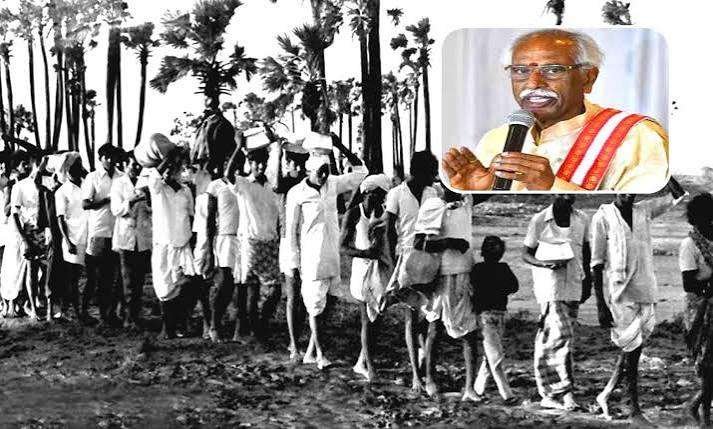
November 19, 1977, remains etched in my memory as one of the darkest days in the history of Andhra Pradesh and one of the most defining experiences of my life. The devastating Diviseema cyclone wiped out entire villages, claimed thousands of lives, and left behind a trail of destruction that is difficult to describe even today. When a group of Rashtriya Swayamsevak Sangh (RSS) volunteers, including myself, reached Avanigadda on November 21, following the instructions of the then Regional Pracharak, Shri Sompalli Somaiah, we were confronted with scenes of unimaginable devastation. Roads and communication networks had collapsed, drinking water and food were scarce, and bodies lay scattered across the landscape. The region resembled a vast graveyard.
In many instances, there was nobody left to claim the deceased or perform their last rites. We realised that our immediate responsibility was not merely to provide relief but also to ensure that every victim received a dignified farewell. Four volunteers at a time, we carried bodies on bamboo poles, chanting Lord Rama’s name as we proceeded to perform the last rites. For nearly ten days, we continued this heartbreaking work, wearing our khaki shorts and white shirts, with our faces covered and cloth tied around our heads. Food and personal comforts were the last things on our minds; we survived largely on whatever was available, often just milk and biscuits. Newspapers soon christened us the ‘Shava Sena’ (Army of the Dead), a name that local people too began using with affection. It was an extraordinary experience that tested our physical endurance but, more importantly, strengthened our conviction that service to humanity transcends every personal consideration.
One encounter during those difficult days remains particularly memorable. When the then Chief Minister, Shri Jalagam Vengala Rao, visited Koduru to review relief operations, he saw us carrying out the last rites and initially mistook us for policemen. On learning that we were RSS Swayamsevaks, he expressed admiration for our work. He wondered how we could undertake such emotionally demanding tasks when even police personnel and rescue teams from Singareni found it difficult to confront the horrifying sight. He even asked whether we depended on intoxicants to overcome the ordeal.
My response was simple: our organisation had instilled in us the spirit of selfless service, and that alone gave us the strength to continue. The Chief Minister appreciated our commitment and arranged kerosene and other essential supplies for our operations. Minister and Avanigadda MLA Shri Mandali Venkata Krishna Rao was another inspiring presence, personally visiting affected villages and coordinating assistance. Our work was also acknowledged at Gandhi Kshetram, where prominent Gandhian Shri Prabhakarji of Maharashtra made a remark that has stayed with me: “RSS means Ready for Selfless Service.” Those words were a tremendous source of encouragement.

We soon realised that relief could not end with distributing food and essential supplies. Families who had lost everything needed homes, livelihoods and the means to rebuild their futures. We therefore adopted Moolapalem and undertook its reconstruction with the active participation of residents. Houses, a school, roads, drinking water and electricity facilities were provided. Fishing boats and nets were arranged to help fishermen regain their livelihoods.
The reconstructed settlement was named Deen Dayal Puram, and its inauguration was graced by Shri Atal Bihari Vajpayee, then Union Minister for External Affairs and later Prime Minister of India. The Andhra Pradesh Cyclone Relief Committee, several voluntary organisations, and donors supported the rehabilitation effort. Relief materials collected at the Indian Express warehouse in Vijayawada were sorted and distributed across nearly 56 villages, with 400 to 500 volunteers participating. The Ramakrishna Mission, Sathya Sai Seva Organisations, Arya Samaj, Vishwa Hindu Parishad and Salvation Army were among those who extended valuable assistance.
Nearly five decades later, the memories remain vivid. Diviseema taught me that humanity is measured not by what we profess but by what we do when fellow human beings are in distress. Service must rise above caste, religion, region and political affiliations. I remain deeply grateful to every volunteer, official, organisation and donor who stood together during those trying days. I also bow my head in solemn tribute to every life lost in that catastrophe. The real legacy of Diviseema is not merely the devastation it witnessed, but the spirit of compassion, courage and rehabilitation that emerged from its ashes.