Shrikant Rao
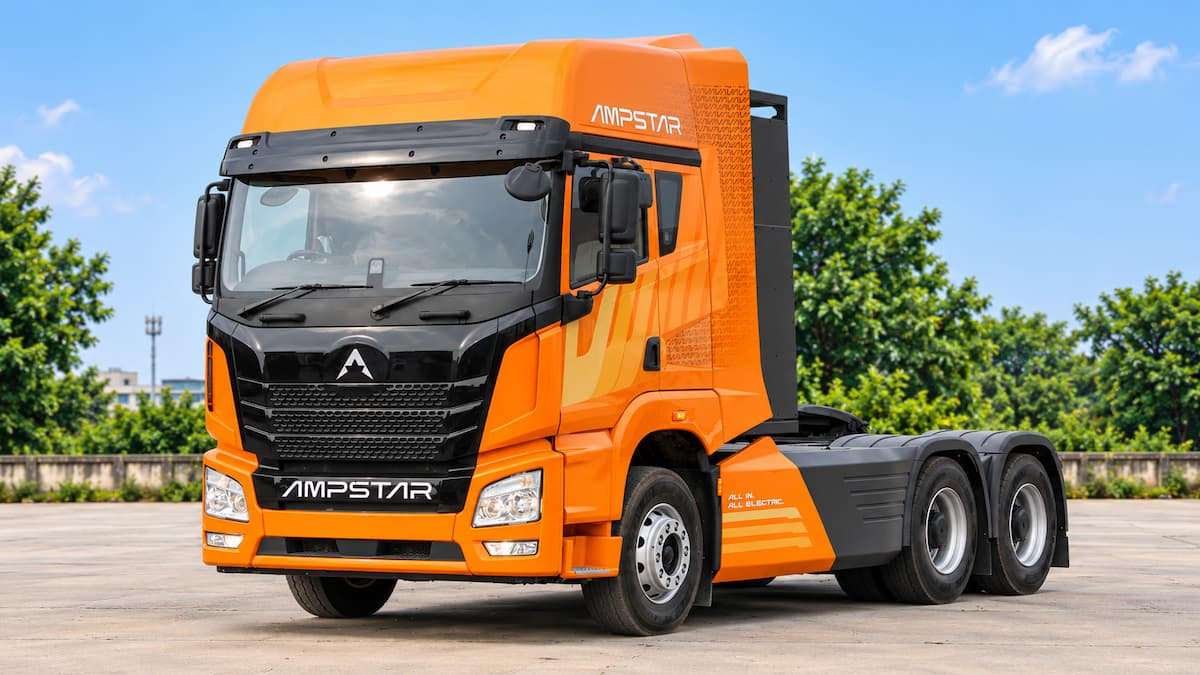
With the dust barely settled on its landmark October commercial breakthrough, JSW Greentech Limited is moving swiftly to execute its first major order for 100 AMPSTAR 4×2 55T Tractor Truck electric prime movers, earmarked for heavy-duty industrial haulage at JSW Cement in Vijaynagar.
This historic transaction, executed in collaboration with JSW Eco-Mobility as the Battery-as-a-Service provider and Paradeep Parivahan Limited as the logistics partner, continues to send ripples through India’s commercial vehicle landscape. By advancing from brand unveil to commercial order execution and phased rollout in just over a single month, the group demonstrates how heavy electric transport can be structured for viability inside a captive, vertically integrated industrial loop.
Regulatory Clearance
The milestone came immediately after the AMPSTAR 4×2 and 6×4 Tractor Trucks received official certification under the Central Motor Vehicle Rules from the Automotive Research Association of India. This statutory clearance confirms the vehicles meet the safety, performance, and environmental standards required for deployment on Indian roads.
Driven by an engineered drivetrain tailored for demanding local commercial operating conditions, the vehicles deliver a peak power output of 430 kW and a peak torque of 2,600 Nm. These specifications are designed to handle heavy gross combination weights across demanding industrial freight cycles.
Corridor Metrics
This deployment forms the backbone of an integrated transport solution moving critical manufacturing materials along an approximately 330-kilometre industrial corridor connecting Nandyal in Andhra Pradesh to Vijayanagar in Karnataka. Tasked with carrying an estimated 1.25 lakh tonnes of clinker and slag every month, the fleet bypasses the public infrastructure bottlenecks that continue to slow independent electric vehicle adoption.
To support seamless material movement and minimize static charging downtime, JSW Eco-Mobility is building a dedicated logistics corridor equipped with four automated battery-swapping stations along the route. This structural architecture decouples the heavy energy asset from the truck chassis, targeting the rapid turnaround times required for heavy manufacturing supply chains.
Velocity Arbitrage
The pace at which JSW Greentech has moved from brand launch to securing a 100-truck commercial commitment highlights an agility advantage over legacy automotive giants, which typically require longer cycles to move from concept to commercial rollout. Addressing this rapid transition, Sumit Mittal, CEO of JSW Greentech Limited, noted that the 55T electric tractor truck “represents one of the most demanding vehicle architectures in commercial transportation.”
Mittal added that in just over a month, the company reached a significant milestone with the first 100 trucks entering deployment for JSW Cement, “supported by JSW Eco-Mobility as Battery-as-a-Service (BaaS) partner.” By treating vehicle deployment as an urgent infrastructure rollout rather than a slow retail cycle, the company has captured industry attention.
Mittal explained that the group is building an integrated ecosystem with battery-swapping stations “to enable the seamless movement of materials” and “make electric heavy-duty transportation commercially viable.” He affirmed that the company’s ambition with AMPSTAR “is to be a catalyst in transforming how businesses move goods across India.” This philosophy positions the vehicle not merely as isolated hardware, but as an integrated node within a captive logistics network.
Freight Economics
The core economic driver behind this closed sandbox deployment is the potential for a substantial reduction in structural operating expenditures. Moving high-tonnage industrial freight over a 330-kilometre corridor using traditional diesel rigs exposes a balance sheet to high per-kilometre fuel and maintenance costs.
By transitioning to a captive battery-swapping infrastructure powered by structured grid configurations, JSW is positioned to optimize its freight logistics cost structure significantly compared to fossil-fuel baselines. This potential drop in relative operating expenses underscores why JSW Cement is leveraging group infrastructure to protect raw logistics margins while advancing its sustainability goals.
Infrastructure Realism
To appreciate the scale of this engineering undertaking, one must look at the operational demands of the corridor infrastructure. Running 100 high-tonnage trucks on continuous cycles across a 330-km route requires each of the four automated swapping stations to operate with high reliability and speed.
These mechanized hubs are engineered to handle heavy, high-voltage battery packs, executing automated swaps to keep vehicle turnaround times to a minimum. By focusing on high vehicle asset utilization, JSW avoids the hours of static high-voltage plug-in downtime that typically challenge heavy electric haulage operations in demanding industrial environments.
Diesel Volatility
The long-term economic and environmental projections of this internal corridor highlight the vulnerabilities of traditional diesel-dependent logistics. Over the term of this contract, company projections indicate the operation of these 100 AMPSTAR trucks is expected to save about 4.5 crore litres of diesel and avoid approximately 6,250 tonnes of carbon dioxide emissions.
For JSW Cement, this represents a targeted step toward decarbonising its supply chain while maintaining throughput. Narinder Kahlon, Director Finance at JSW Cement, stated that the deployment “marks an important step towards decarbonising our logistics operations while supporting the movement of materials across our supply chain.”
Kahlon added that backed by battery-swapping infrastructure, the company aims “to reduce our dependence on diesel, lower emissions and advance our sustainability objectives without compromising operational efficiency.” In an era where carbon accounting increasingly influences corporate valuations, transitioning a high-volume logistics corridor toward lower emissions offers a clear strategic benefit while shielding logistics budgets from global crude oil volatility.
Unlike legacy truck manufacturers structured around distributed retail networks, JSW Greentech offers full-stack solutions. They provide power configurations ranging from 150 kW to 500 kW alongside outright purchase, leasing, and Battery-as-a-Service contracts, designed to simplify adoption for enterprise clients.
Capital De-Risking
For the parent entity, the JSW Group, this commercial deployment represents a strategic exercise in corporate asset optimization and risk mitigation. Logistics costs for bulk raw materials like steel and cement are closely tied to fluctuating diesel prices, leaving traditional manufacturing balance sheets exposed to geopolitical shocks and variable fuel surcharges.
By shifting the movement of 1.25 lakh tonnes of cargo monthly toward an electric grid framework, the parent company replaces a volatile operating expense with predictable energy costs. Furthermore, this setup de-risks the initial scaling phase for JSW Greentech itself. Rather than relying solely on external market validation during its launch phase, the group utilizes its own industrial operations as a structured captive launchpad. This internal demand provides a foundational volume cushion as its Maharashtra factory scales up, insulating early production from cyclical retail slumps.
Valuations Boost
This deployment establishes a strategic framework that can positively influence how markets evaluate the conglomerate’s traditional industrial divisions. Core heavy industries like steelmaking and cement production face growing global environmental scrutiny, carbon border adjustments, and tightening regulatory frameworks.
By eliminating millions of litres of diesel consumption on a dedicated logistics corridor, the group strengthens its environmental reporting metrics, supporting its sustainability profile among institutional investors and green-finance frameworks. Furthermore, JSW Energy—which is scaling toward 30 GW of generation capacity by 2030—is positioned to supply renewable power into JSW Eco-Mobility’s battery-swapping network, redirecting capital that would otherwise flow to external fuel suppliers into an internal energy ecosystem.
Ecosystem Value
The heavy-freight initiative launched by JSW Greentech’s AMPSTAR deployment adds momentum to India’s broader construction and mining equipment ecosystem. By targeting the heavy prime mover class, Indian manufacturers are actively refining mid-to-heavy tonnage electric architectures suited for regional operating conditions, complementing the hyper-large mining dumpers trialed in Western Australia or Chile.
This approach also strengthens domestic supply chain localization. Establishing dedicated greenfield hubs helps shift the local industry from relying purely on imported power kits toward assembling and integrating advanced electro-mechanical systems at home. By demonstrating how a captive battery-swapping network can decouple the energy asset from the vehicle, JSW contributes a practical infrastructure template that other heavy equipment operators can evaluate for mining and highway projects.
Manufacturing Monolith
The long-term foundation of JSW Greentech’s strategy rests on its domestic manufacturing roadmap, designed to compete alongside established Indian commercial vehicle OEMs like Tata Motors, Ashok Leyland, and VE Commercial Vehicles. AMPSTAR vehicles will be built at an integrated greenfield production facility being developed across approximately 90 acres at AURIC in Chhatrapati Sambhajinagar, Maharashtra.
Planned for an annual capacity of 10,000 electric buses and 5,000 electric trucks—a total capacity of 15,000 units—and supported by a research and development centre in Pune, this plant is engineered to house India’s first fully integrated electric vehicle cell-to-battery pack manufacturing facility for commercial vehicles. Incorporating an automated truck-cabin line, a Pre-Treatment and Electro-Deposition system, and Industry 4.0 integrations across ERP, PLM, and MES systems, JSW is building a modern manufacturing base. With plans to expand into tippers and fixed-body dumpers, JSW Greentech is positioning itself to serve the mining, construction, and core industrial sectors.
Supply Sovereignty
By building an integrated EV cell-to-battery pack facility for commercial vehicles directly on site, JSW significantly reduces downstream pack-assembly dependencies. While global cell chemistry and raw mineral supply chains remain an industry-wide factor for all electric vehicle makers, bringing cell-to-pack engineering, thermal management, and cabin automation under one roof gives JSW tighter control over quality, lead times, and vehicle integration, insulating manufacturing schedules from third-party pack vendor bottlenecks.
Frontier Horizons
JSW Greentech’s integrated manufacturing model aligns with broader global growth in heavy commercial electric transportation. Data from the International Energy Agency shows that global sales of electric heavy freight trucks exceeding 15 tonnes tripled year-on-year to reach 230,000 units, pushing the electric market share of heavy trucks to nine percent.
As global commercial vehicle procurement increasingly evaluates total cost of ownership alongside brand legacy, greenfield platforms built on vertical integration are well-positioned for emerging export corridors. Mastering high-power pack integration and durable vehicle architectures in India’s demanding heat and dust conditions creates a strong foundation for international expansion across Southeast Asia, Africa, and Latin America, where resource-driven economies face similar pressures around imported diesel costs and developing charging grids.
Competitive Matrix
JSW’s captive corridor approach is unfolding alongside a wave of heavy-duty electric vehicle announcements across India, as core industrial sectors move from small pilots toward larger fleet commitments. In e-commerce logistics, Amazon partnered with Tata Motors to deploy 3,000 electric trucks across its Indian middle-mile network, while Tata has expanded its portfolio with models like the Prima E.55S electric prime mover and Prima E.28K electric tipper.
In the cement sector, rival UltraTech Cement announced plans to deploy over 600 heavy-duty electric trucks by December 2026 to transport five million tonnes of clinker annually across seven states. Similarly, Wonder Cement has deployed a fleet of 250 Montra Electric Rhino trucks along a 1,450-km freight route, utilizing battery-swapping stations developed with Blue Energy Motors and HPCL.
Cost of Inaction
The rapid pace of these announcements underscores the competitive pressure facing established automotive manufacturers to accelerate their heavy electric roadmaps. Meanwhile, in the off-road mining segment, public sector manufacturer BEML Limited unveiled the BH60-EV, an indigenously developed 60-ton battery-electric mining dump truck powered by a 1,000 kWh battery pack.
BEML’s entry joins specialized domestic pioneer Propel Industries, which has already deployed over 230 electric mining dumpers across active sites and recently showcased its 470 Electric Truck Range—including the 55-tonne 470 eTR tractor-trailer—at a trade show. Together, these developments demonstrate that zero-emission heavy freight in India is moving decisively beyond the drawing board, gaining real operational traction across the country’s core industrial corridors.