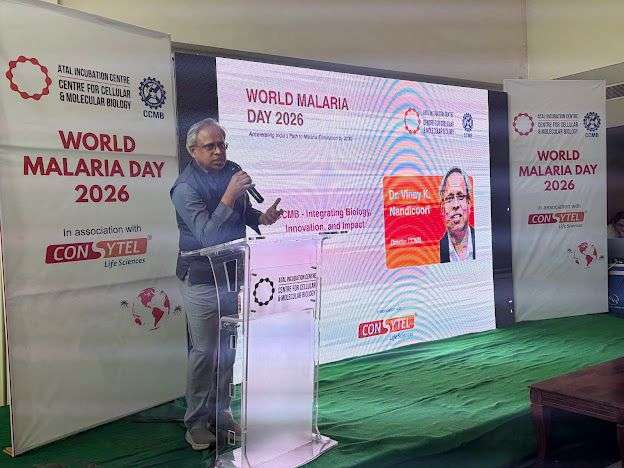
Hyderabad: Marking World Malaria Day, the Atal Incubation Centre – Centre for Cellular and Molecular Biology (AIC-CCMB), in collaboration with Consytel Lifesciences, hosted a high-level multi-stakeholder symposium to accelerate India’s roadmap toward malaria elimination by 2030.
The event brought together experts from academia, public health, industry and government, including representatives from the Ministry of Health and Family Welfare, Centre for Study of Complex Malaria in India, Bharat Biotech, Public Health Foundation of India, Gandhi Medical College and CSIR-Centre for Cellular and Molecular Biology.
Opening the session, Vinay K Nandicoori, Director of CSIR-CCMB, underscored the importance of collective action in tackling malaria. He noted that while scientific research continues to advance understanding of the disease, eliminating malaria ultimately depends on ensuring that interventions reach the most vulnerable populations.
India has made notable progress in reducing malaria incidence and has exited the World Health Organization High Burden to High Impact group. However, speakers emphasised that significant challenges remain in the “last mile” of elimination. Persistent transmission in tribal and forested regions, evolving parasite behaviour, climate-driven shifts, and diagnostic resistance were identified as key hurdles.
The symposium featured expert discussions on successful state-led initiatives such as DAMaN programme Odisha, alongside emerging challenges like relapse caused by dormant parasites. Experts also highlighted new therapeutic approaches, including liver-targeted and plant-based pharmaceutical innovations, as well as the evolving role of malaria vaccines.
Nalam Madhusudhana Rao, CEO of AIC-CCMB, said India’s sharp decline in malaria cases over the past decade demonstrates the value of sustained investment, noting that every rupee spent on malaria control yields significant economic returns. He stressed that innovation and coordinated efforts are critical to closing the remaining gaps.
S K Dash, Founder of Consytel Lifesciences, highlighted the need to move beyond vector control and focus on eliminating the parasite reservoir in human hosts through innovative formulations.
A panel discussion titled “Now We Must: Closing India’s Last Mile by 2030,” moderated by Anuradha Medoju, called for strengthened surveillance, cross-border coordination, and targeted interventions in high-burden regions. The panel also advocated the use of artificial intelligence for disease prediction.
The symposium concluded with a call for a coordinated, evidence-driven and inclusive approach to ensure India remains on track to achieve malaria elimination by 2030.