



Vaisampayana said to Janamejaya that when Duryodhana, his courage shaken upon the field of battle, withdrew in despair, the tidings pierced the heart of the blind monarch Dhritarashtra with grief and anxious foreboding. Eager to know what followed that humiliation, the king questioned Sanjaya, son of Suta, desiring to hear what course his son had adopted after tasting defeat.
That night, burdened with wounded pride and restrained fury, Duryodhana approached the grandsire Bhishma. With words edged in sarcasm yet veiled in courtesy, he spoke: “Under your guardianship, we have devised subtle strategies and engaged the foe with resolve. Yet, in your very presence, the mighty Bhimasena has shamed me beyond endurance. I believed you to be a mountain unshaken by the tempest of the Pandava host, capable of conquering even the celestials; yet today the enemy has flourished as though unopposed. What is the cause of their superior prowess? Is there some flaw in our manner of battle?” Thus did he question the grandsire, hinting at doubt while professing reverence.
Bhishma, smiling at the prince’s impetuousness, replied with measured dignity: “Why speak as though my loyalty were suspect? Have I faltered even for a moment? When I stand in combat, none may endure before me; my mind admits no second thought. Hosts of renowned warriors tremble at my advance. Often have I declared that the Pandavas are difficult to conquer, yet I withhold not a fragment of my strength. Cast aside sorrow; I shall fight with all my might.” Reassured by these steadfast words, Duryodhana’s agitation subsided; he slept in renewed confidence and rose at dawn prepared once more for war.
At daybreak Bhishma surveyed the vast Kuru host and arranged it in a circular Mandala formation, a strategic array praised in ancient treatises such as the Agnipurana and the Kamandakiya Nitisara. Within this grand disposition were interwoven tactical patterns—Danda, Bhoga, Samantha Chakra, and Gomuthika—each designed to deploy the fourfold army of infantry, cavalry, chariots, and elephants with disciplined flexibility. The formation, formidable and intricate, was difficult for the foe to penetrate. Duryodhana stood at its center, guarded by allied kings stationed on either flank.
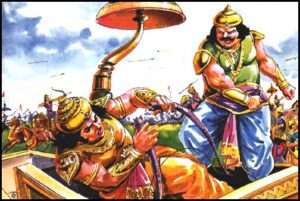
Beholding this arrangement, Yudhishthira commanded Dhrishtadyumna to counter it with the Vajra Vyuha, a diamond-shaped array symbolizing firmness and invincibility. Thus the Pandava army, ordered into a structure resembling a thunderbolt, advanced to meet the Kauravas. Soon the clash resounded across the field as warriors engaged according to rank and vow: Drona with Virata, Ashwatthama with Shikhandi, Shalya with Nakula and Sahadeva, Vinda and Anuvinda with Yudhamanyu, and many monarchs converging upon Arjuna. Bhima confronted Kritavarma; Abhimanyu opposed Chitrasena, Dussasana, and Vikarna; Ghatotkacha met Bhagadatta; Satyaki encountered the rakshasa Alambusha; Dhrishtaketu faced Bhurishrava; Chekitana engaged Kripacharya; and Yudhishthira fought Srutayu. Amidst this vast tumult, Bhishma himself battled hosts of kings.
Arjuna then addressed Krishna, saying that Bhishma’s Mandala had inflamed the ardor of the Kaurava ranks and drawn many warriors upon him at once. Seeking divine favor, he vowed to scatter their strength. Twanging the Gandiva, he released a tempest of arrows. The opposing kings answered with a deluge of shafts that enveloped both Krishna and Arjuna. At this spectacle the Kaurava forces shouted in fierce exultation. Provoked by their clamor, Arjuna invoked the Indrastra. That celestial missile shattered the hostile volleys, struck down elephants and steeds, and cast confusion among the enemy, churning their ranks like Mount Mandara stirring the cosmic ocean. The Kaurava warriors, unable to withstand the fury, sought refuge behind Bhishma’s standard.
Seeing their hesitation, Duryodhana reproached the kings, declaring that while Bhishma advanced alone against Arjuna, they, in the presence of their sovereign, shrank from duty. Stung by his words, the rulers rallied and formed around the grandsire. Meanwhile Drona, with swift shafts, cut down Virata’s bow and standard; yet the Matsya king seized another weapon and wounded his foe. The combat grew fierce until Drona, enraged, pierced Virata’s son with a deadly arrow that passed through his body and felled him lifeless. Witnessing his child’s fall, Virata lost heart and withdrew, and his forces scattered in disarray.
Elsewhere Shikhandi and Ashwatthama exchanged relentless blows; shields were shattered, steeds slain, and bows broken, until Shikhandi was compelled to mount Satyaki’s chariot. Dhrishtadyumna broke Duryodhana’s bow and smashed his chariot; the Kuru prince leapt to the ground with sword in hand, only to be borne away by Shakuni. Satyaki, undaunted by the illusions of Alambusha, dispelled the rakshasa’s sorcery and drove him from the field. Bhima crushed Kritavarma’s chariot and scattered his retinue, forcing him to seek refuge elsewhere.
Thus, as Sanjaya narrated these events, Dhritarashtra sat in deep despondency. The blazing valor of the Pandavas seemed to consume his sons’ proud formations, and the roar of battle echoed like the judgment of fate itself, foretelling the heavy cost of ambition and unrighteous war.

