Shrikant Rao
With industry players preparing to appear at bauma CONEXPO INDIA 2026, the timing is right to look at what Swedish truckmaker Scania is really trying to do in India. The country is selling heavy trucks again in serious numbers, but Scania is not behaving like a company preparing to chase every one of them.
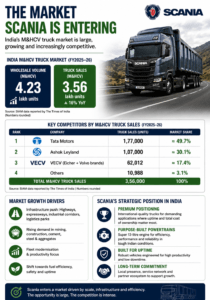
Medium and heavy commercial vehicle wholesale volumes reached about 4.23 lakh units in FY2025-26, taking the market above its pre-Covid level, while truck sales alone touched roughly 3.56 lakh units, up 16 percent over the previous year. Tata Motors sold about 1.77 lakh trucks, Ashok Leyland around 1.07 lakh and VECV 62,012. The numbers leave little doubt about where the centre of gravity lies.
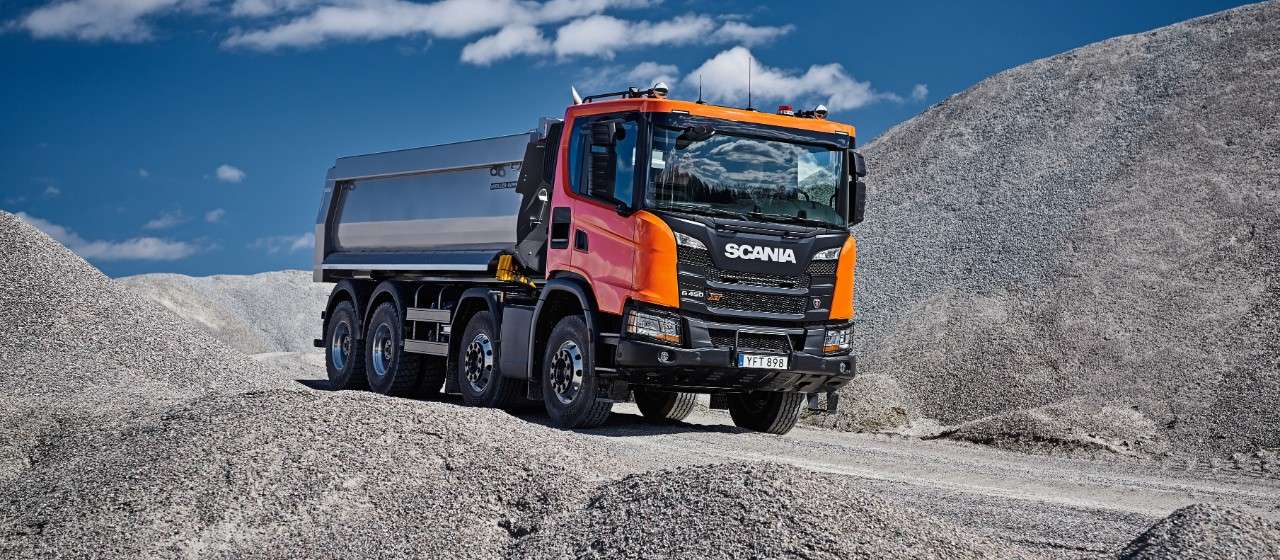
Scania has been in India since 2008, with its manufacturing operation at Narasapura near Bengaluru and its corporate base in the city. Its Indian portfolio includes heavy trucks, with applications spanning construction and other demanding operating conditions. Compared with the nationwide reach of Tata Motors or Ashok Leyland, it remains a small player. That may not be a problem if it has chosen its customers carefully. A truck working in a mine or on a major infrastructure project earns its keep differently from one hauling general freight, and the cost of an hour spent idle can make a surprisingly persuasive argument.
Running Costs
Scania’s 13-litre Super powertrain sits at the centre of that proposition. The current Scania India specification lists the top 13-litre version at 560 hp and 2,800 Nm of torque, while Scania promotes fuel savings of up to 8 percent for its Super powertrain. The Opticruise transmission and longer maintenance intervals are part of the same operating-economy proposition. The numbers matter because a truck working long shifts in a mine or on a heavy-haul route can accumulate thousands of operating hours. A few percentage points in fuel consumption, combined with high availability and controlled maintenance costs, can alter the economics of an asset over several years.
That is the logic behind Scania’s move towards solution sales. Financing, leasing, maintenance and operational support can become part of the proposition, particularly in sectors where a truck is expected to work long shifts with little tolerance for downtime. Indian fleet operators are increasingly comfortable calculating total operating costs, so a premium truck has to prove its worth in the customer’s own spreadsheet, not merely in a product presentation.
The GMMCO relationship fits this picture. As part of the CK Birla Group, GMMCO has long experience with mining and heavy equipment customers, giving Scania a route into sectors where uptime and equipment productivity already influence major purchasing decisions. It also offers access to an established ecosystem without requiring Scania to recreate the vast distribution architecture built over decades by India’s domestic truckmakers.

Heavy Competition
Volvo Trucks, headquartered in Gothenburg, is the obvious comparison. Through Volvo Eicher Commercial Vehicles, it has spent years building credibility in India’s mining, infrastructure and heavy-duty applications. Scania therefore arrives in a part of the market where another Swedish manufacturer has already taught customers to think about fuel, uptime and productivity rather than simply the price of the truck.
BharatBenz brings a different challenge, combining Daimler Truck’s global engineering with an Indian manufacturing and supplier base. Its proposition sits closer to local cost realities, making the premium segment rather less comfortable for a European newcomer.
Then there are Tata Motors and Ashok Leyland, headquartered in Mumbai and Chennai respectively, with advantages that go well beyond the truck itself. Their networks reach deep into the country, parts are easier to find and service support is familiar to operators who may be hundreds of kilometres from the nearest large city. In the Indian trucking business, that familiarity is not a minor convenience. Sometimes the winning technology is the mechanic who can reach you before dinner.
Local Content
That makes Narasapura important. Scania’s Indian manufacturing operation will become more valuable if a larger share of the vehicle can be supported by Indian suppliers and engineering capabilities rather than imported components.
Greater localisation could reduce logistics costs, shorten supply chains and lessen exposure to currency movements while making the Indian operation more competitive within Scania’s wider manufacturing network. The direction is commercially logical, even if the precise current localisation percentage is not publicly clear enough to put into print as a hard number.
There is also a possible regional angle. A stronger Indian manufacturing base could, over time and subject to commercial viability, support selected right-hand-drive markets in South Asia. That remains a possibility rather than an announced Scania plan, but the prospect adds another reason to watch how the Narasapura operation develops.
Global Backing
Scania has the advantage of a parent business that can afford to take a long view. In Q2 2026, the group reported revenue of SEK 53.1 billion, up 6 percent, while vehicle deliveries reached 26,274 and incoming orders rose 41 percent to 28,743. Adjusted return on sales was 11.6 percent. These are global figures, not Indian ones, but they provide the financial backdrop for a company that does not need every new market to deliver instant gratification.
India can therefore be approached patiently: add customers where the economics work, increase localisation, strengthen support and expand only when the business justifies it. The danger is obvious enough. A focused market can become a comfortable hiding place, and competitors do not generally respect comfort zones.
Exhibition Moment
That is why Scania’s participation at bauma CONEXPO INDIA 2026 is worth watching. The event brings together construction, mining and infrastructure industries, putting the truckmaker in front of contractors, quarry operators, equipment owners and project companies whose businesses depend on moving material efficiently.
A mining operation does not buy an excavator without thinking about what will carry the material away. A major construction project has much the same problem. The truck is part of the production chain, and that is where Scania would like its conversation to begin.
The Bet
Scania does not need Tata Motors’ volumes to build a meaningful Indian business. It needs enough customers to decide that the higher initial price is justified by what happens afterwards.
That is a tougher sale.
But perhaps the most interesting thing about Scania in India is precisely what it has chosen not to do. In a market where every manufacturer is tempted to talk about scale, it is trying to find out whether the better business lies in knowing exactly where not to compete.