


MS Shanker
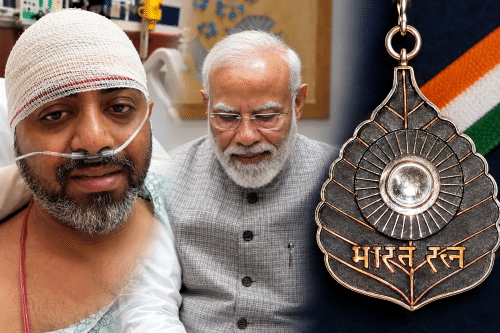
There are occasions when politics should step aside, and the nation should speak with one voice. The extraordinary courage displayed by Captain Smit Machchhar in saving 174 lives in mid-air is surely one such occasion.
The question before Prime Minister Narendra Modi is therefore simple: should the country formally consider its highest civilian honour for a Bharatiya pilot who, after being attacked and stabbed inside the cockpit, still found the courage and presence of mind to help save everyone on board?
The facts, as presently reported, are remarkable.
Captain Machchhar was commanding Flydubai Flight FZ1073 from Dubai to Tel Aviv when his co-pilot allegedly attacked and stabbed him. The aircraft subsequently plunged more than 14,000 feet in a matter of seconds. Despite his injuries, Machchhar managed to open the locked cockpit door, allowing passengers and crew to enter and overpower the attacker. Other pilots on board subsequently helped stabilise and land the aircraft safely at Tabuk in Saudi Arabia. All 174 passengers survived.
That sequence of events needs to be understood in its proper perspective.
The reinforced cockpit door became a defining feature of aviation security after the September 11, 2001 terrorist attacks precisely because preventing unauthorised access to the cockpit was considered essential to stopping an aircraft from being turned into a weapon. In the Machchhar incident, the extraordinary irony was that the man fighting to protect those inside the aircraft was himself seriously injured inside that very cockpit.
What if he had not fought back?
What if, despite his injuries, he had not managed to release the cockpit door?
What if the passengers had not been allowed to intervene?
The consequences could have been catastrophic. It could have led to the expansion of the West Asia war, and its fallout would have been equally disastrous on the global economy. It is not necessary—and would be premature while investigations continue—to declare what the attacker’s ultimate motive was. But the possibility of an aircraft being deliberately used to cause mass casualties is precisely why the incident has attracted such international attention. Israeli Prime Minister Benjamin Netanyahu has publicly credited Machchhar with preventing a catastrophic disaster and saving 174 lives.
This is also why the Bharat Ratna question deserves to be discussed independently of political considerations.
The award was originally confined to achievements in specified fields, but its scope was subsequently expanded to recognise exceptional service or performance of the highest order in “any field of human endeavour.” The award is conferred by the President on the recommendation of the Prime Minister. There is no public application or open nomination process.
That framework is important. It means that if the Government considers Machchhar’s actions to constitute exceptional service to humanity, there is an established constitutional route for bringing such a recommendation forward.
There is also a larger principle involved.
Bharat has honoured statesmen, scientists, social reformers, artists and public figures through the Bharat Ratna. But courage exercised in the most terrifying circumstances, with hundreds of innocent lives depending on one person’s presence of mind, is also a form of extraordinary service.
Prime Minister Modi has already spoken to the injured pilot and publicly acknowledged his bravery. International leaders, including Netanyahu, have also praised Machchhar’s actions.
The issue, therefore, need not be reduced to politics, ideology or regional sentiment.
It is about whether the highest civilian recognition can encompass an act of extraordinary courage that protected human life on an international flight.
If the Government ultimately decides to consider Captain Smit Machchhar for the Bharat Ratna, that decision would necessarily have to follow the prescribed process and the Government’s assessment of the full facts. But given the international recognition already accorded to his actions, prolonged silence could invite an avoidable question: why should a Bharatiya who displayed exceptional courage to save 174 lives have to wait for the world to remind Bharat of his deed?
Politics can wait.
A national act of courage deserves to be considered on its own merits.


This award might motivate a whole new generation to transform into good and courageous human beings. This is the need of the hour. A much awaited avataar of Lord Vishnu will be felt be in heroic selfless acts like these.