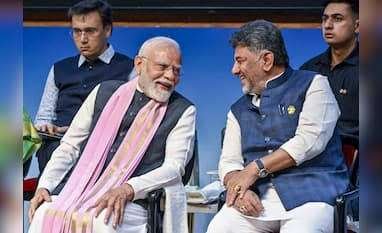
By all conventional political calculations, the emerging bonhomie between Prime Minister Narendra Modi and Karnataka Deputy Chief Minister D.K. Shivakumar deserves more than a passing glance. Could it be signalling the beginning of a new political realignment in Karnataka?
There is an old political adage that there are no permanent friends or enemies in politics, only permanent interests. Nowhere does this hold truer than in Bharat, where yesterday’s adversaries can become tomorrow’s allies, often leaving political observers scrambling to decode the changing equations. The latest political spectacle involving Prime Minister Narendra Modi and Karnataka Chief Minister D.K. Shivakumar (DKS) has certainly provided enough food for thought.
What makes the development particularly interesting is the political backdrop against which it has unfolded. DKS is no ordinary Congress leader. An astute political strategist and one of the party’s principal organisational assets in Karnataka, he has repeatedly demonstrated his ability to mobilise resources and strengthen the Congress at crucial moments. Yet, despite his contributions, his relationship with the Congress high command, particularly the Rahul Gandhi camp, has not always appeared comfortable.
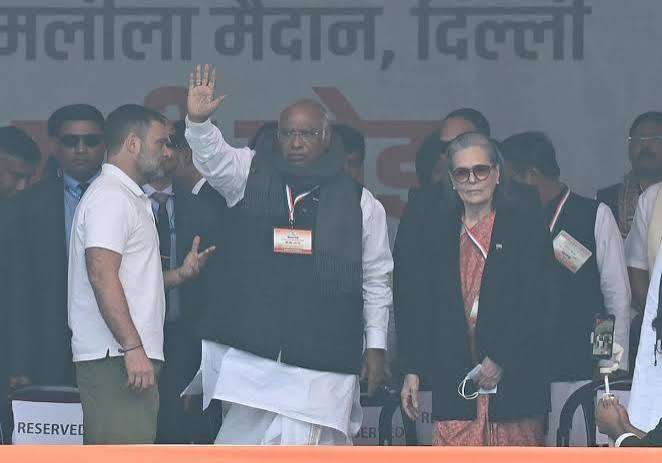
The widely discussed episode during the protest march demanding the resignation of the Chief Election Commissioner, when Rahul Gandhi appeared to push DKS aside to make way for another participant, was particularly telling. Although Shivakumar subsequently offered a rather diplomatic explanation, saying Rahul Gandhi had asked him to rest and avoid physical strain, the visuals had already triggered considerable political discussion. Whether intentional or otherwise, the incident raised questions about the regard in which a senior leader, who has worked hard to strengthen the party, is held by its younger leadership.
For a politician of DKS’s experience and ambition, such episodes cannot simply be dismissed. Political maturity often demands silence in public, even when personal disappointments run deep. However, silence should not necessarily be mistaken for surrender.
It is against this backdrop that his conspicuous preference to accompany Prime Minister Modi during the latter’s two-day Karnataka visit, rather than participate prominently in the Congress-organised Bharat Summit aimed at projecting Rahul Gandhi on the international stage, assumes significance. A Congress Chief Minister or Deputy Chief Minister extending protocol courtesy to the Prime Minister is nothing unusual. But the warmth and visible camaraderie accompanying this particular interaction have certainly attracted attention.
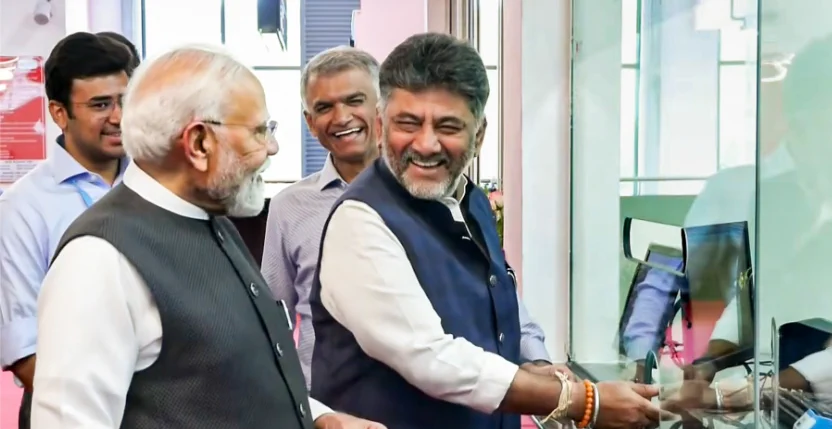
More importantly, Modi’s gesture of personally purchasing a Metro ticket for Shivakumar was noteworthy. In politics, symbolism often communicates more effectively than lengthy speeches. A Prime Minister taking the initiative to buy a ticket for a senior leader belonging to the principal Opposition party was a gracious gesture, but it also carried a subtle political message. It demonstrated a willingness to engage beyond conventional party boundaries. Whether it was simply personal courtesy or a reflection of a larger political understanding remains open to interpretation.
There is another dimension that deserves attention. Unlike several Opposition leaders who have, on occasions, chosen to distance themselves from the Prime Minister during his visits to their respective states, Shivakumar appeared comfortable sharing the public platform and engaging with Modi. This is not necessarily an indication of a political shift, but it does suggest that DKS is prepared to keep his political options and relationships wider than the narrow confines of party rivalry.
Political corridors are already abuzz with speculation that Rahul Gandhi and his loyalists within the Karnataka Congress may attempt to clip Shivakumar’s wings, particularly over the continuing power equations within the state leadership. If such attempts intensify, the consequences could be significant. DKS is a leader with an independent political network, considerable organisational influence and ambitions that cannot be wished away.
Should the Congress high command encourage a confrontation with him, it could inadvertently precipitate a political crisis. With the BJP and its NDA allies commanding a substantial presence in the Karnataka Assembly, alternative political equations cannot be entirely ruled out if the ruling party finds itself divided. A political realignment, however, would depend on the numbers, the willingness of legislators to cross existing political lines and the constitutional and legal circumstances prevailing at that time.
There are precedents in Bharatiya politics of leaders moving away from the Congress to emerge as influential political figures elsewhere. Himanta Biswa Sarma in Assam, for instance, and several other former Congress leaders have demonstrated how political dissatisfaction can eventually reshape the fortunes of parties and states. Shivakumar may or may not travel that route, but dismissing the possibility of a political realignment would be premature.
For the BJP, Karnataka remains strategically important. Winning back the state in 2028 would considerably strengthen its position in southern India, while Telangana presents another significant electoral opportunity. Any unexpected political development in Karnataka could therefore have implications extending beyond the state.
The larger question is whether the Modi-DKS chemistry represents nothing more than a gracious political interaction or the beginning of a more consequential understanding. It would be premature to predict a change of political allegiance. But equally, it would be naïve to dismiss the emerging signals.
One thing is certain: Karnataka’s political landscape may be heading towards an interesting phase of churning. And if the Congress leadership mistakes Shivakumar’s political restraint for weakness, it may discover that the man who helped it secure power could also become the centre of its next political challenge.