


Is the United States heading towards an unusual convergence of political confrontation, corporate uncertainty and financial turbulence? A growing debate surrounding billionaire entrepreneur Elon Musk, calls for greater government control over strategic infrastructure and warnings of a possible stock market crash have brought these questions into sharper focus.
At the centre of this unfolding debate is Musk, whose sprawling business empire extends across electric vehicles, space exploration, satellite communications, artificial intelligence and social media. His companies, including Tesla, SpaceX, Starlink, xAI and X, have become deeply intertwined with America’s economic, technological and strategic interests. Consequently, any serious political or regulatory confrontation involving Musk could have implications extending well beyond his personal business fortunes.
Political battle over Musk
Reports in October 2026 suggested that Democrats were contemplating high-profile congressional investigations into Musk and his business interests if they regained control of Congress. The proposed scrutiny could encompass his involvement with the Department of Government Efficiency (DOGE), associated job cuts, federal contracts, government subsidies and possible conflicts of interest involving companies that have substantial dealings with the US government.
Starlink’s role in satellite communications, particularly its importance in military and civilian operations connected with Ukraine, could also attract attention. The larger question is whether an individual entrepreneur should exercise such considerable influence over infrastructure and services that have national security implications.
Musk has responded defiantly to the prospect of investigations. Warning his political opponents on X, he declared, “Live by the sword, die by the sword,” while suggesting that those orchestrating the campaign against him would themselves face consequences. His reported financial support for Republican political campaigns ahead of the midterm elections further illustrates how the confrontation could spill into the political arena.
Nationalisation enters the debate
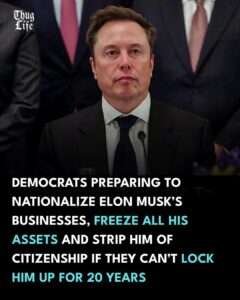
The controversy has taken an even more dramatic turn with former US Labor Secretary Robert Reich suggesting that Democrats should consider nationalising SpaceX and Starlink if they regain congressional power.
Speaking on his podcast, Reich argued that Musk’s control over critical communications and space infrastructure had created an unacceptable concentration of private influence. He advocated withdrawing public funding from Musk’s businesses and preparing a framework for bringing these strategic assets under public ownership.
This is an extraordinary proposition in a country whose economic model traditionally places considerable emphasis on private enterprise. Musk rejected the suggestion, warning that taking over private companies would amount to a serious crime.
However, Reich’s proposal remains a political argument rather than an established government policy. No legislation to nationalise SpaceX or Starlink has been introduced in Congress.
Nevertheless, the debate raises a fundamental question: how should a government balance private innovation and entrepreneurship with national security when essential infrastructure is controlled by powerful corporations?
AI boom and market vulnerabilities
Adding another dimension to the uncertainty is economist Dean Baker’s warning about the possibility of a major stock market correction. Drawing comparisons with the dot-com bubble of the late 1990s, Baker has questioned whether the enormous valuations attached to artificial intelligence companies and technology investments are sustainable.
The AI revolution has attracted unprecedented investor enthusiasm, with companies pouring billions of dollars into data centres, computing infrastructure and advanced technologies. While the long-term potential is considerable, expectations and valuations can sometimes run far ahead of actual commercial returns.
A sharp correction could therefore hurt technology companies, institutional investors and wealthy entrepreneurs whose fortunes are closely linked to stock market valuations, including Musk and Larry Ellison. The consequences would not necessarily remain confined to Wall Street. Ordinary investors, employment, consumer confidence and business investment could also suffer.
Importantly, a crash is not inevitable, and neither its timing nor its magnitude can be predicted with certainty. Baker’s warning, however, highlights the risks of excessive optimism and speculative investment.
Implications beyond America
The convergence of these developments deserves attention because the US remains central to global finance, technology and investment flows. A major correction on Wall Street could trigger volatility in international markets, affect investment sentiment and expose economies with substantial dependence on American capital and technology.
For India, too, turbulence in US financial markets could influence foreign portfolio flows, technology investments, export prospects and currency movements.
Ultimately, the emerging debate is much bigger than Elon Musk or his political disagreements with Democrats. It concerns the increasingly complicated relationship between private corporate power, government authority, national security and the sustainability of financial markets.
Whether these developments culminate in a political showdown, regulatory action or a broader market correction remains uncertain. But the warning signs deserve attention. The world’s largest economy may be approaching a period in which political battles, technological ambitions and financial vulnerabilities intersect with consequences far beyond its borders.