



For decades, Bharat’s defence manufacturing ecosystem was largely confined to a familiar arrangement: the Defence Research and Development Organisation (DRDO) developed critical technologies, while public-sector undertakings and private industries supplied components, fabricated structures and undertook manufacturing assignments. The private sector largely remained a supporting partner rather than an independent force in strategic innovation. That mindset is now changing, and the real promise of Atmanirbhar Bharat lies not merely in manufacturing imported components domestically, but in creating an indigenous ecosystem capable of designing, developing and producing sophisticated weapons systems. The emerging interest of Bharatiya private-sector startups in developing advanced cruise-missile technologies, including a proposed 1,500-km-range supersonic system, signals a significant departure from the conventional role of supplying nuts, bolts and electronic assemblies to DRDO projects. It reflects the growing ambition of Indian entrepreneurs to enter a high-technology arena traditionally dominated by government laboratories and established defence establishments. Developing such a missile would require mastery of advanced propulsion, materials, guidance, navigation and precision engineering, besides years of research, testing and military evaluation. Other developments reinforce this changing landscape. IIT Madras-incubated D-Propulse has demonstrated a 5 kN rotating detonation engine, an emerging propulsion technology with potential applications in future high-speed missiles and drones. Hyderabad-based Azad Engineering has manufactured and delivered an indigenous 350 kg-thrust-class expendable turbojet engine designed by DRDO’s Gas Turbine Research Establishment (GTRE), demonstrating the potential of government-private sector collaboration in advanced propulsion. IG Defence’s proposed 200-acre missile development and manufacturing complex at Nellore, Andhra Pradesh, is another indication of growing private investment in this strategic sector, with its JWALA micro-missile programme among the initiatives being pursued. Established companies such as Larsen & Toubro, Tata Advanced Systems, Godrej Aerospace and Solar Industries have also expanded their capabilities in missile structures, launch systems, propulsion and other critical defence technologies. Together, these companies and emerging startups are helping build an industrial ecosystem capable of undertaking increasingly complex indigenous weapons programmes.
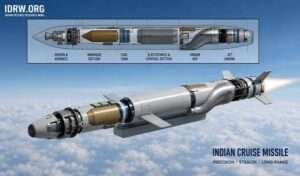
Bharat’s existing missile programmes provide an important backdrop to this transformation. The Indo-Russian BrahMos programme has demonstrated the country’s ability to field a formidable supersonic cruise missile, while DRDO’s Nirbhay and the subsequent Indigenous Technology Cruise Missile (ITCM) programme have advanced indigenous subsonic cruise-missile technologies. The Long-Range Land Attack Cruise Missile (LR-LACM) represents another step towards longer-range indigenous strike capabilities. BrahMos Aerospace is also exploring a 1,500-km-range variant, although this remains a separate development from the proposed private-sector initiative. What is significant is that both government-led research and private enterprise are increasingly exploring the frontiers of missile technology. Government initiatives such as Innovations for Defence Excellence (iDEX), ADITI and the Technology Development Fund have opened opportunities for startups, MSMEs and private innovators to participate in critical defence research. By March 2026, iDEX had engaged 676 startups, MSMEs and innovators, signing 551 design and development contracts, while DRDO had entered into 2,180 technology-transfer agreements. These developments indicate a gradual shift from a government-dominated research model towards a broader innovation ecosystem. However, announcements and ambitious proposals must translate into proven technologies and operational capabilities. Private innovators need sustained funding, access to testing facilities, technology partnerships, faster procurement decisions and assured opportunities to manufacture successful products. DRDO must increasingly regard capable private companies as research and development partners rather than merely contractors. Healthy competition, combined with collaboration, can accelerate innovation, improve quality and reduce costs. The armed forces, too, must actively encourage indigenous solutions by identifying requirements and evaluating promising technologies. Ultimately, Atmanirbhar Bharat cannot be measured merely by the percentage of indigenous components in a weapon system. Genuine self-reliance means possessing the scientific knowledge, engineering expertise and industrial capacity to conceptualise and develop the next generation of defence technologies without excessive dependence on foreign suppliers. For a country that has spent decades overcoming technological restrictions and external dependencies, the growing participation of its entrepreneurs in advanced missile development marks an important shift in ambition. Bharat must graduate from assembling weapons to inventing them, from importing technology to owning it, and from being a defence manufacturing destination to becoming a global defence innovation powerhouse. That is the true promise of Atmanirbhar Bharat.

