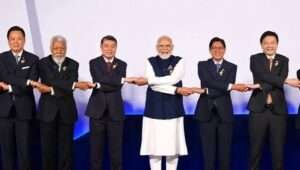
Prime Minister Narendra Modi’s engagements in Manila, Philippines, on Tuesday once again underscored Bharat’s growing diplomatic and strategic influence in the Indo-Pacific region. His participation in the 23rd ASEAN-India Summit, the 21st East Asia Summit and the Quad Leaders’ Meeting was not merely another round of diplomatic engagements but a reaffirmation of Bharat’s determination to shape the emerging regional order through cooperation, strategic autonomy and economic partnerships. Perhaps the most intriguing moment was US President Donald Trump’s description of Modi as a strong and highly popular global leader while addressing the Quad leaders. Coming from a President whose public pronouncements on Bharat and its leadership have frequently been contradictory, the compliment certainly raises questions. Not so long ago, Trump had dismissed Bharat as a ‘dead economy’, publicly criticised Modi, threatened punitive tariffs and repeatedly claimed credit for stopping the three-day Operation Sindoor, launched by the Bharatiya armed forces in response to the brutal Pahalgam terror attack that claimed 26 innocent lives. His repeated assertions, despite New Delhi firmly rejecting any third-party mediation in its military decisions, were hardly befitting the relationship between two major democracies. What, then, explains the apparent change in tone? Has Washington finally recognised that intimidation, tariff threats and public disparagement cannot dictate Bharat’s foreign policy choices? Or has the resilience of the Bharatiya economy, Modi’s international standing and Bharat’s growing strategic importance compelled a reassessment in Washington? Domestic political setbacks and the changing international equations may also have contributed to Trump’s recalibration. Whatever the explanation, one thing is increasingly evident: Bharat is no longer a country that can be taken for granted or pushed around. Its diplomatic engagements are guided by national interests rather than the personal preferences of leaders elsewhere. At the same time, Trump’s assurances and pronouncements must be treated with appropriate caution. His suggestion regarding action against the Council on American-Islamic Relations (CAIR), an organisation facing allegations of links to the Muslim Brotherhood, is one such example. Whether his administration will translate such rhetoric into concrete action remains to be seen. Bharat, meanwhile, has little reason to be distracted by the changing moods of Washington. Its national interests and strategic priorities must remain paramount.
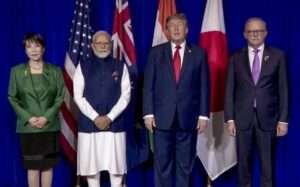
More importantly, Modi’s message to ASEAN leaders was clear and forward-looking: Bharat and ASEAN, together representing nearly one-fourth of the world’s population, must shape the future of the Indo-Pacific through cooperation rather than competition. This is precisely where Bharat’s Act East Policy assumes enormous significance. What began as an initiative to strengthen economic and cultural engagement with Southeast Asia has evolved into a comprehensive strategic partnership encompassing trade, digital technology, defence, space and connectivity. The emphasis on reviewing the ASEAN-India Trade in Goods Agreement (AITIGA), strengthening the Comprehensive Strategic Partnership and advancing the Plan of Action for 2026–2030 reflects an understanding that diplomatic goodwill must translate into measurable economic and strategic outcomes. Bharat’s continued support for the Initiative for ASEAN Integration, particularly in bridging development gaps in Cambodia, Laos, Myanmar and Timor-Leste, further demonstrates that its regional vision is not confined to trade or geopolitical calculations. The forthcoming 35th anniversary of ASEAN-India relations in 2027 offers another opportunity to consolidate this partnership. Modi’s bilateral engagements with Singapore Prime Minister Lawrence Wong and Thailand’s Anutin Charnvirakul reinforced the same approach, with discussions covering digitalisation, healthcare, connectivity and regional developments. Equally significant was the Quad meeting involving Modi, Trump, Japanese Prime Minister Sanae Takaichi and Australian Prime Minister Anthony Albanese, the first leaders-level gathering since September 2024 and the first during Trump’s current presidential term. Modi rightly described the Quad as a trusted and constructive partnership delivering practical solutions in maritime security, resilient supply chains, emerging technologies and disaster response. His announcement that Mumbai would host the inaugural Quad Business Leaders Forum in 2027 is particularly significant, as strategic cooperation must increasingly be supported by business, innovation and private-sector participation. The Quad AI Accelerator also signals the importance attached to trusted artificial intelligence, technology access and technical assistance across the Indo-Pacific. The larger message from Manila is unmistakable. Bharat is emerging as an indispensable pillar of the Indo-Pacific architecture, engaging the United States, Japan, Australia and ASEAN on its own terms. Modi’s diplomacy is neither about choosing sides nor seeking validation from powerful nations. It is about expanding Bharat’s strategic space, protecting its national interests and ensuring that its voice carries weight in shaping the global order. That is the real significance of the Act East Policy and the Quad: a confident Bharat that engages the world as an equal, not as a supplicant.