



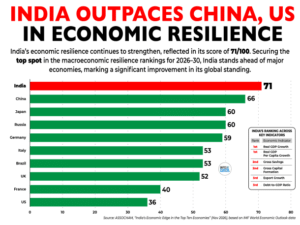
India has emerged as the most resilient economy among ten major global economies for the period 2026 to 2030, according to a recent ASSOCHAM report based on IMF data. India scored 71 out of 100, ahead of China at 66, Japan and Russia at 60 each, Germany at 59, Italy and Brazil at 53 each, the United Kingdom at 52, France at 40, and the United States at 36.
This ranking is significant because it measures macroeconomic resilience rather than economic size alone. It reflects India’s ability to sustain growth, maintain savings and investment, manage external balances, and preserve relative stability in a world facing geopolitical tension, trade uncertainty and volatile energy prices.
What the ranking measures
The ASSOCHAM study assessed ten leading economies using indicators such as real GDP growth, real GDP per capita growth, export growth, current account balance, government debt, fiscal balance, gross national savings and gross capital formation.
India secured the top position because it is expected to perform strongly across several of these measures. It ranks first among the ten economies in real GDP growth and real GDP per capita growth. It also ranks second in gross savings and gross capital formation, and third in export growth and debt to GDP ratio.
The report projects India’s average real GDP growth at 6.9 percent during 2026 to 2030, the highest among the economies assessed. This growth is expected to be supported by domestic consumption, public investment, services exports, improving financial sector conditions and continued business investment.
Why India stands out
India’s greatest strength is its large and expanding domestic market. With a population of more than 1.4 billion, rising incomes, growing urbanisation and increasing digital adoption, India has a consumption base that can support growth even when global demand weakens.
This is important because many economies depend heavily on exports or external capital. India, by contrast, has a broader internal engine of growth. Household consumption, government infrastructure spending, private investment and services exports together provide multiple sources of economic momentum.
India also benefits from a favourable demographic profile. Its working age population is still expanding, while several advanced economies face ageing populations, shrinking workforces and rising welfare costs. This gives India a long term advantage, provided the country creates enough productive employment and invests adequately in education, health and skills.
Savings and investment are equally important. High domestic savings allow India to fund a substantial part of its investment needs without becoming overly dependent on foreign borrowing. Strong capital formation supports infrastructure, factories, housing, machinery and digital networks, all of which raise future productive capacity.
Growth in incomes matters
India’s leadership in real GDP per capita growth is particularly encouraging. Economic growth at the national level is important, but improvements in living standards depend on whether output rises faster than population.
Higher per capita income means greater purchasing power, better access to goods and services, improved savings capacity and stronger demand for housing, education, healthcare, transport and financial products. It also expands the domestic market for Indian businesses.
This is why India’s growth story is not only about becoming a larger economy. It is also about becoming a richer economy in terms of average living standards. If India sustains high growth while improving productivity and job creation, the benefits can reach a wider section of the population.
The role of reforms
India’s improving macroeconomic position did not emerge by accident. Over the past decade, the country has pursued reforms in taxation, digital payments, financial regulation, infrastructure, manufacturing and public administration.
The introduction of the Goods and Services Tax created a more unified national market. Digital public infrastructure has expanded financial inclusion and made payments, credit access and government transfers more efficient. Investment in roads, ports, railways, airports and power infrastructure has improved logistics and reduced business costs.
The Production Linked Incentive scheme has encouraged investment in sectors such as electronics, pharmaceuticals, automobiles, solar equipment and textiles. These efforts aim to deepen domestic manufacturing and integrate India more closely into global supply chains.
India’s banking system has also become healthier after years of addressing bad loans and strengthening capital buffers. A stable financial system is essential for sustained investment, credit growth and economic resilience.
Why the United States scores lower
The United States score of 36 may appear surprising because America remains a global leader in technology, innovation, finance and corporate capability. However, the ASSOCHAM ranking does not measure innovation, military strength or corporate competitiveness alone.
It focuses on macroeconomic resilience over the 2026 to 2030 period. Advanced economies such as the United States naturally grow more slowly because they already operate at high income levels. Their fiscal deficits, public debt levels and external balances can also affect their resilience scores.
The United States remains an extraordinarily powerful economy, but its near term growth outlook differs from India’s. India is in a phase where rapid expansion is more achievable because it has greater scope for catch up growth, infrastructure development, urbanisation and rising consumption.
China’s position
China’s score of 66 places it second, but its growth model faces important challenges. These include an ageing population, weakness in the property sector, high levels of debt in parts of the economy, softer consumer confidence and rising geopolitical pressure on trade and technology.
India’s advantage is not that it has already overtaken China in total economic size. It has not. China remains a much larger economy in absolute terms. However, India’s demographic profile, domestic demand and growth potential may offer more durable momentum over the coming five years.
The real opportunity for India is to convert its growth advantage into long term competitiveness. That requires stronger manufacturing, deeper supply chains, higher productivity, better urban infrastructure and a more skilled workforce.
Challenges India must address
Despite the positive outlook, India cannot afford complacency. The ASSOCHAM report itself identifies fiscal deficit as an area requiring attention. India’s public debt remains high, and government borrowing must be managed carefully to avoid crowding out private investment.
Fiscal discipline does not mean cutting productive expenditure. It means improving tax compliance, broadening the tax base, reducing wasteful spending and protecting investment in infrastructure, education, health and research. India needs a fiscal strategy that supports growth while preserving long term stability.
Employment is another major challenge. Fast GDP growth must create enough good quality jobs for young people entering the workforce. India needs stronger growth in manufacturing, construction, logistics, agro processing, tourism, healthcare and small enterprises.
Skill development will be central to this effort. India must ensure that its workforce is prepared for modern industries, digital services, advanced manufacturing and green technologies. Better vocational training, industry linked education and easier movement between states can help workers find productive employment.
External risks
India’s economic resilience will also be tested by global conditions. Geopolitical conflicts, trade restrictions, supply chain disruption, volatile commodity prices and uncertain financial markets can affect inflation, currency stability and investment.
Energy is especially important. India imports a significant share of its crude oil, so higher global prices can widen the trade deficit, pressure the rupee and increase inflation. Expanding renewable energy, improving energy efficiency, diversifying suppliers and strengthening domestic energy capacity are therefore essential for economic security.
Trade policy is another area of risk and opportunity. India must use global supply chain diversification to attract investment and expand exports. This requires reliable ports, faster customs procedures, predictable regulation, competitive logistics and strong vendor ecosystems.
From promise to performance
India’s top ranking is a strong endorsement of its economic direction. It confirms that the country is seen as capable of sustaining growth while maintaining relative macroeconomic stability.
But rankings do not guarantee outcomes. India must continue to execute reforms, create jobs, strengthen public services, deepen manufacturing and maintain fiscal discipline. The country must also ensure that growth becomes more inclusive, reaching small businesses, rural communities, women workers and first generation entrepreneurs.
The phrase “India decade” should therefore be seen as an obligation, not merely a slogan. India has the scale, savings, demographics and policy momentum to become a central engine of global growth. The task now is to turn potential into performance.
If India sustains high growth, expands productive employment and strengthens its industrial and technological base, it can move from being one of the fastest growing large economies to becoming a defining force in the global economy.
The world is taking note. India must now ensure that the coming decade matches its promise.

