
17. अनन्तविजयं राजा कुन्तीपुत्रो युधिष्ठिरः। नकुलः सहदेवश्च सुघोषमणिपुष्पकौ॥
18. काश्यश्च परमेष्वासः शिखण्डी च महारथः। धृष्टद्युम्नो विराटश्च सात्यकिश्चापराजितः॥
19…द्रुपदो द्रौपदेयाश्च सर्वशः पृथिवीपते। सौभद्रश्च महाबाहुः शङ्खान् दध्मुः पृथक् पृथक्॥
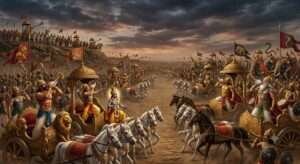
In these verses, Sanjaya, while narrating the unfolding events of the great Mahabharata war to King Dhritarashtra, describes how the distinguished warriors and commanders of the Pandava army sounded their respective conches with tremendous enthusiasm and determination. Addressing Dhritarashtra as O Lord of the Earth (Prithivipate), Sanjaya brings before him a vivid account of the extraordinary gathering of warriors whose individual courage, military distinction and commitment to their cause were about to be tested in the greatest conflict of their age. The successive reverberations of their conches were not merely expressions of martial excitement; they represented the collective resolve of an army conscious of the magnitude of the struggle awaiting it.
Yudhishthira, the eldest son of Kunti, sounded his conch, Anantavijaya, whose name signifies eternal or boundless victory. The significance of this name is particularly meaningful when viewed against Yudhishthira’s character and the moral foundations upon which he sought to establish his authority. His conception of victory was not simply the destruction of an adversary or the acquisition of a kingdom. It was inseparably connected with the restoration of Dharma, the fulfilment of rightful obligations and the establishment of a just social order. Although he had endured humiliation, deception and prolonged exile, his fundamental disposition remained rooted in righteousness and self-restraint. The conch Anantavijaya therefore symbolically represents a victory whose ultimate justification must be found in Dharma rather than in the temporary satisfaction of political ambition.
The reference to Nakula and Sahadeva, the younger Pandava brothers, further demonstrates the unity and military preparedness of the Pandava forces. Nakula sounded Sughosha, while Sahadeva sounded Manipushpaka. Both brothers possessed exceptional abilities, although their contributions to the Pandava cause were often overshadowed by the extraordinary reputations of Arjuna and Bhima. Nakula was renowned for his mastery of swordsmanship, horsemanship and military discipline, while Sahadeva was distinguished by his intelligence, analytical capacity and strategic understanding. Their participation was not merely an extension of their elder brothers’ authority; they represented independent dimensions of military strength and intellectual preparedness. The Mahabharata repeatedly illustrates that the success of a great undertaking depends not exclusively upon its most celebrated personalities but upon the coordinated contributions of individuals possessing different capabilities.
The mention of these conches in a carefully arranged sequence is significant. Yudhishthira, Nakula and Sahadeva were not merely announcing their presence on the battlefield. Their declarations conveyed that the Pandava army stood united across generations of experience, differing temperaments and distinct military specialisations. The sound of each conch became an expression of individual identity within a larger collective purpose. The Mahabharata thus presents an important principle of leadership: unity does not demand uniformity. Strength emerges when individual abilities are harmonised in pursuit of a common objective.
The eighteenth verse expands this account by introducing several distinguished warriors whose presence gave the Pandava army formidable military strength. Drupada, the King of Panchala, was an experienced ruler and warrior whose association with the Pandavas carried both political and personal significance. His participation reflected the wider alliances that had developed around the Pandava cause. His daughter Draupadi, having endured the humiliation inflicted upon her in the Kaurava assembly, represented one of the most consequential moral and political dimensions of the conflict. Her sons, collectively known as the Draupadeyas, also joined the battle, demonstrating how the consequences of injustice had extended beyond the immediate generation of the Pandavas.
The verse also refers to Soubhadra, the mighty-armed Abhimanyu, the son of Arjuna and Subhadra. His presence was especially significant because he represented the younger generation of the Pandava lineage. Although young in years, Abhimanyu possessed extraordinary courage, military training and an instinctive understanding of warfare. His association with the Pandava army was not simply a matter of family loyalty; he embodied the continuity of military discipline and heroic commitment. His subsequent participation in the Kurukshetra war, particularly his entry into the Chakravyuha, would become one of the most poignant episodes in the Mahabharata, illustrating how courage, when confronted by overwhelming circumstances, can acquire a significance far beyond the immediate outcome of battle.
Among the warriors mentioned in this passage, Shikhandi occupies a particularly important position in the unfolding destiny of the war. The history of Shikhandi is closely connected with the extraordinary episode of Amba, whose humiliation and unfulfilled desire for justice ultimately became intertwined with the destiny of Bhishma. Amba’s resentment towards Bhishma arose from the circumstances surrounding her abduction and the subsequent collapse of her marriage prospects. Unable to secure justice through ordinary means, she undertook severe austerities, seeking the means by which Bhishma’s invincibility could eventually be challenged. Through the complex sequence of events described in the Mahabharata, Amba was reborn as Shikhandi, whose presence on the battlefield would become decisive in the confrontation with Bhishma.
It is important to understand the strategic and ethical dimensions of this episode. Bhishma, the son of Ganga, was not merely an exceptionally powerful military commander; he was a warrior of extraordinary discipline, experience and personal integrity. Bound by his terrible vow and his commitment to the throne of Hastinapura, he had placed himself in the service of the Kaurava establishment despite his awareness of the moral complications surrounding the conflict. His military superiority made him exceedingly difficult to defeat. Nevertheless, his personal history created a particular vulnerability in relation to Shikhandi. Bhishma had resolved not to raise weapons against Shikhandi because he regarded Shikhandi as a person born as a woman. This personal commitment became a decisive element in the military strategy adopted by the Pandavas.
The strategic importance of Shikhandi becomes clearer when we consider Krishna’s understanding of Bhishma’s strengths and limitations. Krishna recognised that conventional military confrontation would not easily overcome a warrior of Bhishma’s stature. Therefore, the Pandavas had to identify a means of neutralising his extraordinary fighting capacity without relying solely upon direct force. Shikhandi’s presence offered that opportunity. During the decisive confrontation, Arjuna advanced with Shikhandi positioned before him. Bhishma refrained from directing his weapons against Shikhandi, and Arjuna consequently discharged a succession of arrows that brought the great patriarch down upon the battlefield.
Thus, the fall of Bhishma was not simply the result of superior physical strength. It emerged from the convergence of historical circumstances, personal vows, strategic intelligence and the moral complexities of human conduct. Shikhandi became the instrument through which an apparently invincible military commander was finally brought down. Yet it was Arjuna, guided by Krishna’s strategic counsel, who actually released the arrows that caused Bhishma to fall. Bhishma did not die immediately; through the boon of choosing the moment of his departure, he remained upon the bed of arrows until the appropriate time. This distinction is essential to understanding the narrative accurately.
Satyaki, also known as Yuyudhana, was another distinguished warrior mentioned in this account. He belonged to the Vrishni clan and was an accomplished disciple of Arjuna in the art of warfare. His allegiance to Krishna and his association with the Pandavas made him an important military figure in the conflict. Satyaki was renowned for his archery, battlefield courage and determination. He commanded considerable respect among the warriors and played an important role in the military operations of the Pandava army. Although Krishna himself served as Arjuna’s charioteer and did not take up arms in the war, Satyaki represented the active military participation of the Yadava forces on the Pandava side. It is therefore important to distinguish between Krishna’s role as the divine guide and charioteer and Satyaki’s role as a combatant and commander.
The reference to Virata, the King of Matsya, also deserves attention. During their incognito exile, the Pandavas had found refuge in his kingdom, where they lived in disguise for the prescribed period. Virata’s association with the Pandavas subsequently developed into a political and military alliance, strengthened further through the marriage of his daughter Uttara to Abhimanyu. His participation in the war therefore represented the consequences of hospitality, loyalty and political friendship. The Mahabharata repeatedly demonstrates that alliances forged through mutual trust can acquire immense significance when circumstances demand decisive action.
The conches of Drupada, the Draupadeyas, Abhimanyu, Virata, Satyaki and the other distinguished warriors reverberated independently, yet their combined sound became an overwhelming declaration of collective determination. The Sanskrit expression Shankhan dadhmuh prithak prithak is particularly revealing. It indicates that each warrior sounded his own conch separately. The individuality of each sound was preserved, but together they created a powerful and unified proclamation. This is a profound symbolic representation of the Pandava army itself: different kingdoms, different family traditions, different military experiences and different personal motivations had converged upon one battlefield.
The contrast between the two armies is also worthy of analytical consideration. The Kauravas possessed an imposing military establishment under the command of Bhishma, supported by distinguished warriors such as Drona, Karna, Kripa and Ashwatthama. Their numerical strength was considerable, and their military experience was formidable. The Pandavas, however, possessed an equally significant advantage in the form of strategic unity, personal loyalty and Krishna’s guidance. The difference between the two sides cannot be understood merely by calculating the number of soldiers or the strength of individual commanders. The deeper distinction concerned the moral and psychological foundations upon which their respective causes rested.
Sanjaya’s narration to Dhritarashtra is therefore more than a chronological account of battlefield events. It is an unfolding examination of the consequences of political blindness, personal attachment and the failure to distinguish between legitimate authority and possessive ambition. Dhritarashtra had been repeatedly warned about the dangers arising from Duryodhana’s conduct, yet his attachment to his son prevented him from taking decisive corrective action. Sanjaya’s description of the Pandava conches consequently carries an implicit psychological significance. The very warriors whose presence and determination he describes are the representatives of a cause that Dhritarashtra had repeatedly failed to understand or accommodate through peaceful means.
There is another important philosophical dimension in these verses. A conch is traditionally associated with auspiciousness, awakening and the announcement of a significant undertaking. In the context of the Mahabharata, however, its sound also signifies the irreversible transition from negotiation to confrontation. The prolonged diplomatic efforts of Krishna, the appeals for reconciliation and the possibility of preserving the Kuru dynasty through a just settlement had all failed. The conches now announced that the consequences of those failures could no longer be postponed.
The great war was therefore not merely a struggle for territory between two branches of a royal family. It was the culmination of accumulated injustice, wounded honour, violated obligations, political misjudgment and competing interpretations of Dharma. The warriors assembled on the battlefield carried within themselves individual histories that had shaped their decisions. Bhishma represented the burden of an uncompromising vow; Drona, the conflict between personal gratitude and moral responsibility; Karna, the tragedy of loyalty entangled with resentment; Yudhishthira, the struggle to uphold righteousness amid political adversity; Arjuna, the conflict between personal attachment and duty; and Krishna, the wisdom that sought to reconcile action with the eternal principles of Dharma.
The philosophical significance of these verses extends beyond their immediate historical setting. They demonstrate that a great conflict is rarely the consequence of one isolated incident. It is generally the result of unresolved contradictions that accumulate over time until reconciliation becomes increasingly difficult. The Mahabharata presents this reality with extraordinary psychological depth. Each warrior enters the battlefield with a different understanding of duty, honour, loyalty and justice. Yet the consequences of their decisions become inseparably connected with the destiny of the entire Kuru lineage.
In this sense, the reverberation of the conches is an announcement not only of war but also of an impending moral reckoning. The names of the conches, the identities of the warriors and the historical circumstances surrounding their participation all contribute to a larger philosophical narrative. Anantavijaya, Sughosha and Manipushpaka are not merely instruments of military declaration; within the poetic imagination of the Gita, they become expressions of the determination, discipline and collective resolve of those who have assembled to defend their understanding of righteousness.
Ultimately, these verses prepare the reader for the profound spiritual revelation that follows in the Bhagavad Gita. The external battlefield, with its armies, commanders, conches and weapons, is about to become the setting for an internal conflict of far greater philosophical significance. Before long, Arjuna will look upon the warriors standing before him and recognise among them his teachers, relatives, elders and friends. The confidence expressed through the sounding of the conches will give way to an intense moral and emotional crisis. This transition is deliberate and deeply meaningful.
The Gita thus moves from the sound of collective military determination to the silence of individual introspection. The conches announce the beginning of the war, but Arjuna’s hesitation will open the door to an eternal dialogue concerning the nature of the Self, the inevitability of action, the discipline of duty and the supremacy of Dharma. What begins as a historical confrontation at Kurukshetra will consequently transcend its immediate circumstances and become a universal guide to human conduct.
The eternal truth of the Gita lies in this extraordinary transformation: while the battlefield represents the external struggles of human existence, the wisdom imparted by Krishna reveals how those struggles must be understood and confronted through discernment, self-discipline and righteousness.