Upadhyayula Lakshman Rao
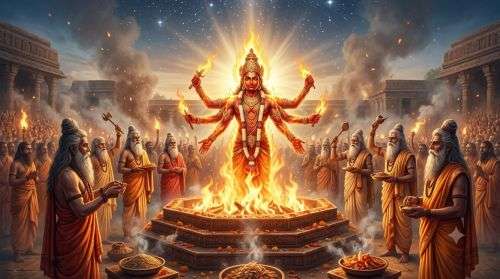
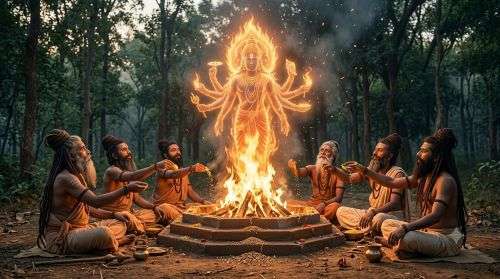
The sage Puruchhepa, standing within the sacred continuum of the Rigveda, raises his voice in measured devotion, shaping hymns in the solemn cadence of Antheysti and Triṣṭubh metres. His invocation is not merely a ritualistic utterance, but a profound alignment of human aspiration with cosmic order. He calls upon Indra, the wielder of the thunderbolt, to descend from the celestial expanse into the consecrated precincts of yajña, just as Agni faithfully reaches the altar and Chandra abides in his luminous realm. The descent of Indra signifies not a physical movement alone, but the invocation of dynamic energy into the ordered field of human endeavour.
The priests, with hearts attuned to reverence, invite Indra as devoted sons would invite a father to partake in nourishment. Before them rests the soma, meticulously pressed, purified, and preserved in vessels, radiant with vitality. This soma, the elixir of divine stimulation, is both substance and symbol—representing the distilled essence of nature’s vitality. Like a thirsty bull drawn irresistibly to the waters, Indra is urged to approach, to partake, and thereby renew his strength, brilliance, and heroic resolve. In this imagery lies a subtle scientific temperament: the recognition that energy must be cyclically replenished, that even divine force is sustained through interaction with natural processes.
As the chariot of Surya traverses the heavens in ceaseless motion, so too are Indra’s steeds implored to hasten toward the ritual ground. The soma, said to be of celestial origin and imperishable in essence, is poetically likened to tender birds concealed beneath protective wings, hidden amidst stones and creeping plants. This reflects an early observational awareness of nature’s hidden reservoirs—where life-sustaining forces are preserved within the folds of the earth, awaiting discovery and transformation through human effort.
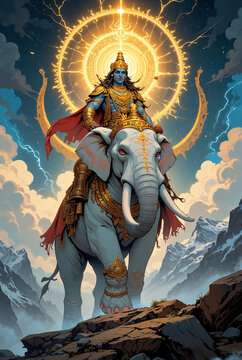
Indra, foremost among the Angirasas, is remembered as the opener of pathways, much like a herdsman who releases cows from their enclosure. In a striking metaphor of natural phenomena, he is described as the one who breaks open the cloud-caverns, releasing the imprisoned waters. This act mirrors the release of rain from storm systems, an intuitive grasp of atmospheric processes rendered in sacred language. When Indra strikes down Vritra with his vajra, he is not merely slaying a demon, but symbolically overcoming the obstruction that withholds life-giving waters. Thus, myth becomes a vessel for both spiritual insight and proto-scientific observation.
Armed with the vajra, sharpened like a weapon honed upon flowing waters and sanctified by hymns, Indra advances with disciplined force. His march is likened to a warrior felling forests with an axe, each stroke decisive and purposeful. Yet beneath the martial imagery lies a deeper principle: the removal of chaos and resistance to restore balance and fertility. The rains he releases nourish rivers and oceans, sustaining ecosystems and human civilization alike. His gifts of cattle to the people, reminiscent of those granted to Manu, symbolize economic stability and social prosperity rooted in natural abundance.
The priests, like skilled artisans crafting a chariot, compose hymns with precision and devotion. Each verse is an offering, each sound a structured vibration intended to resonate with cosmic forces. Their praises uplift Indra as warriors are encouraged in battle, reinforcing the reciprocal bond between the divine and the human. The request for cows and wealth is not mere material desire, but an appeal for sustenance, continuity, and harmony within the cosmic order.
Indra’s valor is further celebrated through his legendary deeds—his destruction of hostile strongholds, his support of righteous patrons such as Divodasa, and his defeat of adversaries like Sambara. These narratives, while mythic in form, encode the perennial struggle between order and disorder, between life-supporting forces and those that hinder them. Even the slaying of the dark adversary, Krishna, is symbolic of dispelling obscurity and restoring clarity and light.
In a striking expression of cosmic power, Indra is said to have grasped the wheel of Surya’s chariot, asserting his influence over celestial motion. Such imagery reflects an early attempt to comprehend the interconnectedness of cosmic forces, where even the movement of the sun is perceived as part of a greater dynamic interplay. His protection of the seer Usanasu further emphasizes his role as guardian of wisdom and patron of those aligned with truth.
Thus, the hymn culminates in a heartfelt prayer: that Indra may grant both material wealth and spiritual prosperity, responding to human calls with immediacy and compassion. He is invoked as ever-present, like a trusted ally who stands ready at every summons. The rains he releases, the enemies he subdues, and the prosperity he ensures are all facets of a single principle—the sustenance of life through balance, strength, and responsiveness.
The descendants of Divodasa, inheritors of this sacred tradition, renew their devotion through fresh and vibrant hymns. They seek not only protection but flourishing, aspiring to shine with the steady brilliance of the sun. In this synthesis of devotion, observation, and poetic expression, the hymn stands as a testament to the Vedic vision—where spirituality and an early scientific awareness are woven seamlessly into a unified understanding of the cosmos.