



As summer approaches and temperatures peak, El Niño becomes the buzzword across a wide spectrum of society, with discussions of its ill effects on the Indian monsoon. Newspapers publish novel headlines linking El Niño to current world events. One recent sample is the headline in Business News of NDTV that reads, Fuel, Extreme Heat, El Niño: Why India May have a terrible year ahead”. This 1,000-word article is an attempt to provide a bird’s-eye view of a climate phenomenon that is generally taught in an entire semester course.
Weather and Climate: To explain in simple terms, weather is like mood swings in a person that are short-term behavioural changes, whereas climate represents his or her personality that is based on long-term behaviour; for example, a normal, cool person getting angry at times. Similarly, weather and climate are interconnected, where the former is a short-term state of the local atmosphere and the latter is a long-term pattern at the global scale. Since both of these are interlinked, the climate in one region influences weather patterns in far-off regions.
Sea Surface Temperature (SST) and Wind are the two fundamental drivers of weather and climate, working in tandem. Oceans cover ~71% of Earth’s surface and absorb massive amounts of solar energy. Therefore, SST determines how much heat and moisture are transferred from the ocean into the atmosphere during normal weather conditions or fuel storms, hurricanes and events such as El Niño and La Niña, which shift global temperature and rainfall patterns.
Winds are large-scale movements of air in the atmosphere created by the Sun’s uneven heating of Earth. This causes warm air to rise and cool air to sink, creating low and high pressure areas, and we know things move from high to low. Also, winds drive ocean currents, physically pushing warm and cold water across the globe, regulating regional weather systems.
El Niño, La Niña, and ENSO: El Niño and La Niña are warm and cool phases of climate variability in the tropical Pacific Ocean that influence global weather, especially in the tropics. A few centuries ago, Peruvian fishermen noticed warm ocean currents appearing along the coast of South America around Christmas time, which they named as El Niño, Spanish for “the little boy. Since this phenomenon was observed around Christmas time, they associated it with the birth of Christ and called it “Christ Child”. Later, a corresponding cool phase opposite of El Niño was named, La Niña, meaning “the little girl” in Spanish, making them Nature’s siblings.
The shifts in the atmospheric pressure during warm and cool phases in the tropical Pacific Ocean region are called the Southern Oscillation. ENSO (El Niño Southern Oscillation) is the atmospheric pressure that corresponds to El Niño warm phase.
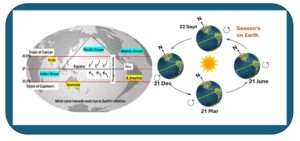
Pacific Ocean climate: The equatorial Pacific Ocean acts as a thermostat that reshuffles weather patterns around the planet. Sea surface temperatures in the central and eastern Pacific Ocean particularly affect the Indian monsoon. How? Look at the shape and extent of the Pacific Ocean on a world map. It roughly resembles a triangle with the equator as its baseline, where it is the widest. The vast tropical region lying between 30 degrees north and south of the equator is exposed to maximum sunlight throughout the year compared to the poles, during Earth’s revolution around the Sun. This allows strong coupling of warm ocean water with the atmosphere when strong and direct sun rays heat up the equatorial Pacific Ocean. As the sea surface temperatures increase, warm air expands and rises into the atmosphere.
When the warm air rises, it creates a void that is filled up by cooler and heavier air from higher latitudes from both the northern and southern hemispheres. This steady flow of air in the tropics, called the Trade Winds, curves towards the west near the equator due to Earth’s rotation. For centuries, these winds have driven global maritime trade and impacted weather patterns in the Asian countries.
Impact on Indian Monsoon: During the Winter Solstice (21 December) the southern Pacific Ocean warms up intensely as the Sun shines directly at the Tropic of Capricorn (23.50 S latitude) due to Earth’s tilt. During this time, warm ocean currents traverse the widest part of the equatorial Pacific Ocean from east to west, driven by interactions between sea surface temperatures and Trade winds. Any fluctuations in either the speed of Trade winds or the sea surface temperatures impact the Indian monsoon. El Niño and La Niña represent these fluctuations as described in the following.
(I) Normal phase: During a normal year, the Pacific climate operates in a balanced state where, I) Trade winds blow steadily towards west along the equator pushing warm ocean currents from the coast of South America toward Indonesia and Australia, and ii) As warm water is driven westward, cold, nutrient-rich water upwells from the deep ocean to replace it off the coast of Peru. These conditions drive warm and moist air towards Asia, resulting in a normal monsoon in India.
(II) El Niño (Warm phase): El Niño conditions occur when the normal balance in the Pacific Ocean breaks down, causing ocean temperatures to shift eastward. This happens because I) Trade winds blowing west weaken significantly, slowing down the westward movement of warm ocean currents that stagnate in the central and eastern Pacific Ocean instead of moving to Asia, and ii) The upwelling of cold water off the South American coast is drastically reduced, raising sea surface temperatures. These abnormal conditions shift heavy rainfall and storm systems to South America and create dry, drought-like conditions in India, Australia, and Malaysia.
(III) La Niña (Cool phase): La Niña is the cold phase of ENSO and happens because: i) Trade winds blowing west attain abnormal high speeds moving more warm ocean currents from South America towards Asia piling up an unusually deep layer of warm water in Asia, and ii) Due to strong Trade winds, deep, frigid water intensely upwells off the coast of Peru, thereby dropping sea surface temperatures below average across the central and eastern Pacific Ocean. These fluctuations in the Pacific climate bring extremely wet weather conditions and above-average monsoon to India, Indonesia, and Australia.
Several questions come to mind: Are El Niño conditions periodic, and does global warming impact their occurrence? Meteorologists believe that El Niño shifts back and forth every 2 to 7 years, with many events lasting about 9 to 12 months because of complex, chaotic interactions between the ocean and the atmosphere in the Pacific Ocean along the equator. While studies show that global warming may not increase its frequency but definitely amplifies its intensity, making droughts, floods, and storms more extreme.
I conclude with a realisation that global warming and climate change are real. We need to work on two fronts to give a better tomorrow to the coming generations. Firstly, as a community, we need to cut energy use coming from fossil fuels and shift to cleaner sources. Secondly, at the individual level, we need to conserve energy by saving electricity, using public transport, reusing and recycling, protecting forests, and supporting renewable energy to reduce greenhouse emissions. For centuries, humans fought Nature to survive during the Stone Age; it’s time we fight to protect it for our survival.


The article has given a very good explanation n causes of seasonal weather changes globally. Yes it is hightime that we conserve energy in many forms as much as possible. Right now solar energy tapping for conservation is the immediate solution which is openly available.
Excellent article Dr Chadda Saab, the topic of the hour, which is on the minds of every individual in the Indian Continent. With the prevailing heat conductions across India, all are wistfully looking for an early & vigorous Monsoon, however, the newspapers & social media abuzz with terms El Nino & La Nina, this article will enlightening a large community about the complex Weather & Climate conditions & their peculiar relationship. Thank you. Cmde NN Rao
Wonderful such a clear explanation of Elnino and Elnina phenomenon which governs the local,regional and global weather and climate phenomenon.
A worthwhile read for everyone interested in climate and environmental issues.
excellent scientific understanding of cyclic pattern weather behaviour explained as nature’s Siblings. It becomes imperative to manage siblings behaviour by applying appropriate weather sustainable solutions for sustainable earth survival.
The article explains in easy to understand terms about El Niño and La Niña. Your way of story telling is super and people from diverse backgrounds of technology can easily understand the article. Congratulations for a great article!!
A very nice article, worth reading and knowledgeable. The author’s conclusions are note worthy and need to be given importance and further improvement.