
This is an article series. Please read all previous articles before reading this article. The URLs for all previous articles are located in the SPECIAL THOUGHTS section.
Previously, we had learnt that the Devata-s in Level 7 and up are referred to as the Aantarika Prapancha Devata-s. We had also learnt that the hierarchical Levels 7 through 3 have 100 “seats” in each level, and that each seat or position has a specific name. So far, I’ve heard very little about the Devata-s in level 6. I’ve not read anywhere, nor have I heard in any discourse from any scholar, about the 100 seats in Level 6 or the names of these seats/positions. But my guess is that this is still true to the Devata-s in Level 6 as well. Very few authors have written/spoken about the Devata-s in Level 6. Whatever has been written/said is also very little. So, I’m piecing together what little information I have and offering to you my take on this topic.
The Six Mahishi-s
So far, we’ve learnt about many Devata-s who are Abhimaani-s for various Indriya-s and/or Pancha Bhoota-s. Abhimaana is what attaches us to those various aspects. For example, on the internet, we see many videos of animals getting caught in a flood and getting washed away. Sometimes, they catch hold of some pillar or rock or a tree branch stuck between two rocks and are barely hanging on to their lives. Suppose some compassionate bystanders try to rescue the animal and somehow get to where the animal is stuck, tie a rope, and try to pull it out… the animal doesn’t let go of the tree branch it is holding on to. This is because the animal does not realize that it is being rescued. The only thing in the animal’s mind is fear. Earlier, it was only the fear of being washed away and drowning. But now, in addition to the fear of drowning, it fears being caught by strangers and killed. Fear is all the animals know. Abhimaana works just about the same way, particularly for us humans and animals. We all have a sense of “ownership” over various things around us, and we get fixated on them. This is referred to as Abhimaana. Another term for it, commonly used in our scriptures, is “Raaga”. Let me digress here for a bit to make my point.
For example, in the Bhagavad Gita, Chapter 3, Verse 34, Shree Krishna states the following:
indriyasa indriyasyaarthe raaga dweshau vyavasthitau…
The above line is specifically relevant in the context of this article because the word “Raaga” and the word “Indriya” appear in the same line. The word “indriyasya artha” has been referred to by many of its synonyms, such as:
- “indriyaartha” (as in “karmendriyaani samyamya ya aaste manasaa smaran, indriyaarthaan vimoodhaatmaa mithyaachaara: sa uchyate” – Bhagavad Gita, Chapter 3, Verse 6)
- “tanmaatra” or simply “maatraa” (as in “maatraa sparshaastu kaunteya sheetoshna sukha du:khadaa:”, – Bhagavad Gita, Chapter 2, Verse 14)
- “vishaya” (as in “raaga dwesha viyuktaistu vishayaan indriyaishcharan…”, – Bhagavad Gita, Chapter 2, Verse 64)
In general, it is important to understand the synonymity of the terms “indriyaartha”, “maatraa”, “tanmaatra”, “vishaya”, and many such similar synonymities, to get the quintessence of the Bhagavad Gita.
Please allow me another digression. The word “Raaga” itself is not easily understood in the context of the above verse in the Bhagavad Gita. The popular meaning for the word “Raaga” is associated with Indian classical music. But, to understand the above verse, one needs to understand that the word “Raaga” is actually used, sort of, as a short form of the word “Anuraaga,” which is a popularly known word. Anuraaga is synonymous with Prema i.e., “Love”. I hope you are now able to see how Abhimaana is somewhat synonymous with the word “Raaga”. Generally, the words “Love”, “Anuraaga”, “Raaga”, and “Abhimaana” all convey a sense of attachment and fixation. The above elaboration was necessary because the antonym of the word “Raaga” is “Viraaga,” which is the root of the word “Vairaagya”. Wise ones that I learnt from have used the term “detached attachment” to refer to the Sanskrit word “Vairaagya”.
In plain English, developing a sense of ownership over people around us (family, relatives, friends etc), or over the animals we adopted, or over the things purchased/created/built… and getting fixated to them, is Abhimaana or Raaga or attachment. This is like a glued or welded joint. But, is it wrong to have a sense of ownership over family, adopted animals and items we built/created? Don’t we have a responsibility towards them all, to care for them, to protect them etc? Yes, we do. But, amidst investing ourselves in their care and protection, one ought to remember the reality that
- None of us is here to stay permanently. We all will have to leave someday, and we will leave alone. And none of us take anyone or anything that we care for while we live.
- “Vi” in “Viraaga” refers to Vyaaptie, omnipresence or all-pervading. Thus, the word “Viraaga” refers to attachment towards the omnipresent, fixation with the one who is ultimately the creator of everything… or, as commonly spoken, “for the love of God”.
The above digression was necessary because the Devata-s in level 6 do not have Abhimaana over anything. They are referred to as the six Mahishi-s or the Shan-Mahishi-s. The only time we hear about them is in the context of Shree Krishna Avataara. Most people will have heard the names of one or, at the most, two of them. But you may be surprised to know that Shree Krishna’s first ever marriage took place even before he lifted the Govardhan mountain, and the one he married was Neelaa, the first of 6 Mahishi-s. Further, he married Bhadraa, Mitravindaa, Kaalindi, and Lakshanaa. Some people may have heard the name Kaalindi as there are at least 3 rivers named Kaalindi. Apparently, Kaalindi is another name for the great river Yamuna. Secondly, the river, which acts as a natural international border separating the “North 24 Paraganas” district of West Bengal state of India and the Satkhira district of Bangladesh, is called Kaalindi. Thirdly, there is a minor tributary river called Kaalindi, which merges with the Kabini river, which further merges with the Kaveri river. But, perhaps the name that most people will have heard is Jaambavati.
Jaambavati is the daughter of Jaambavanta, who was part of Shree Raama’s Vaanara Sena. One more digression… How old was Jaambavanta? In other words, how long ago did Shree Raama Avataara happen? As we learnt about the Vedic timeline earlier, Brahma-s current day is divided into 14 Manvantara-s. Each Manvantara has a little over 71 Mahaa Yuga-s. We are currently in the 7th Manvantara of the current day of Brahma. In the current Manvantara, we are in the 28th Mahaa Yuga. And in the current Mahaa Yuga, we’ve crossed the Kruta, Treta, and Dwaapara Yuga-s and we are currently in the 5128th year of Kali Yuga. Before the 28th Mahaa Yuga was the 27th Mahaa Yuga. And before that were the 26th, the 25th, and the 24th Mahaa Yuga-s. According to Vaayu Puraana and Matsya Puraana, Shree Raama Avataara happened in the 24th Mahaa Yuga. To put it in years, Kali Yuga is 432,000 Earth years. And all other Yuga-s are multiples of 432,000. I’ll let you do the math. So, Shree Raama Avataara happened more than 432,000 X 32 = 13,824,000+ earth years (I’ll let you figure out how I arrived at this number). So, Shree Raama Avataara did not happen some 7000+ years ago like some scholars have been saying based on carbon dating of stones from “Raama Setu”. Coming back to my earlier question, Jaambavanta is more than 13,824,000+ years old. And there is no mention of a consort of Jaambavanta. Therefore, the assumption is that Jaambavati is like a Maanasa Putri of Jaambavanta.
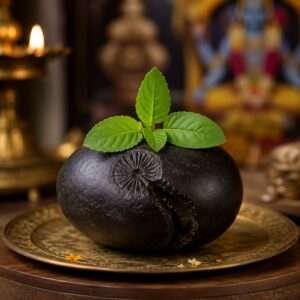
Tulasi and Saalagraama
At this juncture, it is relevant to learn a little about Tulasi and Saalagraama. Most Hindus will have heard about the Tulasi plant, and they may even have one at their home. But unfortunately, based on my observation, most Hindus will not have heard anything about Saalagraama. Whenever I travel in India and have to take my Saalagraama Shila-s with me through airport security checkpoints, security personnel always pick up the Saalagraama Shila-s and ask me “What are these?”. Worse yet are the stories we hear from the pontiffs of various Matha-s travelling by flight. The same security personnel treat them like any other normal flight traveller and ask them to open up the Pooja boxes of their Matha-s, which usually has various icons of worship that are of immense spiritual significance.
There was an Asura by the name Jalandhara. His Patni, by name Vrunda, was a Pati Vrataa, which made Jalandhara invincible and was wreaking havoc in the entire world. Unable to defeat him, the Devata-s approached Paramaatma and pleaded to find a way out. Paramaatma agreed and appeared in front of Vrunda looking like her husband Jalandhara. As always, Vrunda did Pati Seva very devotedly. Pleased by her Seva, Paramaatma showed his true form. But instead of being pleased to see Paramaatma, Vrunda considered that her austerity had got violated and that she was no longer chaste. In anger, she cursed Paramaatma to become a stone. Paramaatma, being far more elevated than Vrunda or anyone else, is not affected by anyone’s curse. However, he did accept Vrunda’s curse, and invoked himself into the Saalagraama Shila, but with a caveat that Vrunda would be reborn as Tulasi plant and that he will accept Pooja offered to Saalagraama Shila only with Tulasi twigs.
The takeaways from the above anecdote about Vrunda are:
- It emphasizes the importance of Paativratya. In a marriage, Patni being a Pati Vrata bodes extremely well for the husband, even if he happens to be an Asura. Patni’s Paativratya becomes a protective armor around the Pati, but only as long as Patni is deserving, as is evident from the fact that Paramaatma revealed himself to Vrunda.
- As in the good old saying “Pati Parameshvara”, a Pati Vrata ought to see the most supreme lord in her Pati and not simply an individual. Such a Pati Vrataa woman always remains protected as in the case of Vrunda, who was reborn as Tulasi and is considered worthy of worship to this day. Nobody talks about Jalandhara. Rewards are always based on the worth.
- Only a devout individual who maintains a Saatvik way of life earns the ability to give either a Vara (boon) or a Shaapa (curse). As a corollary, when hurled at a Saatvik Jeevaatma… even a Shaapa (curse) bodes well for that Jeevaatma and also the entire world. But, even a Vara (boon) bodes ill for the entire world when given to an undeserving Asura. Vrunda’s curse resulted in Paramaatma invoking himself into the Saalagraama Shila and is worshipped in almost all temples across the world. Saalagraama Shila is available only in Gandaki river in Nepal. Internet search will provide plenty of information about Saalagraama Shilaa. Moreover, when 12 Saalagraama Shila-s are together in one place, then such a place is referred to as a Punya Kshetra. A mere visit to such a place is equivalent to a Teertha Yaatra (pilgrimage). Therefore, most temples have at least 12 Saalagraama Shila-s. We have 20 at our home.
What’s important to note here is that Jaambavati’s Sannidhaana (presence) is also there in the Tulasi plant. Why is this important? Well, that needs some explanation.
In the Bhagavad Gita, Chapter 2, Verse 66, Shree Krishna says, “naasti buddhirayuktasya nachaayuktasya bhaavanaa”. Here, Shree Krishna hints about the two primary mental faculties, i.e., Buddhi and Bhaavanaa. Here, Buddhi pertains to rationale and Bhaavanaa pertains to the emotions/passion/compassion/feelings. Buddhi should help us decide, say, what philosophical line of thought to follow. But once that decision is made, Buddhi will no longer get involved in any Karma/Pooja/Homa/Havan that is performed. As we learnt earlier, any Karma involves 3 aspects, i.e., Kaayaa (through the body), Vaachaa (through the words), and Manasaa (through the mind). And in the Manasaa aspect, it is this “Bhaavanaa” that should flow out to draw maximum Anugraha. For example, a 4-year-old child wants to wish their mother on her birthday. The child has barely learnt the alphabet and can’t spell the words too well. So, it just writes “HAPI BARDE” and scribbles some pictures with its color pencils and presents it to the mother. You can imagine how happy the mother will feel. Her joy will know no bounds. She’ll take a picture of it and post it in social media, and pretty soon 100s of people will be liking it. Why? Not because of the pictures or colors or the handwriting (which is the Kaaya part) as every kid can scribble with color pencils and there’s nothing great about it. Nor is it because of the words written as they were not even spelled right. But it is the Bhaavanaa in that child’s mind that got full credit. The same is true when we do any Pooja/Karma. It is that Bhaavanaa that gives us boundless Anugraha from the ones above. And for that Bhaavana to flow out, one needs to have the basic facts right about Paramaatma and the Devata-s.
In the above example, the generic term for the Bhaavanaa between the mother and the child is “Prema Bhaava”. But there are more specific terms. Prema Bhaava towards someone younger than us (as that of the mother towards her child) is called Vaatsalya or affection. Prema Bhaava towards someone equal to you is Sneha or friendship. Prema Bhaava towards someone of the opposite gender is referred to as Sringaara or romantic. And Prema Bhaava towards someone superior to us is Bhakti or devotion/reverence.
Further, Shree Krishna says in Bhagavad Gita (Chapter 15, Verse 19):
yo maam evam asammoodho jaanaati purushottamam |
sa sarvavid bhajati maam sarva bhaavena bhaarata ||
One who knows about Paramaatma will worship him with all Bhaava (Bhaavana) i.e., the aforesaid Vaatsalya, Sneha, Sringaara, and Bhakti Bhaava-s. Here what needs to understood is that a man can only express his Prema Bhaava as only 3 of the 4 Bhaava-s above i.e., Vaatsalya, Sneha and Bhakti Bhaava-s. Obviously, a man cannot express Shringaara Bhaava towards Paramaatma. However, a woman can express her Prema Bhaava towards Paramaatma in all 4 Bhaava-s, including Shringaara which is extremely powerful.
Jaambavati surrendered to Paramaatma through both Bhakti and Sringaara. She and the other Mahishi-s are not Abhimaani-s for any aspects and thus, their Anugraha is necessary for us to embody the sense of Vairaagya. It is for this reason that we wear Tulasi Maalaa, which is a chain of beads made from dried Tulasi wood. This is also the reason for offering the tip of Tulasi branch (not Tulasi leaves, but the twigs or the tip of a newly growing branch of Tulasi plant) to Saalagraama Shila.
The six Mahishi-s are not the only ones who surrendered to Paramaatma through both Bhakti and Sringaara. There are many like them. The most famous among them are the Gopika-s of Gokula and the hunchbacked young lady in Mathura, commonly referred to as Kubja. When Shree Krishna healed her deformities, she surrendered to him and requested to give her a child. Shree Krishna agreed to visit her in future and kept his promise. The son born to Shree Krishna and Kubja was named Vishoka, who was the Saarathi of Bheema in the battle at Kurukshetra. Thus, both Krishna and his son Vishoka were Saarathi-s of the Paandava brothers Arjuna and Bheema, respectively.
And, regarding the Gopika-s… Many traditions follow the application of Tilaka using Gopi Chandana (clay from Gopi Taalaav, a lake near Dwaraka, Gujarat, India). Any Pooja/Karma is considered incomplete without the application of Gopi Chandana. Why? Because this sand has touched the feet of Gopi-s who surrendered to Paramaatma through both Bhakti and Sringaara Bhaava-s. And therefore, we (especially men) apply it at specific Marma Sthaana-s in our body with the hope that it will evoke the subconscious sense of surrender to Paramaatma.
Lastly, about Raadhaa… there are countless temples all across the world dedicated to Raadhaa. But there is no mention of Raadhaa in Shreemad Bhaagavata which is the primary account of Shree Krishna’s biography. From what I learnt through the scholars who’ve researched the scriptures painstakingly, there are numerous commentaries on Shreemad Bhaagavata by many famous scholars including the 3 Mataachaarya (Shankara, Raamaanuja and Madhwa). But there is not even a passing mention about Raadhaa by anyone anywhere in their commentaries on Shreemad Bhaagavata. Internet search too reveals that there is no mention of Raadhaa in any of the works of Shree Raamaanuja or Shree Madhwaachaarya. Internet search claims that there is mention of Raadhaa in Shankara’s work, but not about his commentary on Shreemad Bhaagavata. The scholars I learnt through think that Raadhaa was a fictitious character that poet Jayadeva created and used in his Geeta Govinda. My suspicion is that the numerous Raadhaa Krishna temples may have felt threatened by accusations of being a baseless faith. And therefore, they may’ve felt the necessity to give some credibility to their establishment, and thus may’ve hired scholars to come up with carefully crafted Sanskrit verses about Raadhaa and had them inserted in some other scriptures outside of Shreemad Bhaagavata. Shree Madhwaachaarya has specifically mentioned that many such mischievous acts have happened where by scholars have either inserted or updated or deleted verses to suit their wrongful faiths. Therefore, Shree Madhwaachaarya had to spend an enormous amount of time searching for scriptures where accuracy had been preserved.
Rationale, debate, and arguments apart, based on my personal observation and experience, Raadhaa worship does not seem to agree with the Bhagavad Gita. Nor do I feel that it bodes well for the devotees. In my opinion, Raadhaa worship tries extremely hard to justify its validity, which seems very hollow at its core. Worse yet, it seems to attempt to reduce Shree Krishna to be merely a lover boy, and therefore, such worship can end up with unfavourable consequences. But I haven’t read the ancient manuscripts. So, based on my personal experience, my recommendation is that… in matters about faith, when we must err… It’s better to err on the side of caution. In this case, there is a very elaborate mention of how the Gopika-s had surrendered to Shree Krishna. And this sense of Sharanaagati is immensely important in earning the grace of Paramaatma. Therefore, it’s best to go with the worship of Gopi Krishna instead of Raadhaa Krishna. It is appropriate as well as supported by the scriptures.
May Tulasi and the six Mahishi-s bestow Bhakti and Vairaagya upon us.