



This is an article series. Please read all previous articles before reading this article. The URLs for all previous articles are located in the SPECIAL THOUGHTS section.
Before we delve into Devata-s in Level 4, it would help to understand the terms “Avataara”, “Amsha”, “Avesha” and “Sannidhaana”.
Avataara and Amsha
Avataara means descent, i.e., descent of Paramaatma or a Devata or an Asura. I searched the internet regarding the differences between Avataara and Amsha. Below is what the search engine returned:
The above summary seems too general and some of the words used in the above summary are hinting that the above summary may’ve been overshadowed by a certain school of philosophy that I don’t agree with. For example, “supreme deity” is a phrase that’s not making much sense to me. It ought to be either “Supreme” or “Diety” because it can be argued that the “Supreme” is not a “Diety” and vice versa. In the school of Vedic philosophy that I follow, “Supreme” is Infinite, Omnipotent, Omniscient, Omnipresent and Self-Dependent and, strictly speaking, a “Diety” is none of the aforesaid. Therefore, the above needs a bit more elaboration.
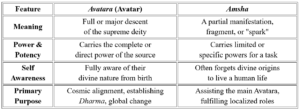
Devata-s are referred to as Amsha Jeevaatma-s. What does it mean? Well, Devata-s exist in their “Moola Roopa” (referred to as “the source” in the above table) and may take Avataara as an Amsha, which is a partial manifestation, carries limited or specific powers, and often forgets the “Moola Roopa”. This applies an Amsha of Shesha, Shiva or any of the Devata-s in Level 5 and below. We see several examples of this. Let’s look at a few:
- Balaraama is Shesha’s Avataara (Amsha Sambhoota). In his “Moola Roopa”, Shesha’s Master is Vishnu. But, in his Avataara, Balaraama can be seen arguing with Krishna (Avataara of Vishnu). He trained Duryodhana (Avataara of Kali, who is the evilest among all Jeevaatma-s) in Gadaa (Mace) warfare; promised Duryodhana that he will get Duryodhana married to his sister Subhadra; has been described in Mahaabhaarata as a frequent consumer of intoxicants; and finally, because of his fondness for Duryodhana, he ended up not siding with Paandava-s despite his own brother Krishna supporting them.
On the other hand, Lakshmana was another Avataara of Shesha, and he ardently served his brother Raama (Avataara of Vishnu).
2. Ashvatthaama is Shiva’s Avataara (Amsha Sambhoota). In his “Moola Roopa”, Shiva told his consort Paarvati that chanting Shree Raama’s name is equivalent to chanting the Vishnu Sahasra Naama. As is popularly known, Shree Raama is Vishnu’s Avataara and so is Krishna. But there are several instances of Ashvatthaama going against Krishna. One time, he had asked Krishna to lend his Sudarshana. When Krishna asked, “Why?”, Ashvatthaama said, “I want to use Sudarshana to destroy you”. During the battle of Kurukshetra, he sided with the evil Duryodhana and shot the dreaded Naaraayana Astra toward the Pandava-s. Later, after the battle of Kurukshetra, Ashvatthaama shot the Brahmaastra, which is capable of annihilating the entire universe. When Shree Vedavyaasa (another Avataara of Vishnu) urged him to withdraw it, he said he doesn’t know how to withdraw the Brahmaastra, but could only redirect it… and redirected it towards Abhimanyu’s unborn baby, so that there is no heir apparent for the throne. But Krishna ensured that the baby was unharmed in the womb. The baby was named Vishnu Raata, who later became known as Pareekshita.
On the other hand, Shuka Muni is Shree Vedavyaasa’s son. He is an Avataara of Shiva. While Ashvatthaama tried to destroy Pareekshita, Shuka Muni taught him Shreemad Bhaagavata.
3) Vaali is Indra’s Avataara. Sugreeva assumed that Vaali was dead and therefore he married Vaali’s consort Taaraa, with full approval from everyone. When Hanumaan pledged his allegiance to Sugreeva, it should have cleared all doubts about Sugreeva’s honesty. But yet, Vaali doubted Sugreeva’s honesty, chased him away from the kingdom and forcibly kept Sugreeva’s consort Rumaa as his own consort. This is what ultimately led to Vaali’s death.
On the other hand, Arjuna is also an Avataara of Indra and he saw Krishna’s Vishvaroopa. Yet, just a few days after seeing Krishna’s Vishvaroopa, he vows to kill Jayadratha before the next sunset, failing which he vows to immolate himself.
4) Dronaachaarya is an Avataara of Deva Guru Bruhaspati. But when he was appointed the commander-in-chief of the Kaurava army during the battle of Kurukshetra, he vows to kill 10,000 people every day just to prove his loyalty to Duryodhana.
On the other hand, Uddhava was also an Avataara of Deva Guru Bruhaspati. But he was an ardent devotee of Krishna. There is documentation of Krishna teaching Uddhava, which is referred to as Uddhava Geetaa. It is part of Shreemad Bhaagavata Puraana.
5) Sugreeva is Soorya’s Avataara. He doubted his brother Vaali’s abilities to fight off demonic forces despite full awareness about Vaali’s abilities through prior experience. Karna is also Soorya’s Avataara. His biggest mistake was explicitly calling Drapuadi a Veshya.
On the other hand, Sugreeva served Raama with immense devotion. And Karna is well known for his extremely generous offerings to anyone who approached him.
Many such examples make it amply clear that Amsha refers to partial manifestation, carries limited or specific powers, and often forgets the “Moola Roopa,” and this applies to all Devata-s in Level 5 and below.
But, the Devata-s in Level 4 and above don’t fall into the above category. Their Avataara is quite rare and never a partial manifestation. They always descend with their full powers, though they may not always use them. And, they never forget their “Moola Roopa”. They are bound only by the intuitive orders they receive from Paramaatma, whom they always remain subservient to. For this reason, Devata-s in levels 4, 3 and 2 are referred to as Para Shukla Traya Devata-s. Their distinct spiritual traits are:
- Pure knowledge – as characterized by the Sanskrit word “Shukla”, which means “White,” symbolizing purity
- Absolute devotion – they never misunderstand God or go against the will of God. They have an unwavering loyalty and alignment with God
- Immunity to Kali – As has been mentioned several times earlier, there are 3 different types of Jeevaatma-s, namely Saatvik, Raajasik and Taamasik. The Saatvik Jeevaatma-s are the Devata-s. And the Taamasik Jeevaatma-s are the Asura-s. Among all the Asura-s, Kali is the evilest. Kali leaves absolutely nothing untouched, except these Para Shukla Traya Devata-s.
Sarasvati and Bhaarati
It had been mentioned earlier that while elaborating on the Devata-s in Level 7 and also Level 5, there are 2 queues in those levels and that each queue has 100 positions. But, unlike the Devata-s in Levels 7 and 5, Level 4 has only one queue with 100 positions. The Devata in Level 4, position 100, is Saraswati, and the Devata in Level 4, position 99, is Bhaarati. Please note that the category “Para Shukla Traya” refers to only Sarasvati and Bhaarati in Level 4. The other Devata-s in this queue will earn the traits about “Para Shukla Traya” in the future.
Sarasvati and Bhaarati are Abhimaani Devata-s for our Buddhi. Here, I’m reminded of a composition by the great saint Shree Purandara Daasa, which he composed in praise of Sarasvati. The exact words, in Kannada, are “kodu bega divya mati, sarasvati”. Here, Shree Purandara Daasa pleads with Sarasvati to swiftly grant him “mati”. Generally, the word “mati” is synonymous with the word “Buddhi”, which basically means “Intellect”. But why wasn’t the word “Buddhi” used instead? Also, you may’ve noticed that women are usually named “Sumati” and rarely named “Subuddhi”. On the other hand, men are named “Subuddhi”, “Buddhi Saagara,” etc. So, it brings up a question… is there a difference between “Buddhi” and “Mati”?
My take is… Yes, there is a difference between “Buddhi” and “Mati”. In my opinion, “Buddhi” refers to rationale, inquiry, inquisitiveness, critiquing, critical analysis, and so on, which are necessarily used in any decision-making process. On the other hand, “Mati” refers to the decision arrived at using Buddhi and then applying compassion to that decision. So, Shree Purandara Daasa is pleading Sarasvati to bestow the ability to use good rationale in arriving at the correct conclusions and then follow those decisions compassionately.
Also, as had been explained earlier, all Devata-s in Level 5 above are Ardha-Naareeshvara-s. They have all the masculine traits and all the feminine traits. However, both Sarasvati and Bhaarati are depicted in feminine form. This is to show that a Jeevaatma is always a receiver and therefore, akin to being feminine. Female trait is to receive with humility and when it does, something good comes through.
Avataara of Bhaarati
As mentioned above, Avataara of one of the Para Shukla Traya Devata is indeed extremely rare. As had also been mentioned earlier, the Devata in the 100th position has earnt the privilege of not having to take any Avataara on earth. Thus, Sarasvati Devi does not take Avataara on earth. However, we’ve been very fortunate to know about one such Avataara through Mahaabhaarata, the biggest and one of the greatest epic scriptures pertaining to Vedic Philosophy. The Avataara being referred to is Draupadi.
Some accounts portray that Draupadi was born directly out of Homa Kunda. But there may be some other accounts of being born to parents and raised by them. Regardless, what needs to be understood here is that a Devata who belongs to the Para Shukla Traya category will not be in Maatru Garbha (a mother’s womb) for nine months. It is indeed a misery to stay in Maatru Garbha which is filled with total darkness, and there’s no food or water or air to survive. How a Jeevaatma can survive and grow in such a space is a great mystery which should leave no doubts in the minds of spiritual seekers about the greatness of Parmaatma. A Para Shukla Traya Devata will not be subjected to such misery.
From the specific description we have available through Mahaabhaarata, it is known that Draupadi was dark-skinned. As a result, her parents had even named her Krishnaa, which literally means “Dark”. As we know through personal experience, dark colours absorb energy and become warm/hot very quickly. Thus, figuratively, Draupadi was born to consume the Paapa of the Kula that she was born into. Later on, she ended up consuming the Paapa of all those who gave up their lives fighting to uphold Dharma in the battle of Kurukshetra.
We can see in this world that VIPs are always surrounded by bodyguards. From a spiritual perspective, a Para Shukla Traya Devata descending on earth is also like a VIP of extremely tall order. And, it should always be noted that, in Paramaatma’s creation, every single Devata descending on earth is usually accompanied by hundreds of Asura-s also descending. When the Lord descended as Shree Raama, Raavana and Kumbha Karna had already been in existence for several Mahaa Yuga-s. When this is the case w.r.t the Lord himself descending, Devata-s will not be spared. And it is to be understood as a necessary condition too, because otherwise… there won’t be an opportunity for anyone to understand the supreme capabilities of a Devata.
There is more to be written about Draupadi. We shall continue on this topic and also elaborate on how Sarasvati is depicted and the traits they symbolize. May Sarasvati and Bhaarati bestow Sanmati to us.
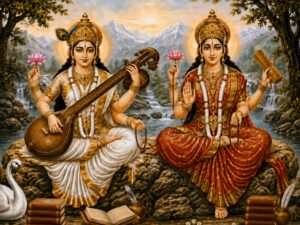
Picture generated through AI by Karthik Dinesh

