MS Shanker
A CNN-News18 survey puts the 2027 battle in perspective, raising questions about the Congress’s independent strength, the SP’s alliance strategy, Yogi Adityanath’s standing and the BJP’s political recovery after its 2024 setback
The countdown to the 2027 Assembly elections has begun in several politically crucial states, but few contests will command as much national attention as Uttar Pradesh. With its 403 Assembly constituencies and 80 Lok Sabha seats, UP is not merely another state in the electoral calendar. It is the political nerve centre of Bharat, where the fortunes of regional parties, the national ambitions of the principal contenders and the broader direction of national politics frequently intersect.
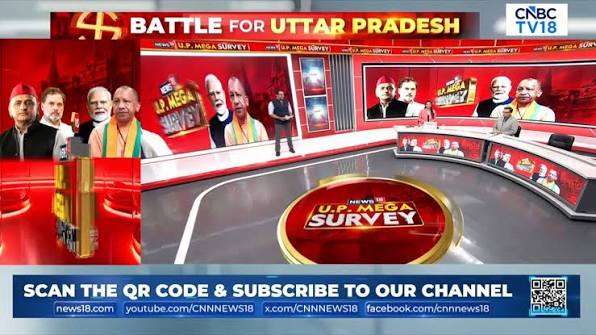
Against this backdrop, the CNN-News18 Mega Survey on Uttar Pradesh has provided an early snapshot of voter sentiment, opening up a series of intriguing questions. Can the BJP-led National Democratic Alliance (NDA) consolidate its position under Chief Minister Yogi Adityanath? Can Samajwadi Party chief Akhilesh Yadav sustain the momentum his party acquired in the 2024 Lok Sabha elections? And, perhaps most pertinently, can the Congress improve its independent electoral standing sufficiently to enter double figures in the state, rather than remain dependent on its alliance with the SP?
The survey, conducted between September 17 and October 2, 2026, covered 30,925 respondents across all 75 districts of Uttar Pradesh. According to the findings reported by News18, the NDA was projected to receive 66.6 per cent of the vote if an Assembly election were held at the time of the survey, against 26.4 per cent for the SP-Congress alliance and 5.4 per cent for the Bahujan Samaj Party (BSP). Yogi Adityanath was also the preferred chief ministerial choice of 66.2 per cent of respondents, while Akhilesh Yadav received 24.4 per cent support. These are survey estimates, not actual votes or a forecast that can be treated as a settled electoral outcome. Nevertheless, the gap reported in the survey makes the findings politically significant.
From the 2024 setback to the 2027 test
The BJP has reason to take the survey seriously, but it would be equally unwise for the party to regard it as a substitute for hard political work.
In the 2022 Assembly elections, the BJP won 255 seats, while its allies took the NDA’s total to 273. The SP-led alliance won 125 seats. The Congress was reduced to two seats, and the BSP managed just one. The verdict enabled the BJP to return to power in UP, making Yogi Adityanath the first chief minister in several decades to lead the same party back to office after completing a full five-year term.
The 2024 Lok Sabha elections, however, delivered a different message. The BJP’s tally fell to 33 seats in Uttar Pradesh, while the NDA won 36. The Samajwadi Party secured 37 seats and the Congress six, taking the opposition alliance’s combined tally to 43. The verdict demonstrated that the BJP’s formidable organisational machinery was not immune to voter dissatisfaction, changing caste equations or the opposition’s ability to consolidate votes.
The setback also brought the BJP’s internal organisational dynamics and its relationship with the RSS into sharper focus. In May 2024, then BJP national president J. P. Nadda’s remarks that the party had grown sufficiently strong to manage its own affairs, unlike in its earlier years when it needed the RSS more, attracted considerable attention. The comments came amid reports of strains between the two organisations, with questions being raised about coordination during the Lok Sabha campaign. There were also reports of differences over the management of the Uttar Pradesh campaign and the extent of Chief Minister Yogi Adityanath’s influence over candidate selection. These developments fuelled debate over whether organisational coordination and local leadership dynamics had contributed to the electoral setback.
The defeat was particularly consequential because Uttar Pradesh had contributed substantially to Narendra Modi’s successive electoral victories at the national level. It also exposed the limitations of assuming that the BJP’s organisational strength, its development narrative and the appeal of Modi and Yogi would automatically translate into victories across every constituency.
Subsequent developments indicated renewed emphasis on organisational coordination. On March 30, 2025, Modi visited the RSS memorial at Dr Hedgewar Smruti Mandir in Nagpur, in the presence of RSS chief Mohan Bhagwat. The visit was widely interpreted as a significant gesture towards reinforcing ties between the BJP and its ideological parent, following speculation about strains in their relationship. Whether this improved coordination would translate into electoral gains, however, remained a question to be answered at the ballot box.
That apart, a Lok Sabha election and an Assembly election are not interchangeable exercises. National leadership, local candidates, constituency-level grievances, caste alignments and perceptions of state governance can produce different outcomes. The 2024 verdict, therefore, cannot by itself establish the likely direction of the 2027 Assembly contest.
The CNN-News18 survey offers a contrasting snapshot, suggesting that the BJP’s position may have recovered considerably from the parliamentary setback. Whether this translates into votes when the electorate is actually called upon to decide will depend on what happens between now and polling day.
Is Yogi’s governance the defining factor?
One of the survey’s most notable findings is the reported preference for Yogi Adityanath as chief minister. His support among respondents, coupled with the reported assessment of his government’s performance, indicates that leadership remains a central consideration in the state’s political debate.
Law and order has long been one of Yogi’s principal political themes. His administration has consistently projected a tough approach towards organised crime, while the BJP has sought to associate the chief minister with administrative discipline, infrastructure expansion and a more assertive state government.
The development narrative extends to expressways, airports, industrial investment, urban infrastructure and the transformation of Ayodhya following the construction and consecration of the Ram temple. For the BJP, these projects are part of a larger argument that UP is moving beyond its earlier image of inadequate infrastructure and administrative weakness.
The question is whether voters see these changes as sufficient justification for another term.
A survey indicating broad satisfaction with a government can provide useful evidence of public perception. It cannot, however, establish that every development claim has translated into improved household incomes, adequate employment or better public services. Infrastructure is visible, but the everyday experience of employment, education, healthcare, agricultural returns and prices is equally important.
Employment, in particular, remains a test that the BJP cannot afford to underestimate. Young voters may appreciate improved connectivity and investment announcements, but they also want jobs commensurate with their qualifications. Recruitment delays, examination controversies and allegations of paper leaks can influence the political mood, particularly among first-time voters and aspirants for government employment.
Consequently, the real challenge for Yogi Adityanath is not simply to retain his image as a strong administrator. It is to demonstrate that administrative control and infrastructure development are producing tangible economic opportunities across the state’s urban and rural regions.
Will the opposition’s 2024 formula work again?
For Akhilesh Yadav, the challenge is to convert the SP’s parliamentary gains into a durable Assembly-level coalition.
The 2024 Lok Sabha results demonstrated that the SP and Congress could benefit from coordination and the consolidation of anti-BJP votes. Their alliance also challenged the assumption that the BJP could retain its parliamentary dominance in UP without facing substantial resistance.
The SP’s strategy has drawn on its traditional support base while seeking to broaden its appeal among backward classes, Dalits and minorities. Its emphasis on PDA — Pichhde, Dalit and Alpsankhyak, or backward classes, Dalits and minorities — has been central to this political approach.
The BJP, meanwhile, has its own extensive network of social and caste alliances, in addition to its Hindutva appeal, welfare programmes and organisational presence. The coming election will test whether the SP can maintain its coalition across different communities or whether the BJP can regain sections of the electorate that shifted away from it in 2024.
The Congress faces a more fundamental question. Its improved performance in the 2024 Lok Sabha elections, when it won six seats in UP, represented a recovery from its two-seat performance in the 2022 Assembly elections. But the parliamentary result does not establish that the party has rebuilt an independent statewide organisation capable of winning a substantial number of Assembly constituencies.
The distinction between winning seats through an alliance and developing an independent electoral base is crucial. The Congress may benefit from seat-sharing with the SP, but its own prospects will depend on the number of constituencies it contests, the quality of its candidates, its organisational strength and its ability to mobilise voters beyond the support it receives through its alliance partner.
That brings us back to the question in the headline: can the Congress get into double figures in UP?
The CNN-News18 survey’s reported vote-share projection for the combined SP-Congress alliance does not, by itself, answer that question. An alliance’s aggregate support cannot be translated directly into the Congress’s individual seat tally. The party’s prospects will depend on the eventual seat-sharing arrangement, constituency-level arithmetic and whether it can convert its share of the alliance vote into victories.
For a party seeking to re-establish itself nationally, the distinction matters. A respectable performance in an alliance can improve its parliamentary presence, but sustained political relevance also requires organisational depth, credible local leadership and the ability to compete independently where circumstances permit.
The Mayawati factor
No serious assessment of UP politics can ignore Mayawati and the BSP.
The BSP’s electoral decline has been dramatic. From winning 19 Assembly seats in 2017, the party fell to one in 2022. In the 2024 Lok Sabha elections, it failed to win a single seat in UP. Yet its vote share remained substantial enough to make it relevant to constituency-level calculations.
The CNN-News18 survey’s reported 5.4 per cent projection for the BSP suggests a smaller position than the party occupied in earlier elections. But a statewide vote share does not tell the entire story. The geographical concentration of votes, the social groups that remain loyal to the party and the constituencies in which it can influence the contest may matter more than the aggregate figure alone.
Could the SP and BSP come together? Such a possibility cannot be ruled out, but neither should it be treated as an automatic route to electoral success. Their previous alliance in the 2019 Lok Sabha elections failed to produce the expected result, and the relationship between the two parties has its own political complications.
An alliance would need to reconcile questions of leadership, constituency allocation, social representation and the distribution of political credit. It would also have to persuade voters that the arrangement offers a coherent alternative rather than merely an arithmetic combination of parties.
There is another complication: votes do not transfer mechanically from one party to another. Voters have their own preferences, local loyalties and assessments of candidates. Even where leaders reach an agreement, the electorate may not respond uniformly.
For the BJP, the BSP’s position could influence contests in which a relatively small shift in votes changes the outcome. For the SP and Congress, the challenge is to understand whether a broader opposition arrangement can attract additional voters without alienating existing supporters.
Ayodhya and the limits of political symbolism
The 2024 parliamentary result in the Faizabad constituency, which includes Ayodhya, was among the developments that prompted questions about the BJP’s electoral assumptions. The SP’s victory there demonstrated that the political significance of the Ram temple does not automatically determine the outcome of every election in the surrounding region.
The BJP has placed considerable emphasis on Ayodhya’s transformation, religious tourism and infrastructure development. The temple remains a defining symbol in its political narrative. But voters also assess local roads, civic facilities, livelihoods, land-related concerns and the performance of elected representatives.
This is a useful reminder for every political party: symbolic achievements can strengthen a narrative, but they cannot permanently replace constituency-level engagement.
The same principle applies across Purvanchal and other regions where the BJP experienced setbacks in 2024. It would be premature to interpret those results simply as a temporary mistake by voters or to assume that the electorate has since repented. Such claims require evidence beyond a survey. The more meaningful question is whether the BJP has understood the reasons for its losses and addressed the grievances that contributed to them.
Equally, the opposition cannot assume that its 2024 gains will automatically endure. A parliamentary election may produce a particular combination of local candidates, alliances and national issues. An Assembly election brings the state government’s record and the chief ministerial choice much more directly into the contest.
Yogi’s national ambitions: a question beyond UP
The reported preference for Yogi Adityanath as chief minister also revives a larger political question: what role might he eventually play in national politics?
A chief minister’s popularity in a large state inevitably attracts attention beyond that state’s boundaries. Yogi’s profile, his association with Hindutva politics and his position within the BJP make him a figure of national interest. Survey responses expressing a preference for him as a future prime minister, if accurately reported, would add another dimension to that discussion.
But such responses must be interpreted cautiously. A question about whom respondents would like to see as prime minister is not equivalent to a party decision, a succession plan or a prediction of a future leadership contest. Nor does popularity in UP automatically establish comparable support across the country.
The BJP’s national leadership structure, the role of Narendra Modi, the party’s parliamentary calculations and the decisions of its senior organisational leadership would all shape any future transition. The question of succession is therefore separate from the immediate electoral test in UP.
It would also be speculative to assume that any individual leader’s advancement must necessarily come at the expense of another. Political parties often accommodate multiple prominent leaders, and their relative roles can change with circumstances.
For now, the more concrete issue is whether Yogi Adityanath can sustain public confidence in his administration and lead his party through another Assembly election. The result, whenever it comes, will provide a more substantial measure of his political standing than a hypothetical leadership preference.
A survey is a snapshot, not a verdict
The CNN-News18 findings deserve attention because of the scale of the reported sample and its coverage across the state. However, the interpretation of any opinion poll requires more than headline percentages.
The survey’s reported methodology identifies the fieldwork period, geographical coverage and interview approach. A full assessment would also benefit from a detailed breakdown of the sample by age, caste, gender, rural and urban residence, as well as constituency-level estimates and the statistical uncertainty attached to the findings.
The timing matters, too. The survey was conducted in September and October 2026, months before the expected Assembly election. Candidate selection, alliance negotiations, campaign controversies, local grievances and major political developments can change voter preferences. A survey measures opinion at the time respondents are interviewed; it cannot guarantee that those opinions will remain unchanged.
The reported findings on employment, governance and leadership should therefore be examined together rather than selectively. A high level of satisfaction with the chief minister may coexist with serious concern over jobs, prices or recruitment. Likewise, a party can command a substantial statewide vote intention while remaining vulnerable in particular constituencies.
For the BJP, the survey offers a basis for assessing where its government retains support and where it must improve. For the SP and Congress, it underlines the importance of organisation, alliance management and a credible alternative programme. For the BSP, it raises the question of whether the party can rebuild its support and convert it into representation.
Ultimately, UP’s voters will decide the outcome, not television graphics, political claims or early projections.
The central political question is therefore larger than whether the BJP can recover from its 2024 setback, whether Akhilesh Yadav can repeat his parliamentary success or whether the Congress can enter double figures. It is whether each party can convince a diverse electorate that its leadership, policies and local candidates deserve another mandate.
The CNN-News18 survey has brought these questions into sharper focus. The answers, however, will emerge only through the political contest that follows.