This is an article series. Please read all previous articles before reading this article. The URLs for all previous articles are located in the SPECIAL THOUGHTS section.
Pundra a.k.a. Tilaka
Proceeding from the brief overview of Veera Vaishnava and Veera Shaiva philosophies, let’s now ponder over a related topic, namely Pundra Dhaarana. Almost all Hindus wear this (at least on spiritual occasions) on their forehead, which is referred to as the Pundra. More commonly, Pundra is referred to as Tilaka or Naama. Though Pundra serves multiple purposes, let’s delve into two of them.
First Purpose: Pundra denotes adherence to a certain Matha and/or philosophical line of thought. As we had learnt very early in this series, whenever we talk to a person or even an animal, we always look at their eyes. Pundra is a mark on the forehead, drawn between the eyes. Thus, one can easily know about the Matha and/or philosophical line of thought that an individual belongs to just by looking at the Pundra or Tilak on that individual’s forehead.
There are a number of different ways that Pundra-s are drawn on the forehead. In general, all Tilaka-s which are drawn vertically on the forehead are referred to as Vaishnava Tilaka-s. Some commonly drawn Pundra-s by people of different sects can be seen below.
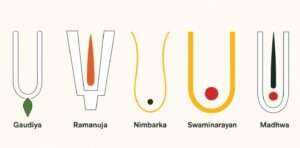
Picture generated through AI by Karthik Dinesh
Most people use small sticks to draw the Tilaka. Some use templates made of copper or bronze, smear either Gopi Chandana or Tirumann or Turmeric or and then press it on the forehead. The ingredient used is also of significance. Gopi Chandana is believed to be the clay from the land on which the Gopi-s walked. Their sense of surrender to Krishna was immense. This has been talked about earlier in the context of Devata-s in Level 6. Tirumann is usually the edible camphor used to draw Tilaka on the forehead of Shreenivaasa’s Moorti (idol) in various temples, especially Tirupati. Other commonly used ingredients are Arishina or Haldi (Turmeric) and Kumkuma (Vermilion).
There is another Pundra that is commonly seen. This is common among Shaiva-s, and it is drawn horizontally on the forehead. There may be a few variations, sometimes being just a thin, small horizontal line, sometimes being slightly thicker and wider, sometimes being 2 lines, and sometimes being 3 very thick horizontal lines drawn spanning the entire forehead, which is referred to as Tri-Pundra. The horizontal Pundra could be drawn using either Vibhooti (Ash from a Homa or from cremation) or Arishina/Haldi (Turmeric) or Kumkuma (Vermillion). Regardless of the number of lines, its size, stretch, and/or ingredients, popularly, the horizontal Pundra primarily denotes adherence to Shaiva philosophy. It can be general adherence to Shaiva philosophy with no particular opposition to Vishnu, or Veera Shaiva/Lingaayata traditions, which are averse to the worship of Vishnu. But the commonality in all these philosophies is that Shiva is the supreme among all the ones we worship. We’ve already delved into the appropriateness of this line of thought previously.
So, which is correct? Vertical or Horizontal? This brings us to the second and more important purpose of Pundra, as this more spiritual in nature.
Let us first see what the scriptures advise us. One scholar by the name Raaghava Bhatta advises that Oordhva Pundra (Vertical) is for the purpose of earning the eligibility to delve into the Veda-s. Scholars of our times elaborate on the above, in agreement that Oordhva Pundra makes sense. The word “Oordhva” means “Upward”. The very purpose of our spiritual pursuit is to seek the Kundalini Energy to flow upwards. Therefore, Oordhva Pundra is in alignment with the direction that we ought to seek for our Kundalini Energy to flow. For this reason, even those who usually wear Tripundra do have a Vatu wear Oordhva Pundra on the day of his Upanayana.
Ok fine. But it can’t be ignored that there is a very large population that wears the Pundra horizontally. Why do they wear it that way? Well, scholars of current times say that it is a fact that while some verses in our Puraana texts advise vertical Pundra, some others do advise wearing the horizontal Pundra. But, as we had learnt earlier, Puraana-s have 3 Bhaashaa-s (Samaadhi, Darshana and Guhya Bhaashaa). Since the direction in which we ought to seek for our Kundalini Energy to flow is vertical and upwards, those verses from Puraana-s that advise wearing Oordhva Pundra (vertical) are to be taken as conveyed in Samaadhi Bhaashaa (conveyed with compassion for the good of all sincere spiritual seekers). And, the Puraana verses which advise wearing Tripundra (horizontal) are to be taken as Darshana Bhaashaa (conveyed as seen in practice among the followers). Since Tripundra is orthogonal to the flow Kundalini Energy, it is to be taken as a sign of the wearers’ adherence to a certain Matha (monastery) and/or philosophical following.
Now, please allow me to offer my take on Tripundra. Apparently, among all the Devata-s, we see Tripundra adorned only by the Devata-s in Shiva Parivaara. We’ve already learnt how Shiva represents the Amukta state of a Jeevaatma. Also, worship of Shiva Paarvati and Shiva Parivaara is specifically meant for those who pursue meaningful and amicable family life. And, familial life involves progeny and progeny requires the maximum possible amount of Kundalini Energy to flow downwards to the genitals, so that the offspring gets maximum energy from the parents and use it to grow physically fit and healthy. Here, what’s desirable is not just a strong and healthy offspring, but a great Jeevaatma or, better yet, Paramaatma or one of the Devata-s takes an Avataara. From what we learn through our great scriptures is that for any great Jeevaatma to take Avataara, the parents are to observe Vrata-s with great sincerity. And, for any Devata to take Avataara, the austerities are to be even more sincere. But any great Jeevaatma taking birth would be immensely beneficial to the entire society. And Devata Avataara would be even more rewarding. Therefore, it would be even more beneficial to accomplish this end goal if everyone in the society joined in praying for the young couples in the society to bring forth great Jeevaatma-s down to the earth as progeny or perhaps a Devata to descend on to the earth to take an Avataara. However, it would be a little awkward and embarrassing to openly state their intentions in public. So, Pundra may’ve been a way that our ancestors chose to indicate their intentions to the society.
For example, in the above picture showing 5 different Oordhva Pundra-s, the Maadhwa Pundra is worn by a person early in the morning, right after a bath. But it would only look like a “U” on the person’s forehead. The black line with a dot at the bottom is not worn along with it. And, to all those who see that person, it will be clear that the particular person has not eaten just yet. Even to this day, when someone goes to a Matha for Prasaada (which is offered as a mid-day meal), we can see a piece of charcoal being passed around. The charcoal is from the Homa that will have been performed earlier that day. This is used to draw the black line on the forehead, thus indicating to everyone that all those wearing it have had their Prasaada (midday meal). And, if we see someone without the black line on the forehead, then that person should be fed a meal. This is in the Maadhwa tradition. There may be similar traditions in other Vaishnava Matha-s.
And, similar to the above, when a couple is seeking progeny… they worship Shiva Paarvati and wear Tripundra, thus indicating their intentions to society and indirectly seeking Aasheervaada from society. All the pious people in the society are to take note of the couple’s intentions. As adults, we know about the physical act involved in the conception of a child. But the people in the society are to keep themselves pious and austere. They are not to allow raunchy thoughts to cross their minds about the couple seeking progeny, and are not to get swayed by such thoughts. It requires an entire society to maintain austerities for a Devata to descend on to the earth. And, when they do… it is a great fortune and bodes extremely well for everyone. This is for the collective good and the society has to participate in it actively and piously.
Also, it is my observation that, subconsciously, I’ve never been inclined to wear the Tripundra. In my opinion, Oordhva Pundra looks more elegant, pleasant and attractive. On the other hand, personally, I feel a bit repulsed by Tripundra. It makes me think that the person wearing it is trying very hard to show his strict spiritual adherence. It looks especially repulsive when worn by women. Thus, Tripundra may also be used a way to keep people away from you, such as when one is passing through some difficult areas in society, perhaps infested with thugs, robbers, and miscreants. Additionally, women may choose to wear this during their menstruation, thus indicating to everyone to keep off.
In summary, Tripundra makes sense to be worn by those seeking progeny, as the Kundalini Energy has to flow downwards. In such cases, Tripundra serves as an indicator to society to pray for those seeking progeny. But other than that, all spiritual seekers are advised to wear only Oordhva Pundra as it is in alignment with the upward flow of spiritual energy. In the current times of disharmony among different Matha-s and denominations, the above may be a gentler and subtler way to get sidetracked spiritual seekers to shun misconceptions, think compassionately and get back on track.
Next… Should we draw them using thin sticks or use seals or impressions? Or are we to smear them using our fingers? Definitely use fingers. Why?
- In my opinion, drawing the Pundra with sticks or using seals/impressions is less spiritual and more decorative & show off. It is almost like women using sticker Bindi-s to look pretty, except it may be a little better because of the auspiciousness of the ingredient used to draw/imprint the Pundra. However, it shows a lack of awareness of the real reason behind wearing the Pundra and indicates a lack of deep thought which goes beyond the good old “this is who we are, this is what we believe, follow and do” line of thought. and displays overall spiritual hollowness quite loudly and clearly.
- The Pranic Energy, which we absorb during sleep, is constantly flowing out through our hands, mostly through the middle of our palms, but a good bit through our fingers too. And therefore, there is great spiritual benefit in wearing the Pundra using our fingers. Pundra is to be worn not only on the forehead, but a total 12 different places, including the forehead. The exact spots where the Pundra is worn are referred to as “Marma Sthaana-s”. One needs to locate these Marma Sthaana-s by touching himself/herself using the fingers and put on the Pundra at those spots. All these are subtle observations which gradually lead to knowing the self, and they go amiss without the use of fingers. Moreover, there are numerous great Phala-s (rewards) to wearing the Pundra on our fingers. Applying Pundra with each finger offers a different Phala. One squanders away all these rewards by drawing the Pundra using sticks or seals or metal impressions.
Coming back to Upaasana of Shiva, I’ve noticed that Tripundra is drawn on Shiva Linga in most temples and even in pictures of Shiva. Personally, I’ve never drawn a Tripundra on a Shiva Linga or picture or any other icon of Shiva. I don’t like to feel repulsed by looking at Shiva (or any Devata in Shiva Parivaara) wearing Tripundra. Therefore, I’ve always drawn Oordhva Pundra on Shiva.
Shiva is a Devata who has to do very sincere Vrata for a duration of 40 Kalpa-s, which is basically 432000 X 10 X 1000 X 2 X 360 X 100 X 40 earth years (I’ll let you do the math). We struggle to remain austere for a single day, but Shiva has to remain austere for 40 Kalpa-s to finally reach Shiva’s position. Therefore, Shiva is not to be spoken of lightly or casually. It is neither is ok to ignore Shiva Parivaara in Pooja, nor is it ok to worship Shiva as the most supreme. Shiva is also one of the Pitru Devata-s and takes care of us all through our youthful years. Therefore, inappropriate line of thought about Shiva involves the risk of not earning Shiva’s grace during our youthful years. The elaborate description of Shiva offered so far is what is followed in the Maadhwa line of spiritual thought and I can assure you that I’ve personally benefitted immensely from following this line of thought. Hope it has made sense to you as well.
Next, we’ll move on to the Devata-s in Level 4.