Indian politics has always been defined by its unpredictability. Parties that appear unassailable often witness internal turbulence, while seemingly weakened organisations occasionally reinvent themselves. Yet, at this juncture, it is difficult to ignore the growing signs of unease within the Congress, particularly among its ambitious second-rung leadership.
The latest round of speculation was triggered by political commentator Dr. Anand Ranganathan, whose remarks suggesting that Karnataka Chief Minister D.K. Shivakumar could eventually find his way into the BJP went viral. Whether one agrees with that assessment or dismisses it as political conjecture, the episode has once again drawn attention to the simmering questions surrounding the Congress’ internal cohesion and future leadership.
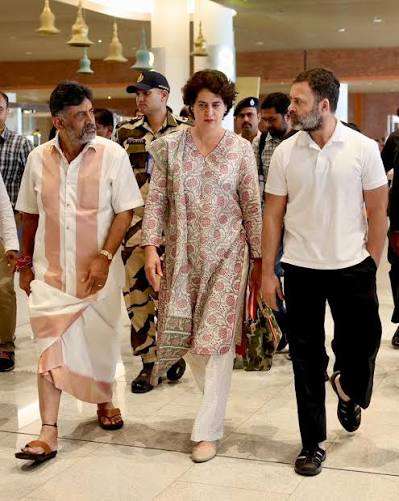
The Congress continues to grapple with a dilemma that has haunted it for over a decade—its dependence on the Gandhi family despite repeated electoral setbacks. Rahul Gandhi’s leadership has coincided with a series of electoral defeats across states, while Priyanka Gandhi, once projected by many within the party as a potential game-changer, has so far struggled to establish herself as a transformative political force.
Her recent criticism of eminent scientist Prof. V. Kamakoti, who was nominated to a high-level task force on examination reforms alongside former ISRO Chairman Dr. S. Somanath, generated avoidable controversy. Many observers felt that personal attacks on distinguished academicians diverted attention from substantive policy debates. More importantly, such episodes are believed to have caused discomfort even among sections of the Congress leadership that expected a more measured political approach.
The Congress has already witnessed a steady stream of high-profile departures over the years. Leaders such as Jyotiraditya Scindia and several others chose to leave, citing differences over leadership and organisational functioning. Their subsequent political careers have only reinforced the perception that the party has struggled to retain ambitious regional leaders.
The coming Assembly elections in states such as Uttar Pradesh, Punjab and Goa could therefore prove critical—not merely electorally, but organisationally. The Congress today governs only a handful of states on its own, while relying on alliances in others. Another disappointing electoral cycle could inevitably intensify internal introspection and possibly encourage more leaders to explore alternative political options.

Punjab presents a particularly interesting contest. The ruling Aam Aadmi Party has faced criticism over governance issues and controversies, prompting the Congress to hope for a revival. Simultaneously, the Shiromani Akali Dal is reportedly attempting to rebuild its political relevance. Whether it eventually seeks renewed cooperation with the BJP remains a matter of speculation, particularly as the BJP appears increasingly confident of expanding independently in the state.
Goa, meanwhile, remains another challenging battlefield for the Congress despite attempts to strengthen alliances. The BJP’s organisational machinery and electoral management continue to make it a formidable force there.
In Uttar Pradesh, the BJP under Chief Minister Yogi Adityanath appears to retain a significant political advantage. The Samajwadi Party’s alliance with the Congress has produced mixed political outcomes, and whether it translates into electoral dividends remains to be seen. The verdict of Uttar Pradesh will once again shape the national political narrative.
The southern states may ultimately witness the most interesting political developments. Karnataka remains a state where both the BJP and Congress possess formidable organisational structures, making leadership stability crucial. Telangana too presents evolving political equations. While the Congress currently governs the state, the BJP continues its efforts to expand, even as the Bharat Rashtra Samithi seeks to regain lost political space after its electoral setback.
Politics often rewards ambition, but it also demands patience. If electoral disappointments continue to mount for the Congress, ambitious regional leaders may begin reassessing their long-term political futures. Whether that results in high-profile defections or merely greater internal pressure for organisational reform remains to be seen.
It is in that context that Dr. Anand Ranganathan’s widely discussed prediction acquires political significance—not necessarily because it will come true, but because it reflects a larger debate about whether India’s oldest political party is approaching yet another phase of internal churning, one that could reshape political equations in southern India and beyond.