



There is a difference between an intimate family conversation around the dining table and sharing personal anecdotes on a public platform. Unfortunately, Rahul Gandhi, Leader of the Opposition in the Lok Sabha, appears to have blurred that distinction yet again.
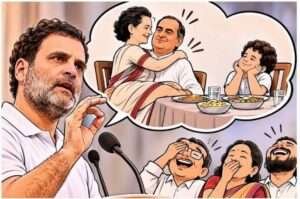
His recent revelation about the romantic equation between his late father, former Prime Minister Rajiv Gandhi, and his mother, Sonia Gandhi, at an event marking the release of her book has triggered an avoidable controversy. Recalling his childhood, Rahul narrated how his father would sit down for family meals while his mother would sit on his lap.
He said he initially assumed such displays of affection were normal in every household, only to discover during visits to his friends’ homes that their parents did not behave similarly. Now, there is nothing inherently objectionable about parents expressing affection for each other, nor is recalling a childhood memory a crime. But the question is one of propriety, sensitivity and the wisdom of taking private family moments into the public domain, particularly when the occasion is the release of a parent’s book.
What was Rahul attempting to establish through this revelation? Was it merely an innocent recollection of childhood, an attempt to portray his family as unusually affectionate, or an effort to project a supposedly more liberal and open-minded social outlook? Whatever his intention, the anecdote has invited comparisons with controversial stand-up comedian Samay Raina’s Allahabadi episode, where references to parents’ intimate lives triggered widespread outrage and legal complications.
The two instances are certainly not identical, and equating them in their entirety would be unfair. Nevertheless, they raise a common question: does freedom of expression demand that every private experience be converted into public entertainment or political messaging? In many Bharatiya households, particularly among those rooted in Sanatana traditions, parents are accorded an exalted position.
The relationship between husband and wife is respected as a private bond, and children are generally taught to maintain a certain decorum when speaking about their parents’ intimate lives. Parents are revered as living Gods, and this reverence does not necessarily mean that affection between them is taboo. Rather, it is about respecting the boundaries between what is appropriate in private and what needs to be discussed publicly. Rahul may have considered his anecdote perfectly normal, but he cannot expect an entire society to share his understanding of personal boundaries.
Predictably, the remarks attracted sharp political reactions. Assam Chief Minister Himanta Biswa Sarma questioned the propriety of Rahul publicly discussing such intimate family memories, arguing that he had embarrassed his own mother. Once BJP spokesperson Shehzad Poonawalla too expressed reservations about the revelation.
Rahul, instead of acknowledging that people could legitimately disagree with his choice of words or the occasion, hit back on X, accusing BJP and RSS supporters of being trapped in a web of fear, anger and hatred that prevents them from experiencing and expressing love. He even invoked his Hindu identity, suggesting that it was his duty to liberate them from such emotions.
This response raises another uncomfortable question: why should every criticism of Rahul Gandhi’s public conduct be dismissed as hatred or intolerance? Disagreement is not necessarily hatred, just as an expression of affection does not automatically become an argument for cultural liberalism. There was also an attempt during a television debate, involving Dr Anand Ranganathan, to draw parallels with the divine relationship between Lord Shiva and Goddess Parvati. But invoking Hindu deities to defend or contextualise a contemporary political leader’s personal anecdote is hardly a convincing argument.
The sacred relationship of Shiva and Parvati, celebrated in Hindu philosophy as an embodiment of devotion, companionship and cosmic balance, cannot be casually reduced to a justification for every form of public disclosure. Poonawalla’s reservations on this comparison are understandable, particularly against the backdrop of repeated controversies involving Congress leaders and their remarks about Hindu Gods and Goddesses.
Rahul’s family background, with its multiple cultural influences and Sonia Gandhi’s Italian origins, may have shaped a different understanding of public displays of affection and personal openness. There is nothing wrong with cultural differences. But Bharat is not a society with a single template for public behaviour, and those who occupy high constitutional and political offices must recognise its diverse sensitivities.
The issue is not whether Rajiv and Sonia Gandhi loved each other or whether they expressed that affection openly at home. Nobody disputes their right to do so. The issue is whether every intimate family memory needs to be narrated from a public platform, and whether those questioning such disclosures deserve to be branded intolerant. Rahul Gandhi, who frequently lectures the country on constitutional values, social harmony and respect for diversity, would do well to practise the same sensitivity towards cultural traditions that he expects others to extend to his personal choices.
Openness is a virtue, but discretion is equally a virtue. Freedom of expression does not absolve public figures of the responsibility to exercise judgement.


