



Rahul Gandhi seems to have discovered yet another political weapon to compensate for his inability to mount a credible challenge to the Narendra Modi Government – phone tapping. The Congress leader and Leader of the Opposition has once again sought to create a political storm around surveillance, with his loyal cheerleaders suggesting that his revelations could even shake the Prime Minister. Really? What exactly is so explosive that the nation is expected to wait with bated breath?
For someone who has repeatedly made sweeping allegations against the government without substantiating them to public satisfaction, Rahul’s latest attempt looks more like another exercise in manufactured outrage than a serious intervention on an issue of national importance. His politics increasingly appears trapped in a cycle of sensational claims, dramatic insinuations and carefully cultivated victimhood. Whenever confronted with questions on his own political performance, he seems to find another controversy to divert attention.
Phone tapping, however, is hardly a discovery of the Rahul Gandhi era. Governments across the world, including established democracies, have used lawful interception as an intelligence and security tool. Bharat, too, has witnessed repeated controversies over alleged surveillance. During Indira Gandhi’s and Rajiv Gandhi’s tenures, Opposition leaders and other public figures raised allegations of political snooping. The UPA years were also marked by controversies surrounding surveillance and interception. More recently, the Pegasus controversy triggered allegations of spyware use against journalists, politicians and public figures, prompting demands for accountability and judicial scrutiny. These episodes demonstrate that surveillance concerns cannot be reduced to a convenient political slogan directed at one government.
Telangana offers another uncomfortable reminder. The previous BRS government faced serious allegations of widespread illegal phone tapping, including the targeting of political opponents and other individuals. The subsequent investigation brought the issue into the public domain as a matter requiring serious accountability. Those allegations deserve scrutiny through due process, not selective outrage depending on who occupies the seat of power.
The fundamental question, therefore, is not whether Rahul Gandhi’s phone could be monitored, but whether any interception is authorised by law, supported by legitimate national-security grounds and subject to appropriate safeguards. No democratic government should enjoy an unrestricted licence to invade citizens’ privacy. Equally, no political leader should be permitted to portray every legitimate intelligence activity as a conspiracy against himself.
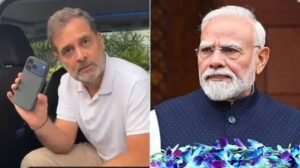
There is a world of difference between protecting national security and conducting political vendetta. The former is a responsibility of every government; the latter is an abuse of power. The Supreme Court’s recognition of privacy as a fundamental right in the landmark Puttaswamy judgment of 2017 makes it abundantly clear that surveillance cannot be arbitrary or unlimited. Accountability must apply regardless of which party is in power.
Yet, Rahul Gandhi’s repeated foreign visits, public interactions and political pronouncements invite legitimate questions about transparency and consistency. If he has evidence of unlawful surveillance, he should place it before the appropriate authorities, seek judicial intervention and demand an independent investigation. Merely hinting at sensational revelations, while keeping the public guessing, is no substitute for evidence. Nor should allegations about foreign contacts or political associations be treated as established facts without proof.
And here is a question that applies equally to journalists, politicians, public representatives and ordinary citizens: why should anyone fear lawful scrutiny if they are conducting themselves within the law? A journalist discharging professional duties, a politician pursuing constitutional responsibilities or a citizen going about legitimate business has every right to privacy and protection against illegal surveillance. But none has a licence to place personal or political interests above the country’s security.
Rahul Gandhi would do well to understand that being Leader of the Opposition is not a licence to manufacture suspicion, but a constitutional responsibility to question the government with facts, evidence and credible alternatives. If he believes his phone has been illegally tapped, let him produce the evidence and pursue the legal remedies available. If he has nothing concrete to offer, the nation is entitled to ask whether this is another diversionary spectacle.
Bharat needs a responsible Opposition, not a permanent grievance industry. National security is too serious an issue to be reduced to another episode in Rahul Gandhi’s endless political theatre.