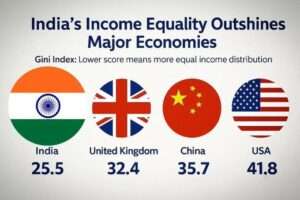
There are moments in a nation’s journey that deserve political unanimity rather than partisan discord. Bharat achieving the distinction of being ranked the world’s fourth most equal society, according to the World Bank’s latest consumption-based Gini Index data, is undoubtedly one such milestone. The World Bank’s figures place Bharat’s Gini Index at 25.5, behind only the Slovak Republic (24.1), Slovenia (24.3) and Belarus (24.4). More significantly, Bharat has outperformed every G20 and G7 nation on this measure of consumption inequality. Major economies such as China (35.7), the United Kingdom (36.6) and the United States (41.8) trail far behind. This achievement deserves to be celebrated, not dismissed simply because it comes during the tenure of the Narendra Modi-led government. National accomplishments should transcend party politics. Governments may change, but the country’s progress belongs to every citizen. The World Bank data also points to another encouraging trend. Extreme poverty in Bharat declined dramatically from 16.2 per cent in 2011-12 to just 2.3 per cent in 2022-23, resulting in nearly 171 million people moving out of extreme poverty. Whether through direct benefit transfers, financial inclusion, rural infrastructure, expanded welfare delivery, improved digital governance or economic growth, the cumulative impact has clearly been reflected in international assessments. Of course, it is important to understand what these numbers actually measure. The Gini Index cited by the World Bank is based primarily on household consumption rather than wealth ownership. It does not imply that Bharat has eliminated income disparities or that every citizen enjoys equal prosperity. Serious challenges remain in employment generation, quality education, healthcare access and regional disparities. These require sustained policy attention and continuous reforms. However, acknowledging these limitations should not become an excuse to ignore genuine progress. Mature democracies recognise achievements while continuing to debate shortcomings. Unfortunately, sections of Bharat’s political discourse as well as irresponsible media appear unwilling to acknowledge any positive development if it reflects favourably on the government of the day.
The Opposition certainly has every democratic right to question policies, expose administrative failures and demand accountability. That is the essence of parliamentary democracy. But there is an equally important responsibility—to distinguish between opposing a government and undermining the nation’s global image. Repeated attempts to portray Bharat as a failed democracy or a collapsing economy, despite contrary evidence from respected international institutions, neither strengthen democracy nor serve the country’s long-term interests. Constructive criticism enhances governance; relentless negativity merely erodes public confidence and provides ammunition to those outside Bharat who seek to weaken its standing. Bharat’s rise on the global stage has inevitably attracted geopolitical competition. In such an environment, citizens and political parties alike must remain vigilant against narratives that seek to exploit domestic differences for external strategic interests. Healthy political contestation should never become a vehicle for forces that wish to see Bharat internally divided or internationally diminished. Democratic disagreements are natural, but national interest must remain the common denominator. With several crucial Assembly elections approaching, followed by the Lok Sabha elections in the coming years, political parties will understandably sharpen their campaigns. Yet elections should be fought on competing visions for development, governance and public welfare—not by denying measurable national achievements or portraying every positive indicator as propaganda. The World Bank’s findings should not be viewed as the victory of one political party over another. They represent a milestone in Bharat’s broader development journey. The country’s progress has been built over decades through the contributions of successive governments, institutions, entrepreneurs, farmers, workers and ordinary citizens. This is, therefore, a moment for celebration as well as introspection. Celebration because millions have witnessed tangible improvements in their standard of living. Introspection because the journey towards equitable prosperity is far from complete. If Bharat continues to combine economic growth with inclusive development, the dream of becoming a truly developed nation by 2047 will move from aspiration to reality.