



The contest between Dronacharya and Yudhishthira rose to such a pitch of intensity that none who beheld it could discern which of the two held the advantage. All eyes were fixed upon the venerable preceptor, for he had solemnly vowed to seize Dharmaraja and deliver him into the hands of the Kauravas. The question that agitated every heart was whether the guru would fulfil his formidable oath.
The arrows discharged by Dronacharya were met and neutralised by Dharmaraja with unfailing skill. Even the celestial weapons invoked by the preceptor were rendered ineffectual by Yudhishthira’s serene mastery. Then Dharmaraja released a blazing Shakti, sanctified by sacred mantras, which rushed forth like a comet, spewing flames and smoke, consuming all in its path and striking terror into all who witnessed its progress. Undaunted, Drona invoked the Brahmastra and shattered the fiery missile in mid-air.
Yudhishthira then pierced his preceptor with five keen arrows. Stung by these shafts, Dronacharya, his wrath kindled, consecrated a mighty mace and hurled it at Dharmaraja. The son of Dharma instantly countered with a similar weapon. The two maces collided in the heavens, raining fire, thunder, and dazzling flashes, like storm clouds bursting with celestial fury.
Drona then slew the horses of Yudhishthira, shattered his chariot, and brought down its banner and standard. Bereft of both vehicle and weapons, Dharmaraja stood exposed and vulnerable. Yet Dronacharya, observing the ancient code of righteous warfare, refrained from striking an unarmed and chariotless foe. Leaving Yudhishthira aside, he turned his terrible energies upon the Pandava host, mowing down elephants, cavalry, chariots, and infantry with merciless precision.
All believed that the moment had arrived for Drona to capture Dharmaraja. But Yudhishthira, alert and composed, swiftly ascended the chariot of Sahadeva and thus escaped the danger.
Elsewhere, Kshemadhurti broke the bow of Brihatkshatra and briefly discomfited him. Recovering his composure, Brihatkshatra slew the enemy’s horses and charioteer and severed Kshemadhurti’s head with a razor-edged shaft. Roaring in triumph, he spread panic among the warriors who had rallied around the fallen king.
The Trigarta princes continued their assault upon the Pandava ranks. Viradhanva broke the bow of Dhrishtaketu. Calm and resolute, Dhrishtaketu hurled a blazing Shakti, which struck Viradhanva to the earth and extinguished the pride of his followers.
Sahadeva next confronted Dronacharya and, in the course of battle, struck down the banner of Durmukha, slew his horses and charioteer, and forced the prince to seek refuge in the chariot of Niramitra. The Pandava warriors applauded this feat. Pursuing Niramitra with relentless speed, Sahadeva severed his head, recalling the noble scene in the Ramayana when Rama pursued Khara and struck him down in the cause of righteousness.
Vikarna then attacked Nakula with a vast supporting force. But Nakula’s fierce resistance compelled him to withdraw, as a mighty wave recoils after dashing against an immovable mountain.
Vyaghradatta showered arrows upon Satyaki. In response, Satyaki slew his steeds and charioteer and severed his head with a swift and fatal shaft.
Shalya assailed the Upapandavas, the valiant sons of the Pandavas, striking each with five arrows. They answered with equal vigour. The sons of Somadatta joined the fray, and a fierce battle ensued. Surrounded on all sides, the Upapandavas pressed upon Shalya. The Madra king slew the horses of Abhimanyu, broke the bow of the son of Bhima, and struck down the banner of Yudhishthira’s son. In retaliation, the son of Nakula slew Shalya’s charioteer, and the son of Sahadeva severed his head.
At that same time, a dreadful encounter took place between Bhima and the rakshasa prince Alambusha. Struck by the demon’s arrows, Bhima fell unconscious for a moment, but quickly recovered and pierced Alambusha with keen shafts. Blood streamed from the rakshasa, making him resemble a dark mountain streaked with crimson ore.
Enraged, Alambusha resorted to sorcery and spread terror throughout the battlefield. Addressing Bhima, he cried, “In my absence you slew my brother Bakasura. Today your strength and prowess shall avail you nothing.” Bhima, invoking the Brahmastra, dispelled the demon’s illusions and drove him from the field.
Then Sanjaya said to Dhritarashtra, “O King, our princes and foremost warriors were routed, and our forces scattered in confusion. Seeing this, Dronacharya advanced against Satyaki and other eminent heroes. Blazing like a sacrificial fire fed with clarified butter, he checked the opposing ranks and restored courage to our dispirited army.”
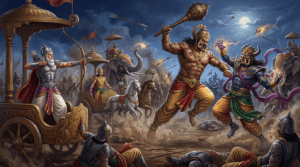
Meanwhile, Ghatotkacha confronted Alambusha. Their battle, waged between two masters of illusion, was marvellous to behold. When Satyaki moved to attack the rakshasa, Ghatotkacha gently restrained him, saying that this conflict belonged to those versed in the arts of maya.
Alambusha hurled a blazing discus at Ghatotkacha, but the mighty son of Bhima shattered it with a colossal mace. The fragments of the broken weapon rained upon the soldiers below, piercing their flesh and tormenting them like the stings of an angry swarm of wasps. Seeing his consecrated discus rendered useless, Alambusha multiplied his magical illusions. Yet Ghatotkacha dispelled each one with equal skill and stood unconquered amid the tumult.
Sanjaya declared that the combat between these two mighty rakshasa princes was so wondrous and terrible that every warrior who beheld it watched in admiration. Thus, he continued his narration of the great and many-sided conflict that raged across the sacred field of Kurukshetra.

