



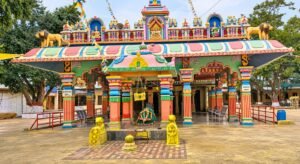
Sri Holemma Devi Temple is situated in the village of Badakundri near Hukkeri in Karnataka’s Belagavi district. Sri Holemma Devi Temple, also known as Sri Holevva Devi Temple, is a revered Shakti shrine located on the banks of the sacred Hiranyakeshi River. Dedicated to Goddess Holemma, a local manifestation of Goddess Mahalakshmi, this ancient temple holds a special place in the religious traditions of North Karnataka. The Goddess is worshipped as the protective Mother of the region and as the ancestral family deity of numerous devotees from Karnataka and neighbouring Maharashtra.
The temple is traditionally believed to be approximately 400 years old, with its origins associated with the 17th century.
Historical accounts attribute its establishment to the Desai family of Wantamuri, although the exact year of construction has not been conclusively established.
The presiding deity is Goddess Holemma Devi, also affectionately called Holevva Amma, worshipped locally as a manifestation of Goddess Mahalakshmi and Adi Shakti.
The Goddess is revered as a compassionate and powerful Mother who protects devotees and blesses families with prosperity, good health and happiness.
For many families in the Belagavi region and neighbouring Maharashtra, Holemma Devi is their Kuladevata, or ancestral family deity.
Devotees seek her blessings during important family occasions, including marriages, childbirth and other auspicious ceremonies.
The temple reflects the traditional rural shrine architecture of North Karnataka, with a sanctum dedicated to Goddess Holemma Devi and spaces for devotees to assemble during worship.
Its location near the Hiranyakeshi River adds to its religious and natural significance.
Unlike the elaborately sculpted Chalukyan temples of Karnataka, the importance of this shrine lies primarily in its continuing traditions of Goddess worship and its close association with the local community.
The temple serves as an important gathering place during annual festivals and religious celebrations.
The history of Sri Holemma Devi Temple is associated with the former local ruling and landholding families of the Belagavi region.
According to historical accounts, the temple was established under the patronage of the Desai of Wantamuri, a family associated with the administration of this region.
Over the centuries, the shrine developed into an important centre of village Goddess worship.
The proximity of the Hiranyakeshi River contributed to its religious significance, as rivers have traditionally been associated with purification, fertility and prosperity in Hindu religious practices.
Generations of families have maintained their devotion to Holemma Devi, preserving the temple’s traditions through annual pilgrimages, family rituals and village festivals.
According to the traditional beliefs of Badakundri, the sacred banks of the Hiranyakeshi River have long been associated with the worship of the Divine Mother. Here, Goddess Mahalakshmi is revered in her local manifestation as Holemma Devi, also affectionately called Holevva Amma.
An interesting tradition associated with this temple speaks of the rediscovery of the Goddess’s sacred image and its reinstallation at the present shrine. Although the circumstances of this rediscovery have not been preserved in a detailed written account, devotees regard the presence of the Goddess beside the river as especially sacred.
Over generations, Holemma Devi came to be worshipped as the protective Mother of the surrounding villages. Farmers sought her blessings for good harvests, healthy cattle and prosperity, while families prayed for protection, happiness and the fulfilment of their wishes. Her association with the flowing Hiranyakeshi River strengthened the local belief in her as a nurturing and protective divine presence.
A distinctive belief connected with the shrine concerns the sacred river itself. Some devotees traditionally bathe in its waters and perform customary rituals seeking relief from skin ailments. Such practices are expressions of religious faith rather than medically established treatments.
The Goddess is also worshipped as the Kuladevata of numerous families across Karnataka and Maharashtra. Even those who have settled far from their ancestral villages return to Badakundri during important family occasions to offer prayers and seek her blessings.
Thus, the sacred identity of Badakundri is closely connected with three enduring traditions — the rediscovered presence of Goddess Holemma, the sanctity of the Hiranyakeshi River and the generations of families who continue to worship her as their divine Mother.
The annual Holemma Devi Jathra is the most important celebration associated with the temple, attracting devotees from different parts of Karnataka and neighbouring Maharashtra.
During the festival, devotees offer sarees to the Goddess, participate in special pujas and seek her blessings for family welfare and prosperity.
Navaratri and Deepavali are also considered auspicious periods for the worship of Goddess Mahalakshmi and Shakti.Tuesdays and Fridays are traditionally regarded as sacred days for Goddess worship, when devotees offer prayers for protection, prosperity and the fulfilment of their wishes.


