


Having invoked and sanctified a celestial missile with due mantras, Arjuna discharged it against Duryodhana. Yet Ashwatthama, vigilant and deeply skilled in the science of divine weapons, neutralised that missile by releasing another celestial astra empowered by equal sanctification. Seeing his mighty shaft rendered fruitless, Arjuna was momentarily seized by astonishment and said to Krishna, “By the prowess and alertness of Drona’s son, my unfailing weapon has been made ineffective. I have heard that this missile, once employed, should not be invoked again, lest it bring destruction upon the world. Therefore, I shall accomplish my purpose by the strength of my Gandiva and the power of my own arm.”
With that resolve, Arjuna drew the mighty Gandiva to its full extent and, with astonishing rapidity, released nine arrows at a time against Duryodhana and Ashwatthama, enveloping them in a dense and ceaseless shower of shafts. The Kaurava army, hoping to create confusion, raised loud cries of triumph, while conches and war drums resounded as though victory had already been secured. But Arjuna, discerning the hollowness of those exultant sounds, answered with terrible precision. He slew Duryodhana’s horses, struck down his charioteer, shattered his chariot, and pierced the Kaurava king through both hands with razor-headed arrows.
Realising that the armour he wore had become useless under Arjuna’s relentless assault, Duryodhana cast it aside and, with great effort, donned another coat of mail. Perceiving the danger to their sovereign, the fourfold Kaurava host—comprising elephants, horses, chariots, and infantry—rushed from every side and surrounded Krishna and Arjuna, covering them with a vast and deadly canopy of weapons.
Then Arjuna, inflamed with righteous wrath, moved through the hostile ranks like Time itself at the hour of dissolution. Wherever his arrows fell, elephants toppled, steeds collapsed, and warriors were hurled lifeless to the earth. In a short span, the battlefield was transformed into a ghastly landscape where heaps of slain men and beasts rose like hills, while streams of blood and mangled flesh turned the ground into a crimson mire.
At that dreadful moment, Krishna raised the divine conch Panchajanya to His lips and blew a blast so profound that it seemed to fill heaven and earth. Its thunderous reverberation shattered the courage of the Kaurava warriors and robbed them of all desire to continue the fight. Sanjaya then said to Dhritarashtra, “O King, our forces, stricken with confusion and terror, fled in every direction, while Arjuna, blazing like a fire fanned by the wind, tore through our army without resistance.”
Meanwhile, the principal warriors assigned to guard Jayadratha once again raised tumultuous cries and sounded their instruments, seeking to suggest a victory they had not won. Arjuna, perceiving their shallow stratagem, smiled grimly and renewed his assault upon Duryodhana. At once, eight foremost warriors advanced to bar his path and protect Jayadratha.
Dhritarashtra asked, “Who were those heroes who confronted Arjuna?” Sanjaya replied, “They were Vrishasena, Prince Shalya’s ally Saila, Jayadratha, Kripa, Karna, Ashwatthama, Shalya, and Bhurishravas—all masters of archery, all resolved to prevent Arjuna from reaching Jayadratha.”
Arjuna then blew his celestial conch, Devadatta, whose mighty sound reverberated through all quarters and filled Duryodhana with apprehension. Karna, Duryodhana, and the others responded by pouring torrents of arrows upon him, striving to halt his progress. Ashwatthama, blazing like fire, struck Krishna with seventy shafts and Arjuna with three, and by his consummate skill cut the banner and assailed the horses.
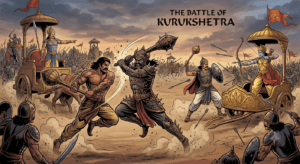
Arjuna, angered by this attack, pierced Ashwatthama with one hundred and sixty arrows, Karna with ten, and Vrishasena with three. He struck Shalya with a keen shaft, and Shalya retaliated with ten arrows. Karna then pierced him with thirty-two shafts; Bhurishravas with three; Vrishasena with five; Kripa with ten; Ashwatthama with sixty; and Jayadratha, sheltered behind those heroes, struck both Krishna and Arjuna with seventy-three arrows.
Receiving this fierce shower, Arjuna smiled with terrible composure. He checked Karna and Vrishasena with twelve arrows, broke Shalya’s bow, wounded Bhurishravas—the son of Somadatta—with nine shafts, struck Ashwatthama with eight, and pierced Kripa with twenty-five. Though engaged on every side, Arjuna never lost sight of his objective. Even while combating Ashwatthama and the assembled warriors, he released a hundred arrows toward Jayadratha.
Bhurishravas then pierced Krishna and Arjuna with sharp shafts, and the other Kaurava heroes followed his example. But Arjuna, his spirit rekindled, twanged the Gandiva with irresistible force. Whirling his bow so swiftly that it seemed a revolving circle of light, he shattered the bows and arrows of his adversaries and struck each warrior with unfailing accuracy, like a tempest sweeping through a forest.
The Kauravas, encouraging one another, regrouped and again closed around Arjuna. Yet he met their assault with supreme precision, drawing streams of blood from every quarter and reducing their proud resistance to helpless disorder.
Dhritarashtra, eager to know the details of that astonishing encounter, asked Sanjaya to describe the standards that adorned the chariots of those heroes. Sanjaya said, “Arjuna’s banner bore the radiant monkey, Hanuman. Ashwatthama’s standard displayed a lion’s tail. Kripa’s carried a bull. Karna’s showed an elephant adorned with a golden chain. Vrishasena’s bore a splendid peacock. Shalya’s was marked with a plough. Prince Saila’s displayed a golden elephant. Bhurishravas’ banner bore a jewelled sacrificial altar. Jayadratha’s carried a silver boar. Duryodhana’s standard was emblazoned with a terrible serpent.”
“When these banners fluttered in the sky, they shone with extraordinary brilliance. Yet among them all, O King, Arjuna’s monkey-banner outshone every other, blazing with incomparable splendour and seeming to dominate the very heavens.”
Dhritarashtra then asked, “While Arjuna was thus engaged in this marvellous and fearsome combat, what befell the forces of Yudhishthira, who were opposed by Drona?” Sanjaya replied, “At that same time, a terrible battle raged between the armies of Drona and Yudhishthira, filling even the celestials who watched from the sky with dread.”
In that vast conflict, Brihatkshatra fought Kshemadhurti; Dhrishtaketu contended with Veeradhanvan; Nakula engaged Karna; Sahadeva fought Durmukha; and Satyaki encountered Vyaghradatta, each displaying equal valour and determination.
Shalya, moving across the field with his forces, attacked the sons of Draupadi. Alambusha assailed Bhima. Drona and Yudhishthira met in direct combat, and Yudhishthira pierced his revered preceptor with ninety arrows. Drona responded with terrible celestial weapons, and the struggle between teacher and disciple rose to a pitch of ruthless intensity.
Thus did Sanjaya, in faithful obedience to the inquiries of Dhritarashtra, recount the dreadful and wondrous events that unfolded on that memorable day of the great war.

