


The aged King Dhritarashtra, consumed by grief and speaking to his beloved son Duryodhana, recalled the confidence that had once filled the Kaurava court whenever the prospect of war was discussed. “Time and again,” he said, “you assured me that while Bhishma, Drona, Kripa, Ashwatthama, Karna, and countless mighty kings stood beside you, there existed no force capable of challenging our power. You would proudly declare that neither Yudhishthira, Bhima, Arjuna, Nakula, nor Sahadeva, whether individually or united, could withstand your strength upon the battlefield. Karna, with the pride of his mighty shoulders and unrivalled mastery of arms, repeatedly proclaimed that he alone could subdue all the Pandavas within a short span. You reminded me that Bahlika, Somadatta, Shalya, Jayadratha, Vinda, Anuvinda, and innumerable heroic warriors mounted on splendid chariots formed an invincible fortress around our kingdom. Trusting in the combined prowess of Bhishma, Drona, Karna, Ashwatthama, yourself, and your brothers, I believed that the sons of Pandu would surely perish.”
Dhritarashtra’s voice trembled as he reflected upon the cruel irony of fate. “Instead of witnessing the fall of the Pandavas, it is our own heroes who have fallen. Bhishma, the lion among men, whose courage surpassed that of ordinary mortals, lay upon the bed of arrows after Shikhandi stood before him while Arjuna released his deadly shafts. Such was the inscrutable design of destiny that even the unconquerable grandsire met an end unimaginable to the world. Indeed, nothing is impossible where fate decrees its will.”
He continued with profound sorrow. “Drona, the preceptor of princes, whose wisdom and martial excellence surpassed all warriors of his age, was brought down through circumstances that no one could have foreseen. Jayadratha, whom many believed impossible to defeat, met his death despite every protection. Bahlika and Somadatta, whose valour had long inspired fear among enemies, were struck down with astonishing ease. What can mortal wisdom say before the mystery of destiny? Bhurishrava, endowed with the strength of a mighty elephant and trusted by you above many others, also fell upon the battlefield. Bhagadatta, whose prowess had terrified kings throughout the earth, likewise met an unexpected end. Karna, upon whom you placed your greatest confidence, could not accomplish the destruction of the foremost Pandava warriors as he had vowed. Even the irresistible strength of Shalya proved powerless before the decree of Providence. Those noble heroes, worthy of honour and reverence, were slain as though they had been ordinary men, revealing that when destiny moves, neither strength nor fame can alter its course.”
The blind monarch sighed deeply as the burden of his loss overwhelmed him. “My son, you often declared that with the support of your brothers you would conquer every enemy who stood against you. Yet not one of them has been spared. The hand of Time has carried them all away. Tell me now, where shall I seek refuge? What thoughts passed through your proud mind when mighty Bhima shattered your thighs before the assembled kings? That dreadful moment revealed the fruit of arrogance. Prosperity and honour dwell only with those favoured by righteous deeds, while those who abandon virtue ultimately lose both glory and protection. Our sons have perished, and with them the hopes of our dynasty. It is fitting that I abandon the palace and spend the remainder of my life in the solitude of the forest.”
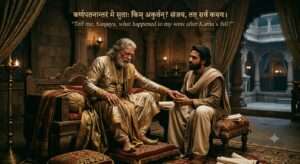
His grief deepened into painful resignation. “If I remain within this kingdom, Bhima’s bitter words will burn my heart every day. O Sanjaya, I know he will continually remind me of Duryodhana and Dushasana, wounding me with reproach more painful than death itself. Better that I depart to the forest, carrying my sorrow in silence than endure the daily torment of remembrance.” Having uttered these words, Dhritarashtra drew a long sigh, his face pale with anguish, and sat in mournful silence before Sanjaya.
After some time, the king spoke again. “When Bhishma, Drona, and Karna had fallen, upon whose courage did our remaining warriors rely? It is now evident that the conduct of my son Duryodhana was the root of this universal destruction. His pride, stubbornness, and refusal to accept righteous counsel brought ruin not only upon our family but upon the rulers of the earth. Long ago the wise Vidura warned me with words born of truth and foresight. Yet those blinded by arrogance ignored his counsel, and I, clouded by attachment to my son, allowed my own judgment to follow theirs. I dismissed Vidura’s wisdom, and today I bear the bitter harvest of that fatal error.”
The aged king then sought to know the final events of the war. “Tell me, Sanjaya, who was appointed commander after Karna’s fall? How did Shalya, so mighty and capable of crushing entire armies, meet his end? Who possessed the strength to overcome him? How did Kripa, Kritavarma, and Ashwatthama survive when so many invincible warriors perished? Tell me also how the heroes of Panchala, Chedi, Matsya, and the valiant Prabhadrakas embraced death. Explain how the sons of Draupadi, headed by Prativindhya, and the countless warriors of the Pandava host met their fate. By what fortune did the five Pandavas, Sri Krishna, Satyaki, and Yuyutsu escape destruction? Relate every event in its proper order, withholding nothing.”
Sanjaya respectfully bowed and began his narration. “O King, sustained by their unwavering righteousness, extraordinary valour, and the divine protection of Sri Krishna, the Pandavas endured every terrible assault. After the deaths of Bhishma, Drona, Karna, and the foremost kings who had upheld the Kaurava cause, your son Duryodhana found himself defeated and abandoned with only a small remnant of his once-glorious army. Broken in spirit and overwhelmed with immeasurable grief, he returned from the battlefield. Yet, unable to bear the sight of his own camp, he did not enter his royal pavilion. Instead, he sat beneath the open sky among the few friends and relatives who still remained beside him, silently contemplating the collapse of all his ambitions.”
Seeing the shattered condition of the Kaurava king, the compassionate Kripacharya addressed him with affection and wisdom. “O Duryodhana,” he said, “battle has always been the final refuge of Kshatriyas, and by following this sacred path many ancient kings attained everlasting fame and ascended to the higher worlds. Yet sometimes wisdom demands reflection rather than blind persistence. I shall offer counsel which may appear contrary to the customary code of warriors, but listen carefully. If you find it beneficial, embrace it; if not, discard it without resentment.”
Kripa continued, “Bhishma, Drona, and Karna were unsurpassed in heroism and unmatched in the science of warfare. Around them stood many illustrious kings and devoted allies, all accomplished in martial skill. Yet the Pandavas’ own arms and the favour of destiny have overcome these mighty men. During seventeen relentless days of battle, our greatest heroes have fallen one after another. Our strength has diminished, our confidence has vanished, and the survivors are exhausted and wounded. Meanwhile, behold the sons of Pandu. Though they have endured the fiercest combat, they stand protected by Sri Krishna, radiant with unconquerable spirit. Their wounds have not diminished their resolve, and their celestial horses still shine with undiminished vigour.”
Pointing toward the distant battlefield, Kripa concluded with solemn conviction. “Arjuna, guided by Krishna and borne upon his chariot drawn by white steeds, moves through the Kaurava army like the majestic Airavata entering a tranquil lake. Just as the mighty elephant churns the waters wherever it walks, so does Arjuna scatter and overwhelm every division that stands before him. His brilliance cannot be restrained, and his advance is as irresistible as the decree of Time itself.”
Thus Sanjaya continued his narration, revealing how the wisdom once spoken by Vidura had proved true in every respect, while pride, blindness, and the rejection of righteous counsel had brought about the inevitable destruction of the Kuru dynasty. The tale stands for all generations as a solemn testimony that strength without humility, power without wisdom, and ambition without righteousness inevitably lead even the mightiest kingdoms to ruin.

