Special Correspondent
The objective of this e-paper has always been crystal clear. We have provided, and will continue to provide, a platform for every genuine stakeholder in the Hyderabad Cricket Association (HCA) to air grievances, expose irregularities, and demand accountability—provided there is at least some evidence to support the allegations. This opportunity, none of the other regular publications can ill afford to, and as professional colleagues, we have no intentions to cast aspersions on them, as every publication has its own agenda.
What we have little patience for are those who grumble in private, sulk in WhatsApp groups, whisper in corners and then claim to be crusaders of reform. Silence is not courage. Sulking is not activism. Complaining behind closed doors while refusing to act is nothing more than institutional cowardice.
This e-paper reiterates that it will continue its campaign relentlessly and unapologetically until genuine cleansing takes place within HCA. That means eliminating rogue clubs, exposing conflict-of-interest clubs, investigating allegations that some individuals purchased institutional clubs only to rename and control them, dismantling the “pay-to-play” culture allegedly flourishing through private cricket academies and compromised selection processes, and ensuring that those who enriched themselves while impoverishing Hyderabad cricket are held accountable.
Some insiders even allege that fortunes were built, properties accumulated and wealth transferred to relatives while cricket in Hyderabad steadily declined. If these allegations have substance, there is only one competent agency capable of tracing the money trail. It is not rocket science. Investigators merely need to compare the financial status of certain office-bearers before entering HCA administration and after leaving it. The numbers, if scrutinised honestly, may tell a fascinating story.
Interestingly, the fraternity of affiliated club secretaries itself appears deeply divided.
A section of them now questions what court-appointed administrators and former judges have achieved. Others privately agree but refuse to speak publicly. Why? Because meaningful reform may threaten their “livelihood.”
Yes, livelihood.
That word may sound harsh, but consider the reality. Every affiliated club receives substantial annual grants. Several insiders allege that many clubs lease out their cricketing activities for lakhs of rupees each season while simultaneously drawing grants from HCA, funded through BCCI distributions. If an impartial inquiry is conducted, how many clubs would survive as genuine cricket institutions and how many would be exposed as revenue-generating entities masquerading as cricket clubs?

That is the question nobody wants answered.
The silence of various state agencies over the years has also raised eyebrows. Why has there been such reluctance to investigate? Is it administrative inertia? Political convenience? Or because influential people have their own stakes in preserving the existing ecosystem?
After all, everyone in Hyderabad cricket knows the whispers. A few more lakhs here, a few more favours there, and suddenly a deserving youngster is watching from the sidelines while somebody else’s candidate wears state colours.
Now, let us address the criticism against the judiciary.
Some club secretaries argue that court-appointed administrators have failed to clean up the mess. Is there some merit in that criticism? Perhaps partly.
After all, HCA is no ordinary institution. It is a labyrinth of vested interests, power brokers and entrenched networks. Understanding its complexities would challenge even the most diligent administrator.
Yet before pointing fingers at retired judges, a more fundamental question must be asked.
What exactly did the former presidents, secretaries and power centres achieve when they themselves controlled HCA?
Did they create world-class infrastructure?
Did they establish a transparent selection system?
Did they produce international cricketers through visionary planning?
Or did Hyderabad continue producing stars despite the system rather than because of it?
Take the cases of VVS Laxman, Mohammed Siraj and Tilak Varma. Their journeys are stories of individual grit, family sacrifice and relentless hard work. Can any former HCA regime honestly claim ownership of their success?
In fact, some of these self-made stars were barely acknowledged by the very administrators now claiming to be guardians of Hyderabad cricket.
The uncomfortable truth is that many of those attacking court-appointed officials today belong to a category that benefited enormously from the old system. Some allegedly lost voting rights under conflict-of-interest provisions. Others saw their influence diminish. A few reportedly found their recommendations politely ignored.
What followed?
Predictably, frustration disguised itself as reformist outrage.
The irony is breathtaking.
Those who presided over decades of decline now demand explanations from those attempting to untangle the mess they left behind.
Nevertheless, if these critics genuinely believe both HCA and the judiciary have failed, there is a straightforward solution.
Why don’t 100 or 150 affiliated clubs sign a joint representation and demand that the Telangana government constitute a Special Investigation Team, as envisaged by court directions? Why not approach the Director General of Police and seek a comprehensive investigation into club ownership patterns, financial transactions and governance failures?
The answer is simple.
Because many know what such an investigation may uncover.
That is why outrage remains confined to WhatsApp groups instead of signed petitions.
Therefore, this e-paper has one final appeal.
Those controlling multiple clubs through relatives, associates or alleged benami arrangements should voluntarily come clean before investigative agencies eventually do it for them. If club ownership has become a political bargaining chip or an electoral weapon, the game cannot continue forever.
The individuals who helped reduce one of India’s proud cricketing centres into a battleground of litigation, factionalism, and self-interest cannot now portray themselves as victims.
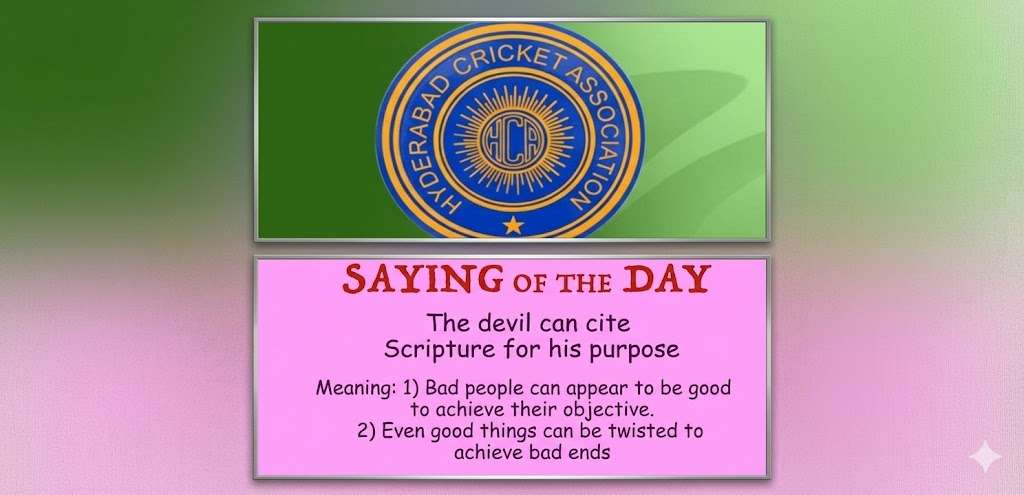
Like devils quoting scriptures, they seek to blame everyone else for a crisis they helped create.
The real question is no longer whether HCA needs reform.
The real question is whether those who benefited from the rot dare to face it.