


MS Sparsha
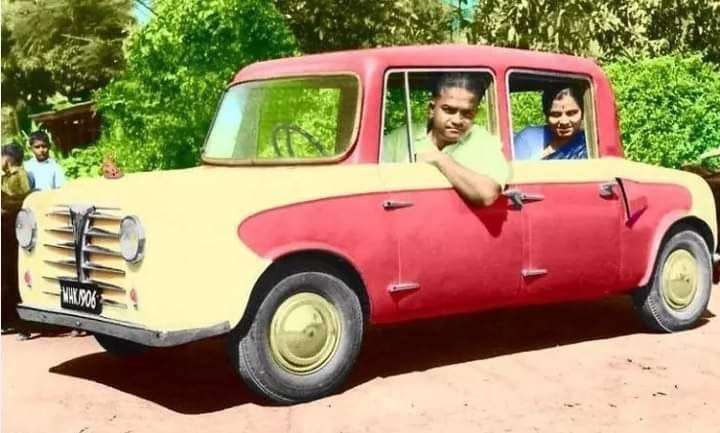
Decades before the world cheered for the Nano, a 7th-grade dropout from Kolhapur was already doing the impossible. In 1945, while the British Raj was packing its bags, Shankarrao Kulkarni was hand-beating a revolution out of scrap metal in a backyard workshop. He did not have a degree/a factory/a single foreign bolt, just a vision of a car that cost less than a high-end bicycle. It was called the Meera, & it was the ‘Nano’ that India was not ready for.
Shankarrao Kulkarni was a self-taught mechanical genius. He did not want to assemble foreign kits; he wanted to engineer an Indian solution for Indian roads. He wanted to build a car that cost only ₹12K (a fraction of what foreign cars cost at the time).
B//w 1945 & 1970, he built several iterations of the Meera. Each was an improvement on the last, focusing on fuel efficiency & simplicity. Kulkarni knew that Indian summers killed engines. He also knew that rural Indians did not want the hassle of maintaining complex cooling systems.
Kulkarni’s car had a unique feature: the engine was in the rear (like a Porsche/the later Nano) to allow for better cooling &re legroom in the front. He was a man who understood the Physics of the Common Man before the term even existed.
The 1949 model of the Meera featured an air-cooled engine. It had no radiator, no water pump, & no hoses. It was a 2 seater mini-car that could hit 40-50 km/h & gave a staggering 17-20 km/liter, efficiency that would be respectable even today.
But he failed & Kulkarni did not fail because of bad engineering; he failed because of Bureaucracy. He drove it to Bombay (exhibited at Gateway of India) to show it to govt & crossed tough terrain like Khandala Ghat w/o breakdown, impressive reliability. He wanted a license to mass-produce it (never granted).
The govt was obsessed with Protectionism & favored established players like the Birlas (Hindustan Motors). They told him his car was too small & not safe enough, despite the fact that Kulkarni had driven it 1000s of KMs across rough Indian terrain w/o a single breakdown.
Legend has it that Kulkarni offered the car’s design to the govt for free, just so they would produce it for the common man. They still said no. When Ratan Tata launched the Nano in 2008, he was essentially fulfilling Kulkarni’s 1945 dream.
Kulkarni’s Meera was built using all-Indian parts, even the rubber & the glass. He refused to import a single bolt. It stands as a silent witness to what could have been the People’s Car that predated the Maruti 800 by nearly 40 yrs.
The Meera did not die because of a faulty engine; it died because India’s imagination was still in shackles. Shankarrao Kulkarni proved that an Indian in a garage could out-think the engineers of Detroit/Oxford. Today, as we see Make in India on every billboard, we should remember the small, air-cooled car from Kolhapur that 1st dared to put India on wheels.


Had the Nehru government backed innovators like Shankarrao Kulkarni instead of burying them under red tape, India’s automobile industry could have been decades ahead.
Yet Nehru, who called himself ‘the last Englishman to rule India’, is hailed as the visionary who built the ‘temples of modern India’. The reality is that the licence-permit raj often stifled the very innovation that could have transformed India.
Kulkarni was not asking for handouts; he was offering an affordable, indigenous car for ordinary Indians.
Just imagine where India would have been today in affordable mobility, manufacturing and job creation had pioneers like Kulkarni been encouraged rather than obstructed. The Meera is a reminder not just of a missed invention, but of a missed opportunity.