For decades, India depended on foreign nations for its most advanced combat aircraft. From the MiGs of Russia to the Mirages and Rafales of France, the country’s air power was built largely on imported technology. That chapter is now beginning to change dramatically. The Union Government’s approval of the Advanced Medium Combat Aircraft (AMCA) programme marks a defining moment in India’s strategic and technological journey. It is not merely another fighter aircraft project. It is India’s declaration that it is ready to stand shoulder-to-shoulder with the world’s foremost aerospace powers. When the AMCA enters service, India will become only the fourth nation after the United States, Russia and China to independently design, develop and operate a fifth-generation stealth fighter aircraft. That achievement alone places India in an exclusive club that very few countries have managed to enter. The significance of AMCA extends far beyond national prestige. Modern warfare is increasingly dominated by stealth, artificial intelligence, network-centric operations and long-range precision strikes. Nations that fail to master these technologies risk strategic vulnerability. AMCA ensures that India remains not merely relevant but formidable in the battlespace of the future. Designed as a twin-engine stealth fighter, the AMCA incorporates advanced radar-absorbent materials, a highly optimized airframe and internal weapon bays that significantly reduce radar detection. In simple terms, the aircraft is designed to see without being seen. This ability to penetrate heavily defended enemy airspace and strike critical targets gives India a decisive operational advantage. Perhaps the most impressive feature is its expected long-range combat capability. Equipped with next-generation sensors, indigenous AESA radar and advanced beyond-visual-range missiles, the aircraft is expected to detect, track and engage hostile aircraft at distances exceeding 300 kilometres. In modern aerial warfare, the fighter that spots the enemy first usually wins. The AMCA is being designed with precisely that philosophy in mind. The aircraft’s supercruise capability—sustaining supersonic speeds without fuel-hungry afterburners—will further enhance its effectiveness. Combined with AI-assisted combat management systems and a futuristic panoramic cockpit, the AMCA represents a fusion of human skill and machine intelligence.
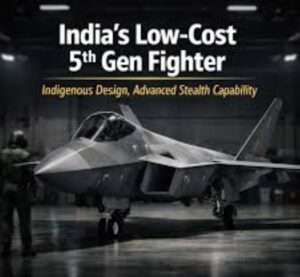
Naturally, comparisons with America’s F-35, China’s J-20 and Russia’s Su-57 have already begun. Such comparisons must be viewed cautiously because the AMCA is still under development. However, what is beyond dispute is that India is now competing in the same technological arena. The AMCA is being designed to match contemporary global standards in stealth, sensor fusion, survivability and combat effectiveness. If development proceeds as planned, India will field an aircraft capable of holding its own against the best in the world. Equally revolutionary is the manner in which the project is being executed. For the first time in a major military aviation programme, India’s private sector is being given a leading role alongside government agencies. Companies such as Tata Advanced Systems and Larsen & Toubro are expected to play critical roles in manufacturing, integration and systems development. This represents a significant shift from the traditional state-dominated model and could transform India’s defence-industrial ecosystem for decades to come. The establishment of a massive integration and flight-testing complex at Puttaparthi in Andhra Pradesh further underscores the scale of India’s ambitions. The first prototypes are expected to be powered by GE-F414 engines, while future variants are likely to feature more powerful engines co-developed with France, enhancing both performance and indigenous capability. Critics may point out that the aircraft is still years away from induction. That is true. Aerospace excellence cannot be achieved overnight. The United States, Russia and China all spent decades and billions of dollars mastering fifth-generation technologies. What matters is that India has now committed itself to that path with confidence and clarity. The AMCA is more than a fighter jet. It is a symbol of India’s growing technological confidence, industrial capability and strategic maturity. It demonstrates that India no longer wishes to remain a buyer in the global defence marketplace. It intends to become a designer, developer and exporter of cutting-edge military technology. For a nation aspiring to become a major global power, that transformation is not just desirable—it is essential. The AMCA represents India’s aerospace coming of age, and with it, the emergence of a stronger, more self-reliant and militarily capable India.