



Bharat’s solar revolution is no longer a promise on paper; it is a national transformation unfolding at an unprecedented pace. The Modi government’s decision to reduce the timeline for solar installations to just six days is another welcome intervention, reinforcing the principle that clean energy expansion must be matched by administrative efficiency. While a dejected and politically rejected Congress-led Opposition continues peddling its manufactured narratives from overseas platforms, Bharat is busy building, generating and delivering. The contrast could not be starker: one side is obsessed with projecting a country in decline, while the other is steadily strengthening its economic and technological foundations. The Leader of the Opposition, Rahul Gandhi, may find overseas platforms convenient for questioning Bharat’s economic trajectory and running down its institutions, but rhetoric, political theatrics and self-serving international spectacles cannot erase measurable national achievements. Nor can inviting an assortment of detractors to events branded as national conversations substitute for a credible economic alternative. Bharat’s progress must be judged by outcomes, not by the political anxieties of those unwilling to acknowledge them. And solar energy offers one of the clearest examples. Bharat added 37 GW of solar capacity in 2025, surpassing the United States in annual additions and emerging as the world’s second-largest solar growth market. The momentum has gathered further strength. Solar capacity additions nearly doubled from 23.83 GW in FY 2024-25 to 44.61 GW in FY 2025-26. Another 24.29 GW was added in the first part of FY 2026-27, demonstrating that the expansion is continuing. This is not accidental growth. It is the outcome of sustained policy direction, competitive bidding, infrastructure investment and an ecosystem that has progressively encouraged both domestic and international participation. The foundations were laid through initiatives such as the National Solar Mission, launched in 2010, followed by the Solar Parks Scheme, Green Energy Corridor Programme and competitive procurement mechanisms. However, the Modi government deserves credit for taking these initiatives forward with greater scale, ambition and execution.
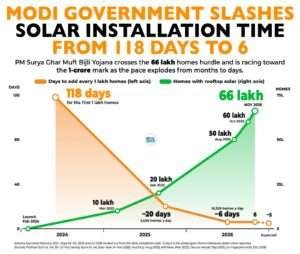
Today, Bharat’s solar footprint stretches across Rajasthan, Gujarat, Karnataka, Tamil Nadu, Andhra Pradesh and Maharashtra, with large solar projects accounting for approximately 133 GW of installed capacity, including the solar component of hybrid projects. Bhadla in Rajasthan, Pavagada in Karnataka, Ananthapuramu and Kurnool in Andhra Pradesh, and Rewa in Madhya Pradesh have become important landmarks in this transformation. Rooftop solar installations contribute another 34.97 GW, while off-grid systems are extending electricity access beyond conventional transmission networks. The manufacturing story is equally significant. Solar module manufacturing capacity, which stood at a meagre 2.3 GW in 2014, surged to approximately 172 GW by March 2026 and further to 192 GW by June 2026. That is a dramatic shift from dependence towards domestic manufacturing capability. India’s total non-fossil fuel capacity reached 308.03 GW by September 30, 2026, including 299.25 GW of renewable energy and 8.78 GW of nuclear power. FY 2025-26 also witnessed a record 55.29 GW addition in non-fossil fuel capacity. Even more tellingly, renewable energy sources met 51.5 per cent of India’s electricity demand on July 29, 2025, marking the highest monthly share recorded up to that point. These figures demonstrate that the energy transition is no longer confined to policy documents or international climate conferences. It is translating into infrastructure, manufacturing, investment and energy security. The larger significance of this revolution lies in reducing dependence on imported fossil fuels, creating employment, strengthening domestic industry and positioning Bharat as a serious player in the global clean-energy economy. Of course, challenges remain: storage infrastructure, grid stability, land acquisition, distribution company finances and the affordability of rooftop installations require sustained attention. Solar power cannot succeed in isolation; it must be supported by battery storage, transmission capacity and a robust distribution network. But these are challenges of expansion, not reasons to dismiss the achievement. The six-day installation timeline is therefore more than an administrative concession; it reflects the urgency of converting national ambition into household-level participation. Political opponents may continue their overseas criticism, but Bharat’s solar panels, manufacturing facilities and expanding renewable capacity tell a far more convincing story. A nation does not become a global power by repeatedly advertising its shortcomings to foreign audiences. It does so by building capabilities at home. Bharat’s solar revolution is tangible evidence of that resolve.

