



Sanjaya continued his narration to King Dhritarashtra, describing the swift, decisive events that unfolded on the Kurukshetra battlefield after the mighty Śalya fell. Enraged by his brother’s death, Śalya’s brother rushed against King Yudhishthira with blazing fury. Showering a relentless stream of arrows, he shone upon the battlefield with the same brilliance and determination that had marked Śalya himself.
Yudhishthira, renowned more for his calm wisdom than aggressive warfare, astonished friend and foe alike with his remarkable speed and precision. Meeting every arrow with an equal response, he first shattered his opponent’s mighty bow, then cut down his banner and standard. In an unexpected display of martial prowess, the son of Dharma seized a gleaming spear and hurled it with unerring aim. The weapon severed his adversary’s head, which fell to the earth adorned with glittering earrings that sparkled brilliantly in the dust of battle.
The Pandavas rejoiced at this magnificent feat, praising Yudhishthira as the gods had once glorified Indra after the destruction of the mighty demon Vṛtra. Kettle-drums thundered, tabors rolled, conches blared, and war-horns echoed across the field, filling the Pandava army with renewed confidence and irresistible enthusiasm.
Panic spread through the Kaurava ranks as many warriors fled for safety, pursued relentlessly by the invincible Satyaki. Seeing the rout, Kritavarma intercepted him, and a fierce duel immediately followed. Kritavarma pierced Satyaki with ten sharp arrows, wounded his horses, and shattered his bow. Undismayed, the valiant Yadava instantly took up another bow and answered with a storm of deadly shafts. He slew Kritavarma’s charioteer, killed his horses, and grievously wounded the warrior himself. Kripacharya swiftly rescued the injured Kritavarma by placing him upon his own chariot and carrying him away from the battlefield. Witnessing Satyaki’s irresistible onslaught, the Kaurava forces trembled with fear.
Yudhishthira then advanced against Kritavarma and destroyed his chariot’s horses. Ashwatthama hastened to the spot, lifted Kritavarma onto his own chariot, and bore him safely away. Soon afterward, Kripacharya struck Yudhishthira with a powerful arrow. The son of Dharma instantly retaliated, driving six keen shafts deep into Kripa’s ribs. Enraged by the counterattack, Kripacharya turned his arrows upon Yudhishthira’s horses, seeking to halt his advance.
Sanjaya then addressed the blind monarch once more. “O King, your son Duryodhana mounted his magnificent royal elephant, shaded by a resplendent white umbrella and attended by waving yak-tail fans. Around Yudhishthira gathered the surviving kinsmen of Śalya. Raising his voice, Duryodhana cried, ‘Do not rush recklessly into the foremost ranks. Stand firmly beside me and strengthen our defence.'”
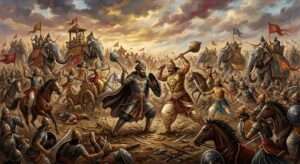
His words, however, carried little weight. Their confidence had already begun to fade, and desperation, rather than hope, drove them into battle. They hurled every variety of weapon against the Pandava heroes. Yet Arjuna, Bhima, Nakula, Sahadeva, Satyaki, Shikhandi, Dhrishtadyumna, and the sons of Draupadi swept through the fourfold Kaurava army with astonishing speed, leaving devastation in their wake.
Meanwhile, the warriors of Madra, the loyal friends and relatives of Śalya, fought with indomitable courage. They surged through the battlefield like powerful crocodiles moving through the turbulent ocean, striking down all who crossed their path. Their fearless resistance drew the attention of Shakuni, who turned to Duryodhana and said, “The companions and kinsmen of Śalya are being hunted down by the Pandavas and slaughtered like helpless beasts. We cannot ignore either their courage or their sacrifice.”
Duryodhana replied with sorrow, “The followers of Śalya have disregarded my command. What more can we do? You alone possess the wisdom to advise the surest means of protecting me, my family, and this army.”
Delighted by the confidence placed in him, Shakuni answered, “O King, when an army advances into the enemy’s ranks, nothing is more important than the safety of its leader. Unless the commander is protected, victory earns no honour.” Duryodhana accepted the counsel and declared, “I shall personally protect them.”
With conches sounding loudly, the Kaurava forces surged forward once more. Yet before Duryodhana could even reach the foremost battle line, Arjuna, Bhima, and the other Pandava warriors overwhelmed the remaining followers of Śalya, sending them as unwilling guests to the abode of Yama, the Lord of Death.
As Yudhishthira and the Pandava army pressed onward with growing confidence and joy, the spirits of Duryodhana’s forces collapsed. They gradually fell back in confusion, retreating in every direction. The illusion of certain victory that had sustained Duryodhana finally dissolved, and disorder spread throughout his army.
Sanjaya concluded with deep sorrow: “At that dreadful moment, our warriors were once again overwhelmed by grief. The memories of the fall of Bhishma, Drona, Karna, and now Śalya crushed their remaining courage. Bereft of hope and shaken in spirit, they lost all resolve, and the Kaurava army stood on the brink of complete ruin.”

