

Bharat was fortunate to get a decisive leadership change in 2014. Otherwise, the accumulated rot in several public institutions, including the banking sector, could have continued unchecked. For nearly six and a half decades, Congress governments treated public-sector banks and financial institutions less as independent institutions serving depositors and borrowers and more as extensions of political power. Bank nationalisation under Indira Gandhi in 1969 had a legitimate social objective. It sought to take banking beyond urban centres, expand institutional credit and protect ordinary citizens, particularly farmers, from exploitative moneylenders. It also helped lay the foundation for agricultural credit and food security. But a noble objective cannot justify political interference in commercial lending.
The trouble was not nationalisation itself, but the political culture that followed it. Banks increasingly faced pressure to accommodate favoured borrowers, meet politically driven lending targets and sometimes overlook elementary credit discipline. The result was a system in which an ordinary farmer or small trader had to establish creditworthiness, while influential borrowers could allegedly find easier passage through corridors of political power.
The warning signs were visible early. The 1957 LIC-Mundhra scandal, involving investments of public insurance funds in companies controlled by Haridas Mundhra, exposed serious lapses in institutional safeguards. The Chagla Commission inquiry brought the controversy into the open and led to the resignation of Finance Minister T.T. Krishnamachari. It was an early reminder that public financial institutions could not be treated as convenient instruments for rescuing influential business interests.
The political use of banking became even more visible in the 1980s. B. Janardhana Poojary, then a Congress Minister of State for Finance, popularised the much-publicised loan melas. Extending institutional credit to the poor was a worthwhile objective. However, contemporary reports raised serious questions about political recommendations, relaxed documentation, inadequate assessment of project viability and the possibility of loans being distributed for electoral advantage. Credit without proper appraisal is not empowerment; it can become a burden for borrowers and banks alike.
The bigger crisis, however, accumulated over the years. The corporate credit boom of 2006–08 saw banks extend enormous loans to infrastructure, power, steel and other businesses. Optimistic projections, weak appraisal, delayed projects and promoter defaults eventually translated into mounting bad loans. Restructuring and evergreening often concealed the true extent of stress. A loan that should have been recognised as a non-performing asset could remain disguised through repeated restructuring.
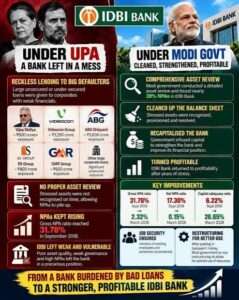
The RBI’s Asset Quality Review in 2015 under the Modi government forced banks to recognise the accumulated stress rather than continue hiding it under accounting adjustments. The exercise was painful, but necessary. The magnitude of the problem became unmistakable, and public-sector banks had to confront the consequences of years of weak lending discipline.
IDBI Bank became a particularly stark example. It was placed under the RBI’s Prompt Corrective Action framework in May 2017 because of its deteriorating financial position. Its exposure to stressed corporate borrowers, including companies such as Videocon, Winsome, ABG Shipyard and Kingfisher, illustrated the dangers of concentrated and poorly assessed lending. LIC subsequently acquired a controlling 51 per cent stake in 2019, providing capital and supporting the bank’s recovery. The RBI lifted the PCA restrictions in March 2021.
Today, the proposed strategic sale marks another milestone. The Union Cabinet approved Fairfax Financial Holdings as the buyer for a 60.72 per cent stake in IDBI Bank for ₹52,878 crore in October 2026. A bank that once required extraordinary support has regained sufficient financial strength to attract a major strategic investor. That is a significant institutional turnaround, although the transaction must still complete the regulatory process.
The wider public-sector banking story is equally striking. Gross NPAs declined from 7.3 per cent in March 2022 to 1.93 per cent in March 2026. Aggregate net profits rose from ₹67,000 crore in FY22 to a record ₹1.98 lakh crore in FY26. These are not cosmetic improvements. They reflect stronger balance sheets, better recoveries, improved provisioning and renewed lending capacity.
The Insolvency and Bankruptcy Code, introduced in 2016, also changed the equation. Defaulting promoters could no longer assume that endless restructuring would protect their control over businesses. The possibility of losing the enterprise itself strengthened the bargaining position of lenders.
Indian banking once appeared to operate through two queues: one at the counter for the farmer, small trader and kirana owner; another through political connections for the well-connected. The challenge since 2014 has been to dismantle that second queue and restore accountability.
Those who presided over the accumulation of bad loans cannot simply disown the legacy and lecture others on banking reforms. Equally, the present government must ensure that political interference never returns under a different name. Public-sector banks belong to their depositors and the nation, not to the party occupying power.
The real measure of reform is not merely selling a bank or announcing record profits. It is ensuring that every rupee entrusted by the public is lent responsibly, recovered fairly and used to build Bharat’s economy. That is the banking culture a Viksit Bharat deserves.