



Sree Vandanmedu Mahaganapathy Temple is an ancient and sacred shrine dedicated to Lord Mahaganapathy, situated amidst the beautiful hills and cardamom plantations of Vandanmedu in Kerala’s Idukki district. The temple is particularly famous for its unusual Sthalapurana involving tribal hunters, a serpent protecting the deity, and a mysterious gathering of wild elephants. It is one of the important Ganapati temples of the region, attracting devotees seeking the blessings of Lord Ganesha for prosperity and the removal of obstacles.
The temple is traditionally believed to be more than 1,000 years old, although its exact antiquity has not been established through historical records.The present temple developed during the twentieth century. The idol reportedly came to wider public attention in 1960, and the formal consecration was performed on 2 February 1966 by Brahmasree Rudran Namboothiri of Neelamana Illam, Perumbavoor.
The presiding deity is Lord Mahaganapathy, worshipped as the remover of obstacles and the bestower of wisdom, success and prosperity. The main idol is carved from stone and depicts Lord Ganapati in a seated posture with two arms. His right hand is folded, while his left hand holds a Modakam, towards which his trunk is gracefully extended.
The temple also houses shrines dedicated to Lord Ayyappa (Sastha), Goddess Vana Durga, Nagaraja, Nagayakshi, and other guardian deities.
The temple follows traditional Kerala temple architecture, with a beautifully constructed Sreekovil (sanctum sanctorum) housing the principal deity.
The complex includes a Mukhamandapam, Namaskara Mandapam, Chuttambalam, Nadapandal, large Balikkal, Dhwajasthambam, Gopuram and separate shrines for the subsidiary deities.
An interesting architectural feature is the arrangement of the Mukhamandapam, large Balikkal and flagstaff within the same Nadapandal, a comparatively unusual arrangement in Kerala temples.The Chuttambalam was constructed in 2000, with entrances on all four sides.
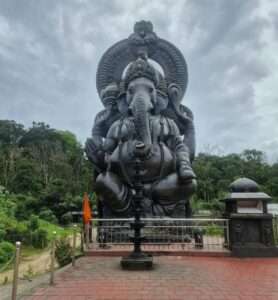
The temple is also known for its 38-foot-high Ganapati sculpture, which adds to its distinctive appearance.
In ancient times, Vandanmedu was covered by dense forests inhabited by tribal communities. The region was known for its wildlife, particularly elephants and serpents.
According to accounts of the temple’s modern development, a forest department employee noticed the Ganapati idol in 1960 and erected a small shelter over it. He began lighting a lamp before the deity, and regular worship gradually developed.
A modest shrine was subsequently established, followed by the formal consecration in 1966.Over the years, the temple underwent several improvements and developed into an important religious centre for the surrounding villages.
According to the traditional Sthalapurana, many centuries ago, when Vandanmedu was surrounded by thick forests, two tribal hunters were passing through the region in search of animals.
During their journey, they noticed something extraordinary.
On a small rock in the middle of the forest stood an idol of Lord Ganapati, protected by a serpent with its hood raised over the deity.
The hunters were astonished by this unusual sight. They continued their journey, but when they returned along the same route, they found the serpent still guarding the idol.
Realising that something divine was associated with the place, they reported the incident to their tribal chief, known as the Ooru Mooppan.
The chief instructed the hunters to bring the idol to his residence.
Following his orders, the hunters returned to the forest and, after considerable difficulty, drove away the guarding serpents. They carefully lifted the Ganapati idol from the rock and carried it to the chief’s house.
However, shortly after the idol was brought there, an extraordinary incident occurred.
A large herd of wild elephants and numerous serpents suddenly surrounded the residence of the tribal chief.
The elephants gathered around the house, while serpents appeared in the surrounding area. The chief and his wife became terrified, unable to understand the reason for this unexpected gathering of wild creatures.
The chief soon realised that the disturbance might be connected with the removal of the sacred Ganapati idol from its original location.
He immediately instructed the hunters to return the idol to the exact place where it had been discovered.
The hunters carried the idol back into the forest and respectfully placed it upon the same rock.
The moment the idol was restored to its original position, the elephants and serpents mysteriously disappeared.
The tribal chief and his people understood this incident as a divine indication that Lord Ganapati wished to remain at that particular spot.
From that day onwards, the place became sacred to the local tribal community. Devotees began lighting lamps and offering prayers before the deity.
The tradition remained closely associated with the descendants of the tribal chief. It is recorded that, until the early 1990s, an elderly descendant of the Mooppan continued visiting the shrine on Thrikkarthika day, lighting a lamp and making offerings.
Thus, according to local belief, the temple originated at the very spot chosen by Lord Mahaganapathy himself, with the serpent and elephants serving as divine guardians of his presence.
The principal annual celebration is the Thiru Utsavam, observed during the Malayalam month of Kumbham (February–March).
The festival begins with Kodiyettu (flag hoisting) on Kumbha Bharani day. Important ceremonies include Pallivetta and the sacred Arattu, accompanied by traditional temple music, processions, and devotional offerings.
Ganapathi Homam is one of the principal rituals performed at the temple. Devotees offer prayers seeking relief from obstacles, success in their undertakings, family welfare, and prosperity.
A distinctive local offering is cardamom, reflecting the temple’s close association with Vandanmedu, one of Kerala’s important cardamom-growing regions.
Ganesh Chaturthi, Thrikkarthika and the temple’s consecration anniversary are also occasions for special worship and prayers.


