



The Kena Upanishad stands as one of the most profound expressions of the intellectual courage, spiritual inquiry, and philosophical depth of ancient Bharata Varsha. Its brilliance lies not merely in the answers it offers, but in the extraordinary questions with which it challenges the human intellect. What impels the mind to think? Who directs the life force that sustains the body? By whose command do the eyes see, the ears hear, and the tongue articulate words? What power enables the mind to comprehend, yet remains beyond the mind’s capacity to comprehend it? These are not ordinary questions arising from casual curiosity; they penetrate the very foundations of existence and invite humanity to investigate the relationship between consciousness, perception, knowledge, and the ultimate reality.
The opening mantra of the Kena Upanishad establishes the spirit of this inquiry with remarkable precision:
“केनेषितं पतति प्रेषितं मनः। केन प्राणः प्रथमः प्रैति युक्तः। केनेषितां वाचमिमां वदन्ति। चक्षुः श्रोत्रं क उ देवो युनक्ति॥”
The meaning is profound: impelled by whom does the mind direct itself towards its objects? By whose command does the life force function? Who enables human beings to speak, and what power governs the eyes and ears? These questions demonstrate that the ancient sages did not regard the visible functioning of the human body as the final explanation of life. They sought to understand the deeper principles underlying these functions. Their inquiry moved from the observable to the unobservable, from the instruments of perception to the conditions that make perception possible, and from the acquisition of knowledge to an examination of the very nature of the knower.
The genuine spirit of questioning opened the gates of exploration for the sages of ancient India and continues to serve as a guiding principle for intellectual progress. Every significant invention, discovery, and scientific application begins with an observation, a doubt, or a question that challenges an accepted explanation. When an individual asks why an event occurs, how a phenomenon operates, or whether an established belief withstands examination, the process of discovery begins. In this respect, the inquisitive spirit of the Upanishads possesses an enduring relevance to scientific temperament. It encourages humanity not to remain satisfied with appearances, but to investigate the principles beneath them. The great fortune of Bharata Varsha lies in having nurtured philosophical traditions that encouraged such profound questions and preserved them for successive generations to explore, interpret, debate, and examine through different intellectual disciplines.
Questioning, however, is easier than discovering a truthful answer. A child may ask a father why he was born, or ask a mother where his father is, without understanding the intricate circumstances, relationships, and responsibilities underlying either question. The simplicity of the question does not guarantee the simplicity of its answer. Human existence itself is surrounded by uncertainties that cannot always be resolved through immediate explanations. Why does suffering occur? Why do people differ in their understanding of justice? What constitutes happiness? How does consciousness emerge, and what are the limits of human knowledge? Each answer may illuminate one dimension of reality while revealing further questions. Thus, life is not merely a collection of answers; it is an expanding landscape of inquiry in which every genuine discovery opens new avenues of investigation.
The recognition of this limitation is not a weakness of the human intellect. It is one of its greatest strengths. An individual who believes that every question has already been answered closes the doors to discovery, whereas one who acknowledges the boundaries of present knowledge remains receptive to new evidence and fresh interpretations. Scientific progress depends upon precisely this intellectual humility. Theories are proposed, tested against observation, refined when evidence demands it, and sometimes replaced by more comprehensive explanations. The Vedic spirit of inquiry, when understood in this broader philosophical sense, encourages a similar willingness to examine the foundations of one’s understanding. It does not require the abandonment of reason; rather, it invites reason to become more disciplined, reflective, and conscious of its own limitations.
The sages understood that the deepest questions concerning existence could not be exhausted by superficial explanations. They therefore cultivated an atmosphere in which inquiry could continue across generations. Their purpose was not simply personal distinction or intellectual conquest, but the enlargement of human understanding. Knowledge becomes truly valuable when it contributes to wisdom, ethical conduct, and the welfare of society. A sage who discovers an insight and shares it with others transforms private contemplation into a public inheritance. Such individuals become guiding lights because their influence survives beyond their physical existence. Their bodies may perish, but the questions they raised, the principles they articulated, and the intellectual traditions they established continue to illuminate the minds of those who follow.
The light of such wisdom is fundamentally different from the temporary brilliance of worldly success. Wealth, authority, popularity, and institutional power may disappear with changing circumstances, but an idea grounded in truth can continue to influence humanity for centuries. The enduring significance of the Upanishads rests in their capacity to stimulate fresh thought in every age. Their verses are not merely remnants of an ancient civilization; they are invitations to reconsider the nature of knowledge, the responsibilities of the knower, and the distinction between possessing information and attaining understanding. The intellectual heritage of India remains alive not because every ancient statement must be accepted without examination, but because its deepest questions continue to challenge human thought and encourage the pursuit of truth.
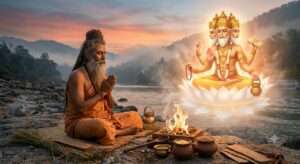
The Kena Upanishad directs attention towards the distinction between the instruments of knowledge and the fundamental principle that makes knowing possible. The eyes perceive forms, the ears receive sounds, and the mind interprets experiences. Yet the Upanishad asks us to look beyond these functions and investigate the ground of awareness itself. Its celebrated declaration expresses this idea in a series of paradoxes:
“यन्मनसा न मनुते येनाहुर्मनो मतम्। तदेव ब्रह्म त्वं विद्धि नेदं यदिदमुपासते॥”
That which the mind cannot grasp as an ordinary object, but through which the mind itself is able to think, is to be understood as Brahman. The verse challenges the assumption that the ultimate reality can be comprehended in exactly the same manner as an external object. Ordinarily, knowledge involves a knower, something known, and a process of knowing. The Upanishadic inquiry asks whether the fundamental ground of awareness can itself be reduced to an object within that process. If every object of thought is known through the mind, can the ultimate basis of knowing be completely contained within the mind’s own conceptual boundaries?
This question has a remarkable philosophical relationship with the modern investigation of consciousness. Neuroscience studies the functioning of the brain, the relationship between neural processes and perception, and the mechanisms through which sensory information is integrated. Psychology examines attention, memory, interpretation, and the formation of experience. Cognitive science investigates how systems process information and develop representations of the world. Yet the question of how subjective experience arises, and how first-person awareness relates to physical processes, remains a subject of extensive philosophical and scientific inquiry. The resemblance between these modern questions and the concerns of the Upanishads should be understood as an intellectual parallel rather than proof that ancient spiritual teachings and contemporary scientific theories are identical. Their methods and standards of evidence differ, but both can stimulate serious reflection on the limits of what is presently understood.
The distinction is essential because scientific temperament demands that philosophical insight not be confused with experimentally established fact. The Upanishads offer a contemplative and metaphysical approach to reality, while science depends upon observation, reproducibility, measurement, and the testing of hypotheses. Spiritual inquiry may illuminate questions of meaning, self-understanding, and ethical responsibility; scientific inquiry may explain mechanisms and establish relationships through evidence. When these approaches engage in a spirit of mutual respect without being forced into false equivalence, they can enrich human understanding. The ancient text inspires questions, while scientific discipline reminds us to distinguish what we observe, what we infer, what we believe, and what remains unknown.
The Kena Upanishad further challenges intellectual pride through its emphasis on the difficulty of claiming complete knowledge of Brahman. A person who confidently announces that the ultimate reality has been fully understood may have mistaken a limited conception for the totality of truth. Equally, to declare that nothing whatsoever can be known would be to surrender the very possibility of inquiry. The wisdom of the Upanishad lies in navigating the space between these extremes. One must neither boast of possessing the whole truth nor abandon the pursuit of it. The genuine seeker continues to learn while remaining aware that every conceptual achievement may represent only a partial understanding of a much deeper reality.
This spirit of humility is expressed in another celebrated mantra:
“न तत्र चक्षुर्गच्छति न वाग्गच्छति नो मनः। न विद्मो न विजानीमो यथैतदनुशिष्यात्॥”
There, the eye does not reach, nor speech, nor the mind. We do not fully know how to explain it or teach it through ordinary means. The significance of this declaration is not that the senses, language, and reason are useless, but that their capacities have limits. The eye can reveal colour and form, yet it cannot by itself explain the meaning of beauty. Language can communicate information, yet words alone cannot guarantee wisdom. The mind can construct elaborate theories, yet a theory’s sophistication does not automatically establish its truth. Human knowledge becomes mature when the powers of perception and reasoning are exercised fully, while their limitations are acknowledged honestly.
The Upanishadic conception of Brahman also invites reflection on the difference between the visible manifestations of reality and their underlying basis. We encounter the world through countless forms, names, relationships, and changing experiences. The philosophical search asks whether this diversity can be understood in relation to a deeper unity. Such a question has ethical significance as well. If a person develops the conviction that life possesses a depth that cannot be measured merely by wealth, status, or outward appearance, that conviction may encourage greater restraint, compassion, and respect for others. The spiritual value of knowledge is therefore not measured solely by the subtlety of an argument, but also by the transformation it produces in human conduct.
The true teacher is not merely a person who transfers information from one mind to another. A genuine teacher awakens the capacity to question, distinguishes evidence from assumption, encourages intellectual independence, and helps learners recognise the responsibilities that accompany knowledge. The same principle applies to the learner. A student who memorises statements without understanding them may acquire information, but a student who investigates their meaning, examines their implications, and applies them judiciously begins to develop wisdom. Teaching and learning thus become reciprocal processes. The teacher continues to learn through reflection and dialogue, while the learner gradually becomes capable of independent thought. In this mutual enrichment, education rises above the mechanical accumulation of facts and becomes a sustained search for understanding.
The light of knowledge also imposes a moral obligation. Intelligence without integrity can become an instrument of exploitation, and scientific advancement without ethical responsibility can produce consequences that damage society. The same analytical ability that develops a medicine can be misused for profit at the expense of public welfare; the same technological ingenuity that connects people can be employed to manipulate them. Consequently, knowledge must be accompanied by discernment, accountability, and compassion. The Vedic ideal of seeking truth becomes socially meaningful when it encourages individuals to act honestly, respect evidence, correct their errors, and use their abilities for the common good. The guiding light of a society is not simply the brilliance of its intellectuals, but the wisdom with which their discoveries and insights are applied.
The enduring contribution of the Kena Upanishad is therefore not confined to any single explanation of the universe. Its greater contribution lies in cultivating a disciplined awareness of the questions that stand behind human experience. It teaches us to look beyond the obvious without dismissing the observable, to pursue knowledge without arrogance, and to acknowledge uncertainty without surrendering to ignorance. It reminds us that the journey towards truth requires both courage and restraint: courage to question established assumptions, and restraint to avoid claiming more than the available understanding permits.
The life of inquiry continues because answers are never merely endpoints. Every well-established answer may become the foundation of another question, and every discovery may reveal a new field of exploration. This is the dynamic relationship between knowledge and ignorance: the more deeply we understand a subject, the more clearly we recognise the questions that remain. The scientific researcher, the philosopher, the spiritual seeker, and the thoughtful citizen may approach these questions through different methods, yet all can benefit from intellectual honesty and an openness to learning.
The guiding lights of society are those who preserve this spirit of inquiry and transmit it to future generations. They do not demand unquestioning obedience to their authority; they inspire others to think clearly, investigate carefully, and live responsibly. Their greatness lies not in claiming to possess every answer, but in helping humanity ask better questions and pursue more truthful explanations. Their wisdom survives through the minds they awaken, the institutions they strengthen, and the values they embody.
Ultimately, the brilliance of the Kena Upanishad rests in its understanding that the search for truth must remain both profound and humble. The human mind may travel far through observation, reasoning, experimentation, and contemplation, yet intellectual maturity requires the recognition that the known is only one part of the vast landscape of existence. Bharata Varsha’s philosophical heritage continues to offer the world a powerful invitation: to question without prejudice, to investigate without fear, to learn without arrogance, and to apply knowledge with compassion. As long as humanity continues to seek truthful answers while remaining receptive to deeper questions, the light of wisdom will not be extinguished. It will pass from one generation to another, illuminating the path of inquiry and reminding society that the highest purpose of knowledge is not merely to understand the world, but to make human life more thoughtful, just, and meaningful.

