



The Aitareya Brahmana, rooted in the profound philosophical traditions of the Vedas, invites humanity to undertake an extraordinary inquiry into the nature of the Self, the origin of consciousness and the fundamental intelligence that sustains the universe. This inquiry is not merely an exercise in religious contemplation; it is an exploration of existence through observation, introspection and reason. The central question is timeless: What is the Self, and who is the ultimate knower behind all our experiences? What is that inner principle through which we see, hear, smell, speak, taste, think, understand and experience the world? The search ultimately leads beyond the physical organs and their functions towards the mysterious and subtle foundation of consciousness.
The human body possesses eyes that perceive, ears that receive sound, a nose that recognises fragrance, a tongue that distinguishes taste and speech that communicates thought. Yet, the philosophical inquiry raises a deeper question: Are these organs themselves the ultimate experiencers, or are they merely instruments through which an underlying intelligence expresses itself? The eye may receive light, but the act of seeing involves an integrated process of perception and recognition. The ear may receive vibrations, but the experience of hearing requires the mind to interpret them. Similarly, the senses provide information, while the conscious principle enables the individual to experience and comprehend it. Thus, the Upanishadic inquiry moves from the external instruments of perception towards the inner witness, the Atman.
The heart and the mind occupy an important place in this philosophical understanding. The heart is traditionally regarded as the inward centre of life and consciousness, while the mind serves as the instrument of thought, reflection and decision. However, the Self cannot be confined to either a physical organ or an individual mental activity. It is the deeper principle by which all these functions become meaningful. Awareness, superiority of understanding, wisdom, intelligence, brilliance, vision, movement, restraint, comprehension, memory, determination, intention, vitality, desire, hope, knowledge, sensation and consciousness are described as different expressions or designations of Prajna, the principle of intelligence.
This enumeration is particularly significant because it presents intelligence as something much more comprehensive than the capacity to accumulate information or perform logical calculations. Intelligence includes perception, discrimination, memory, imagination, decision-making, purposeful action and the ability to understand relationships. It encompasses both the reception of experience and the interpretation of that experience. The capacity to distinguish right from wrong, to recognise consequences, to retain knowledge and to transform understanding into purposeful conduct reflects the deeper dimensions of human intelligence. In this sense, Prajna is not merely an isolated faculty of the brain; it represents the integrated principle of awareness through which existence becomes intelligible to the individual.
The Vedic expression identifying Prajna with Brahman carries an extraordinary philosophical significance. Brahman, in this understanding, is not simply another deity among the numerous divine manifestations described in the Vedic tradition. It is the ultimate reality, the fundamental principle underlying all existence. The association of intelligence with Brahman suggests that consciousness and the universal foundation of reality cannot be understood as entirely separate principles. The names of Indra, Prajapati, Agni, and other gods are brought into this philosophical framework to indicate the diverse manifestations through which the universal principle is contemplated and expressed. The multiplicity of divine forms is therefore approached through an underlying unity.
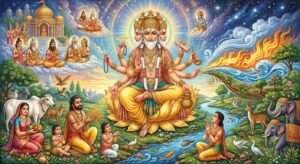
This understanding also provides a meaningful interpretation of the relationship between the individual and the cosmos. The same fundamental reality that sustains the individual being is contemplated as the foundation of the wider universe. The earth, atmosphere, heavens, water, fire and the other elements are not viewed as disconnected entities existing independently of the cosmic order. They form an interconnected structure of existence. The five great elements, traditionally identified as earth, water, fire, air and space, constitute the material framework through which life and physical experience become possible. The Vedic vision recognises that the individual is not an isolated creation but an integral participant in this vast cosmic arrangement.
The reference to the different categories of living beings further expands this vision. The traditional classification includes Andaja, those born from eggs; Jarayuja, those born from the womb; Svedaja, those associated with moisture and warmth in the ancient biological classification; and Udbhijja, those emerging from the earth or sprouting through germination. These categories reflect an early attempt to organise the diversity of life according to observable modes of generation and development. Birds, animals, human beings, trees, plants and creepers all belong to the magnificent diversity of the living world. Cows, horses, elephants and other creatures are not merely listed as separate forms of existence; they represent the extraordinary variety through which life expresses itself.
Viewed through a contemporary scientific temperament, this classification is particularly interesting as an example of humanity’s early effort to understand biological diversity through observation and conceptual organisation. Modern biology explains reproduction, embryonic development, cellular organisation, heredity and evolution through methods of systematic investigation and experimental evidence. The ancient classifications should not be mistaken for modern biological taxonomy, but they reveal an intellectual inclination to observe nature, identify patterns and establish meaningful categories. The underlying philosophical concern extends beyond the manner in which organisms originate: it asks what sustains life and makes the living world an interconnected reality.
The most profound dimension of this teaching emerges when intelligence is described as the universal foundation and the very essence of the cosmic order. The intelligent principle is present not only in human perception but also in the totality of existence. The universe is understood as having its establishment in this fundamental reality, while intelligence provides the means through which the universe is known and understood. The expression of Prajna as Brahman therefore brings together the knower, the process of knowing and the ultimate reality that makes knowledge possible. It is a philosophical movement from the apparent diversity of the external world towards the underlying unity of existence.
The reference to the intelligent eye may also be understood as a metaphor for the vision of wisdom. Ordinary sight recognises external forms, colours and movements, whereas intellectual vision seeks to understand the principles governing them. A person may observe the earth, water, fire, plants, animals and human beings as separate objects, but deeper understanding recognises their interdependence within a common natural order. The ability to perceive this unity without denying the diversity of existence represents a higher form of understanding. The universe becomes not merely something to be seen but something to be comprehended through awareness and discrimination.
There is an interesting point of convergence here with the scientific investigation of consciousness, although the two approaches employ different methods and address different questions. Contemporary neuroscience examines how the brain processes sensory information, integrates memory, generates attention and supports decision-making. Physics and cosmology investigate the fundamental structure, development and laws of the universe. Biology explores the mechanisms that sustain living organisms. These disciplines have produced remarkable knowledge, yet the fundamental philosophical question concerning the subjective experience of consciousness remains an active area of inquiry. The Vedic seers approached this mystery through disciplined introspection and philosophical reasoning, asking what remains constant behind the changing experiences of the individual. Their conclusions belong to a metaphysical framework and should not be treated as scientific findings in the modern experimental sense. Nevertheless, the spirit of inquiry, observation and the search for fundamental principles provides a valuable intellectual bridge between ancient philosophy and contemporary reflection.
The culmination of this teaching is expressed through the journey of the individual beyond the limitations of worldly existence. When a person realises the true nature of the Self through the illumination of Prajna, the conventional identification with the body, possessions, achievements and temporary experiences begins to lose its absolute significance. The individual is no longer understood merely through the limitations of physical identity but through an awareness of the deeper reality underlying existence. The departure from this world and the attainment of the heavenly realm, as described in the traditional spiritual vision, symbolise the fulfilment of a life guided by knowledge and realisation. All desires are fulfilled, all aspirations find their ultimate satisfaction, and the individual attains the state described as immortal and beyond decay.
Immortality in this philosophical context deserves careful consideration. It is not necessarily a promise of the physical body continuing indefinitely, but an expression of liberation from the limitations of transient existence. Everything in the material world is subject to change: the body ages, relationships evolve, possessions disappear and circumstances transform. The Atman, according to the Upanishadic understanding, is not subject to these changes in the same manner as material objects. Realising this distinction is regarded as liberation from ignorance and attachment. The fulfilment of desires is therefore not merely the acquisition of everything one wishes to possess; it is the transcendence of the restless dependence upon external fulfilment.
The Aitareya tradition thus presents a remarkable progression of thought: from the functioning of the senses to the nature of the mind, from the mind to intelligence, from individual intelligence to universal consciousness, and from the diversity of creation to the underlying unity of Brahman. It encourages humanity to look beyond appearances and examine the principles that make perception, knowledge and existence possible. Its message is not an invitation to abandon the material world, but to understand it with greater depth, humility and discrimination.
Ultimately, the greatness of this Vedic inquiry lies in its insistence that the highest knowledge begins with a fundamental question about oneself. The individual who understands the Self is better equipped to understand the relationship between humanity, nature and the universe. Intelligence becomes more than a means of personal advancement; it becomes a pathway towards wisdom, responsibility and harmony. Scientific investigation expands our knowledge of the external universe, while philosophical introspection examines the nature of the knower. When both are pursued with intellectual honesty, openness and humility, they enrich humanity’s understanding of existence.
The timeless message of Prajna is that knowledge must ultimately illuminate life. The true measure of intelligence is not merely what the human mind can acquire, but how deeply it can comprehend, how wisely it can discriminate and how harmoniously it can participate in the larger order of existence. In recognising consciousness as the central mystery of human experience and contemplating Brahman as the ultimate foundation of reality, the Vedic vision offers an enduring invitation to move from ignorance towards knowledge, from fragmented perception towards universal understanding, and from the limitations of individual identity towards the realisation of the eternal Self.

