
\\*स घोषो धार्तराष्ट्राणां हृदयानि व्यदारयत्। नभश्च पृथिवीं चैव तुमुलो व्यनुनादयन्॥\\*
From the Fourteenth Stanza Onward
Sanjaya, continuing his narration to Dhritarashtra, now describes the extraordinary reverberation of the conches and war instruments sounded by the Pandava forces. The mighty and tumultuous sound, spreading across the heavens and the earth, pierced the hearts of Dhritarashtra’s sons and filled the entire battlefield with an atmosphere of overwhelming intensity. This was not merely the noise of an approaching war; it was an emphatic declaration of determination, courage, unity and preparedness by the Pandava army. The sound carried a psychological force that transcended the physical dimensions of the battlefield, announcing that the Pandavas had assembled not as a scattered group of claimants to a kingdom, but as a formidable force prepared to defend their honour, rights and understanding of Dharma.
From this fourteenth stanza onward, Sanjaya’s narration assumes particular significance. His description of the Pandava forces is not simply a military account intended to inform the blind king about the developments on the battlefield. It also reveals an underlying psychological and moral dimension. Sanjaya understands the gravity of the impending conflict and recognises that the assembled armies represent the culmination of years of injustice, humiliation, resentment and failed negotiations. He therefore presents the strength, discipline, leadership and determination of the Pandavas with considerable emphasis. Through his words, he enables Dhritarashtra to visualise the magnitude of the opposition confronting his sons and the potentially disastrous consequences of allowing the conflict to proceed.
Sanjaya’s responsibility is particularly delicate because he is addressing a king whose blindness is physical, but whose judgement has repeatedly been clouded by attachment to his children. Dhritarashtra possesses the authority of the throne, yet his inability to distinguish paternal affection from royal responsibility has brought the kingdom to the threshold of destruction. His attachment to Duryodhana has repeatedly weakened his capacity to act impartially, even when the injustice committed against the Pandavas was evident. Sanjaya, being an observer and narrator entrusted with conveying the truth, must communicate the reality of the situation without allowing the king’s personal prejudices to distort his understanding.
The tremendous sound of the Pandava conches, which Sanjaya describes as piercing the hearts of Dhritarashtra’s sons, deserves a deeper interpretation. A battlefield is not merely a geographical space occupied by opposing armies; it is also an arena in which confidence, fear, determination and psychological endurance confront one another. The conches sounded by the Pandavas symbolise their collective resolve. Their reverberation indicates that the warriors are conscious of the cause for which they have assembled. Unlike an army driven exclusively by territorial ambition or the desire for personal advancement, the Pandava forces have behind them a history of suffering and a conviction that their legitimate rights have been denied.
The psychological impact of this sound upon the Kauravas is equally significant. An army may possess numerical superiority, powerful weapons and the backing of influential rulers, yet its strength can be undermined by uncertainty about the righteousness of its cause. The Kauravas have assembled under the command of experienced warriors such as Bhishma, Drona and Kripa, whose military abilities are beyond question. Nevertheless, their presence raises a fundamental moral dilemma. These distinguished elders are bound by obligations of loyalty and gratitude, but they are also conscious of the injustice that has brought the two branches of the same family into confrontation. Their participation illustrates the complexity of human duty when personal allegiance conflicts with a higher moral understanding.
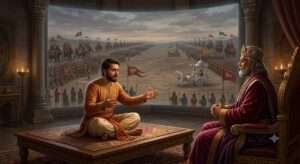
Sanjaya may also be attempting to awaken whatever remains of Dhritarashtra’s conscience. He knows that the king is not entirely unaware of the injustice suffered by the Pandavas. The humiliation of Draupadi, the deceitful game of dice, the denial of their rightful kingdom and the repeated failure to honour peaceful settlements have all taken place under his reign. At various stages, Dhritarashtra has had opportunities to restrain Duryodhana and prevent the deterioration of relations. Yet every opportunity has been weakened by indecision, excessive affection and the unwillingness to exercise sovereign authority against his own son.
At this decisive moment, Sanjaya’s detailed description may carry an unspoken appeal: the king must understand what he is about to lose. The Pandavas are not isolated individuals who can be intimidated into surrender. They are supported by formidable warriors, experienced commanders, allied kingdoms and, above all, the moral authority associated with their struggle for justice. Their military preparedness demonstrates that the consequences of Duryodhana’s obstinacy can no longer be contained within the boundaries of a family disagreement. The conflict has expanded into a confrontation involving numerous kingdoms, generations of warriors and the future political order of the land.
There is a profound logical dimension to Sanjaya’s narration. When a ruler is confronted with the possibility of war, his first responsibility should be to assess the consequences rather than merely celebrate the strength of his own army. Military power must be measured not only by the number of soldiers or the reputation of commanders but also by unity of purpose, clarity of leadership, confidence in the cause and the willingness of warriors to sacrifice themselves for a legitimate objective. Sanjaya’s account encourages Dhritarashtra to consider these factors. The Pandavas possess not merely a powerful military formation but also a strong sense of collective purpose. Their confidence is reinforced by the presence of Krishna, whose participation gives their cause an extraordinary moral and philosophical dimension.
It is reasonable to infer that Sanjaya hopes the king may still experience a moment of genuine reflection. Perhaps, even at this late hour, Dhritarashtra might recognise that the destruction of the Kuru dynasty is not inevitable if he is willing to exercise the authority vested in him. As the reigning king and the head of the Kuru household, he alone possesses the political position to command an immediate cessation of hostilities and initiate a final attempt at reconciliation. Such an intervention would require courage, impartiality and the willingness to restrain Duryodhana. Nevertheless, it could preserve countless lives and prevent the destruction of a dynasty whose greatness had been established through generations of sacrifice and statesmanship.
However, the tragedy of Dhritarashtra lies in the fact that he repeatedly recognises the truth without possessing the resolve to act upon it. Knowledge without decisive action becomes ineffective, and awareness without moral courage merely prolongs injustice. He has listened to the counsel of Vidura, witnessed the wisdom of Bhishma and understood the warnings of Krishna. Yet his attachment to Duryodhana has consistently prevailed over the larger interests of the kingdom. His failure is therefore not simply a failure of political judgement; it is a failure of character and responsibility.
From the perspective of the Mahabharata, Sanjaya’s narration also establishes an important distinction between physical blindness and the blindness created by attachment. Dhritarashtra cannot see the armies assembled before him, but Sanjaya provides him with an opportunity to perceive the reality through truthful narration. The deeper question is whether the king is prepared to see beyond his emotional limitations. The ability to receive information does not necessarily guarantee the wisdom to understand it. True vision requires freedom from prejudice, an honest evaluation of circumstances and the courage to accept consequences.
The conches of the Pandavas thus become symbolic instruments of an approaching moral reckoning. Their sound pierces the hearts of the Kauravas because it announces that the consequences of prolonged injustice have finally arrived. What began as a dispute over succession and possession has developed into a conflict concerning the foundations of Dharma, the obligations of rulers and the consequences of allowing personal ambition to override justice. The battlefield has become the final forum in which unresolved moral questions must be confronted.
The episode’s enduring message is that the destruction of peace rarely occurs through a single decision. It is generally the culmination of numerous failures to act at the appropriate time. Every ignored warning, every compromised principle, and every injustice left uncorrected contributes to an eventual crisis. Dhritarashtra’s tragedy is that he has opportunities to prevent it but repeatedly chooses postponement. When the moment for decisive intervention finally arrives, the forces set in motion by his earlier decisions have become almost impossible to control.
Sanjaya’s words, therefore, should be understood as more than a description of the Pandava military strength. They represent a final opportunity for the king to recognise the magnitude of his responsibility. He may still possess the authority to prevent the war, but authority without moral determination has little practical value. The conches have sounded, the armies are prepared, and the destiny of the Kuru dynasty is approaching its decisive moment.
The Bhagavad Gita, in its eternal wisdom, invites us to examine this very conflict within ourselves. Dhritarashtra represents the human tendency to become imprisoned by attachment, while Sanjaya symbolises the voice of truthful awareness that attempts to awaken reason and conscience. The struggle between these two forces is not confined to Hastinapura or Kurukshetra. It is reflected in every human situation where personal affection, ambition or possessiveness challenges the demands of fairness and righteousness.
Ultimately, the greatest lesson of this passage is that peace cannot survive merely through expressions of goodwill. It requires justice, restraint, accountability and the courage to correct wrongdoing before it becomes irreversible. When those entrusted with authority fail to uphold these principles, the consequences extend far beyond the individuals responsible. The tumultuous sound that echoed across the battlefield was therefore not merely the announcement of war; it was the unmistakable warning of history that injustice, when repeatedly protected by power, eventually brings destruction upon the very system that sustains it.