
Lakshmanrao Upadhyayula
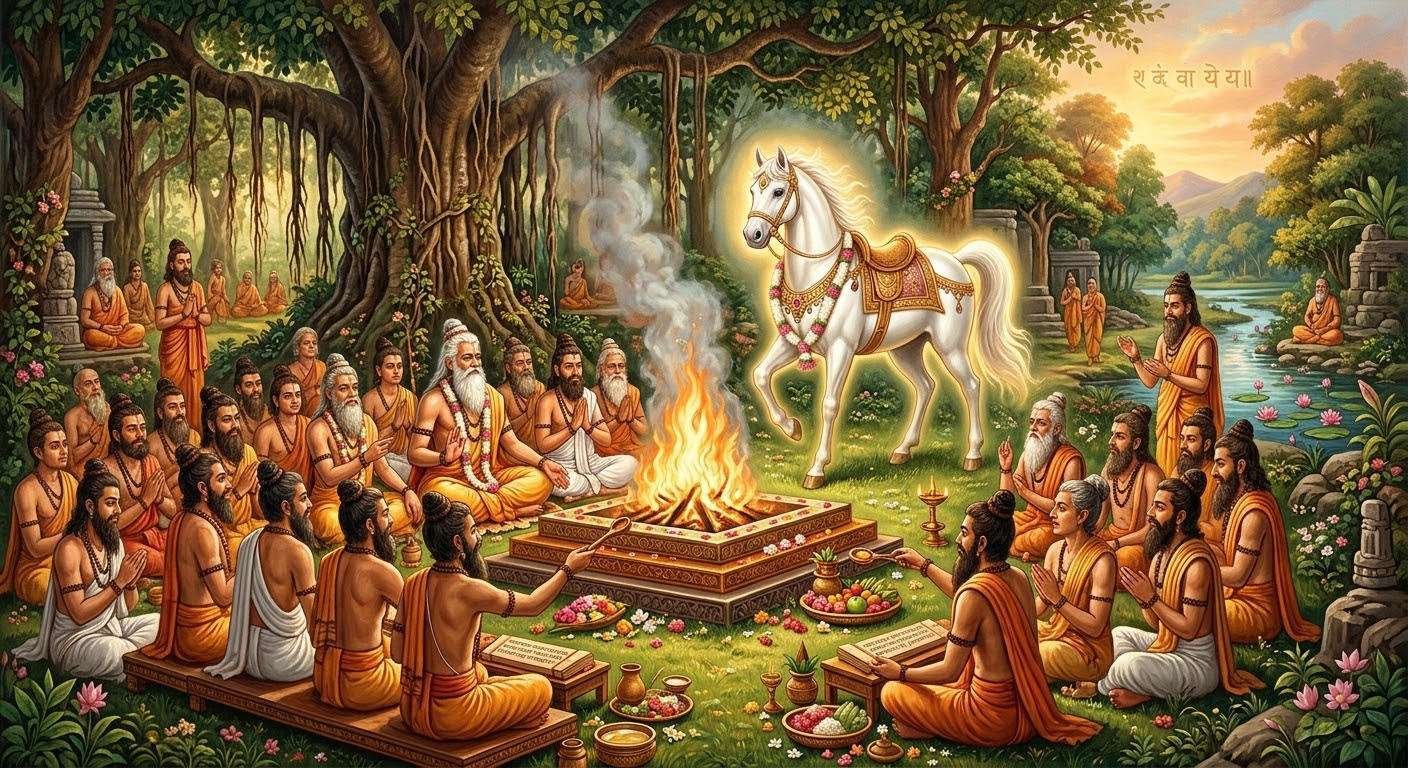
The sage Vāmadeva invokes Dadhikrā in the majestic Triṣṭubh metre of the Ṛgvedic hymns, presenting him not merely as a celestial horse but as a profound symbol of dynamic energy, courage, speed, protection and victorious action. The hymn brings together heaven and earth, the generous king Trasadasyu, the warrior spirit of the horse and the aspirations of human beings. Dadhikrā emerges as a force through which divine power becomes active in the human world.
King Trasadasyu is portrayed as a great donor who receives abundant riches through divine favour and distributes them generously among those who seek his support. Horses, children, weapons and prosperity are associated with his royal power. The emphasis is not simply upon possession but upon distribution. Wealth acquires its highest significance when it circulates for the welfare of society. In this sense, the hymn presents generosity as a sacred responsibility of kingship and leadership.
Dadhikrā is described through images of extraordinary vitality. He is swift-moving, powerful, radiant and beautiful, while simultaneously serving as a protector of humanity and a destroyer of hostile forces. Heaven and earth themselves appear to be associated with his grandeur. The horse becomes an embodiment of disciplined energy, combining physical strength with purposeful movement. His beauty is not ornamental alone; it is the visible expression of vitality under control.
The worshippers are satisfied by the presence of Dadhikrā and turn toward him in prayer. His movement is compared with the flowing force of water descending naturally and irresistibly. The comparison is significant because flowing water represents continuity, momentum and the ability to overcome obstacles without losing direction. Dadhikrā therefore represents a form of energy that does not remain dormant but constantly seeks expression through purposeful action.
He is also depicted as a warrior who is prepared for battle and eager to confront challenges. His ambition is to move in harmony with time itself, never remaining behind the changing circumstances of existence. His chariot travels with the speed of the wind, suggesting an extraordinary conception of velocity in the Vedic imagination. The image can be appreciated scientifically as an observation of motion: wind, flowing water, the galloping horse and the moving chariot become natural analogies for different forms of kinetic energy.
Dadhikrā is capable of restraining an enemy possessing many formations and phases in battle. He moves across the directions with remarkable freedom and speed, while the warrior force accompanying him creates an overwhelming impression. The hymn repeatedly returns to movement, momentum and force. Such repetition gives the description a dynamic character, almost as though the listener is witnessing the horse advancing across the battlefield rather than merely hearing a static description of him.
The Vedic priest, through sacred utterance, invokes protection for the patron and seeks the removal of hostile forces. Speech itself is therefore treated as an instrument of power. The hymn reflects an ancient understanding that disciplined thought, correctly articulated speech and purposeful action must work together. The priest does not rely upon physical strength alone; the power of the mantra is integrated with the strength of the warrior and the generosity of the king.
The imagery becomes particularly vivid when Dadhikrā approaches the enemy. Those who confront him experience fear, just as birds scatter when they perceive a hungry hawk approaching. The comparison captures a fundamental principle of nature: an organism responds instinctively to an approaching predator when survival is threatened. The Vedic poet transforms this natural observation into a metaphor for military psychology. The mere sight of Dadhikrā is sufficient to disturb the confidence of his opponents.
People who see Dadhikrā moving toward food and cattle are similarly described as fleeing before him. Here the horse represents not uncontrolled violence but the concentrated force of an advancing army. Food and cattle were major measures of wealth and security in the ancient pastoral economy, and therefore their protection was essential to social stability. Dadhikrā becomes the guardian of the resources upon which human communities depended.
His intention to penetrate the divine or opposing army is accompanied by the tremendous power of his chariot. The horse is adorned, magnificent and attractive to human beings. Yet beneath this beauty lies immense strength. The reins are held firmly, suggesting that power must be controlled by discipline. This is one of the deeper ideas embedded in the imagery: speed without restraint can become destructive, whereas speed governed by intelligence becomes an instrument of achievement.
The dust raised by his rapidly moving hooves fills the surrounding directions. The image is remarkably physical and observational. A galloping horse produces impact, friction, vibration and displaced earth; its hooves strike the ground, generating dust that rises into the atmosphere and eventually settles again upon the earth. The poet transforms this visible phenomenon into an image of overwhelming martial momentum.
Dadhikrā is patient in his strength but extraordinarily fast when action becomes necessary. He is the instrument through which the dynamics of war are expressed. His movement is compared with a swift runner and a powerful galloping force capable of crossing enemy formations. The dust rising from the earth and falling back upon it creates a natural cycle, reminding us that every movement leaves a temporary disturbance in its environment.
The horse is radiant and produces a powerful sound. His approach is therefore perceived through several senses simultaneously—sight, hearing and the physical sensation of movement. The comparison with the thunderbolt, Vajra, intensifies the impression of sudden and irresistible force. Those who desire battle may possess courage beforehand, but when confronted by such concentrated power, even the confident warrior is compelled to reconsider his position.
When surrounded by enemies, Dadhikrā does not become helpless. Instead, the hymn presents him as becoming even more formidable. The psychological dimension is important: courage is not merely the absence of fear but the capacity to preserve effectiveness when surrounded by danger. Dadhikrā therefore represents resilience under pressure, a quality equally valuable in warfare, leadership and ordinary human life.
The hymn associates Dadhikrā with the fulfilment of human aspirations. His speed, strength and victorious movement are not ends in themselves; they are expected to bring prosperity to the community. The Vedic conception of divine power is consequently closely connected with human welfare. The deity is approached through prayer not merely for personal gratification but for protection, prosperity, victory and the flourishing of society.
His extraordinary speed is repeatedly celebrated. His movement is imagined as crushing opposition and overcoming forces vastly greater in number. The poet is not making a mathematical claim about military strength but creating an image of concentrated energy capable of producing disproportionate results. A single powerful force, when properly directed, can sometimes achieve what a multitude of uncoordinated forces cannot.
The reference to Sūrya introduces another dimension. The Sun is associated with the bestowal of waters and the sustaining power of nature. Solar energy drives the great cycle of evaporation, clouds and rainfall that sustains terrestrial life. Although the hymn speaks in sacred language rather than modern scientific terminology, its imagination places solar power, water, atmospheric movement, fertility and earthly prosperity within an interconnected cosmic order.
The reference to the Pañca Kṛṣṇa may be understood within the complex symbolic vocabulary of Vedic tradition. The terms connected with Deva, Mānava, Asura and Pitṛ point toward different orders of existence and ancestral or cosmic powers in Vedic thought. Rather than reducing these expressions to a single literal interpretation, they can be viewed as part of the hymn’s larger vision in which divine, human, ancestral and other cosmic dimensions participate in the order of existence.
Dadhikrā is ultimately portrayed as a magnificent giver, capable of bestowing hundreds and thousands of gifts. His generosity parallels the generosity of Trasadasyu. The horse and the king therefore reflect one another: Dadhikrā represents the dynamic power that wins and protects prosperity, while the king represents the human responsibility to distribute that prosperity. Strength and generosity become complementary virtues.
The scientific temperament of the hymn lies not in modern technical explanations but in its close observation of nature and physical processes. The poet notices the speed of a horse, the force of its hooves, the dust rising from the ground, the sound produced by its movement, the fear of birds before a predator, the flow of water, the motion of wind and the sustaining relationship between the Sun and water. These observations are transformed into a symbolic language in which physical phenomena illuminate psychological and spiritual truths.
At a deeper spiritual level, Dadhikrā can be understood as the disciplined energy within human consciousness. The horse represents the restless power of life, while the reins represent intelligence and self-control. The chariot represents the organized vehicle through which energy is directed, and the warrior represents the individual who must confront inner and outer obstacles. Speed without direction is confusion; strength without restraint is danger; but energy guided by wisdom becomes purposeful power.
Thus, the prayer of Vāmadeva is simultaneously a celebration of nature, kingship, courage, disciplined energy, generosity and spiritual aspiration. Dadhikrā is not merely the swift horse rushing through a battlefield. He becomes an archetype of awakened energy—the force that moves rapidly, protects the vulnerable, confronts opposition, creates confidence and carries human aspiration toward fulfilment. The final prayer therefore asks this radiant power to accept the hymns of the worshippers and grant the fruits they rightly seek, linking divine invocation with the enduring human desire for prosperity, protection, courage and harmonious existence.