



The Vedic vision of creation represents one of humanity’s most profound attempts to comprehend the origin of existence, the relationship between the visible universe and the invisible source of life, and the mysterious unity underlying the apparent diversity of creation. The sages approached these questions not merely through observation of the external world, but through disciplined contemplation, intellectual inquiry, and spiritual insight. Their search was directed towards the fundamental cause behind every phenomenon, the principle that connects the cosmic order with human experience. In this magnificent tradition of thought, simplicity becomes the gateway to vastness, and a seemingly elementary question opens the door to an immeasurable field of philosophical exploration. The teachings associated with the Aitareya tradition invite humanity to look beyond appearances and recognise that the universe, despite its countless forms, may be understood as an interconnected manifestation of a deeper reality.
The account of creation begins with the conception of different cosmic regions, expressed through the terms Ambha, Marichi, Mara, and Apah. These are not merely geographical divisions of an immense universe; they represent a contemplative effort to arrange existence according to its perceived structure and order. Ambha is described as the world beyond heaven, while heaven serves as its supporting region. The atmospheric expanse, identified with Marichi, lies beneath heaven, and the earthly realm, associated with Mara, constitutes the world of mortal existence. Apah, the waters, occupy a further position in this cosmological arrangement. Such descriptions reveal the ancient mind attempting to understand the universe as an ordered whole rather than a random collection of unrelated objects. The classification of cosmic regions reflects an enduring intellectual impulse: to discover relationships between the higher and lower, the sustaining and the sustained, the eternal and the transient.
The central question, however, is not simply what the universe contains, but who or what brought it into existence. The inquiry moves from the visible arrangement of the worlds towards their originating principle. The Creator, understood in the narrative through the figure of Brahma and the wider spiritual conception of Ishwara, represents the source from which the multiplicity of existence emerges. The quest for this source is inseparable from the search for the ultimate subject of knowledge, the one who is known as Sah, meaning “He” or “That One” in the context of the narrative. The philosophical significance lies in the movement from the observation of created things towards the recognition of the cause that precedes them. Every object raises the question of its origin; every origin invites inquiry into its own cause. Yet an endless chain of causes cannot, by itself, satisfy the human intellect. Contemplation therefore seeks a foundational principle through which the existence and coherence of the whole may become intelligible.
Having surveyed the worlds, the Creator is described as intending to establish guardians for them. To fulfil this purpose, he forms a human shape from the waters and gives it a definite structure. This image is remarkable because the human form becomes the setting in which the cosmic principle unfolds through distinct organs and functions. Creation is no longer presented only as an arrangement of external worlds; it is revealed through a living organism in which different faculties emerge in an ordered sequence. The human being thus becomes a field of inquiry into the nature of the universe. The body, with its organs and vital powers, offers a means of contemplating the relationship between the individual and the cosmos. The significance of this conception lies not in a claim that every feature of the universe can be reduced to human anatomy, but in the recognition that human existence provides a powerful framework through which the mysteries of existence may be investigated.
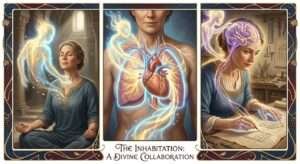
The newly formed being, however, does not immediately become an instrument of purposeful life. The narrative describes the being undertaking penance, or tapas, directed towards the Creator. In the Vedic understanding, tapas signifies more than physical austerity or the endurance of hardship. It conveys the concentrated intensity of disciplined awareness, the inward heat generated by sustained contemplation, and the transformative power of focused intention. Creation itself is associated with purposeful intelligence, and the created being becomes fully meaningful through an awakening of its capacities. The relationship between the Creator and the created therefore involves not merely the formation of a body but the emergence of a principle of life and consciousness. This suggests a profound philosophical distinction between possessing a physical structure and becoming a living, responsive being. Form provides the foundation, but the animation and integration of its faculties make meaningful experience possible.
The emergence of the organs and their corresponding powers unfolds with extraordinary symbolic precision. From the mouth arise speech and the principle of fire, Agni. The mouth is the instrument through which thought becomes audible, intention assumes expression, and knowledge enters the shared world of human communication. Speech enables individuals to transmit experience, preserve knowledge, establish relationships, and organise collective life. Fire, meanwhile, represents transformation, illumination, and the power by which one state of existence is converted into another. The association between speech and Agni therefore invites a contemplative understanding of expression as a transformative force. Words can illuminate the mind, sustain truth, and inspire constructive action; they can also mislead, divide, and destroy trust. The symbolic relationship reminds humanity that speech is not an insignificant bodily activity but a power carrying moral and social consequences. When disciplined by truth and wisdom, language becomes an instrument of enlightenment.
From the nostrils emerges the vital breath, associated with Vayu, the principle of wind and movement. Breath is among the most immediate yet mysterious conditions of life. It continues without conscious direction during ordinary existence, yet its interruption exposes the fragility of the living body. The association of breath with Vayu establishes a symbolic correspondence between the movement of air in the external world and the vital process within the individual. It encourages the mind to recognise that life depends upon continuous interaction with the environment. The individual does not exist in absolute isolation; the body participates in a larger order through respiration, nourishment, sensation, and movement. Breath thus becomes a reminder of the intimacy between life and the universe. What appears to belong exclusively to the individual is sustained through a relationship with the world beyond the boundaries of the body.
From the eyes emerges vision, associated with the Sun. This correspondence carries both practical and spiritual significance. Sight enables the individual to perceive shape, movement, distance, and colour, while sunlight makes the visible world accessible to ordinary experience. The Sun, as the source of illumination, becomes a powerful symbol of the knowledge that dispels obscurity. Yet the deeper implication extends beyond physical eyesight. To see is not always to understand, just as the presence of light does not guarantee that the observer will interpret what is revealed correctly. Genuine insight requires discernment, reflection, and the willingness to examine what lies beyond immediate appearances. The association of vision with the Sun therefore invites humanity to distinguish between seeing an object and comprehending its significance. External light reveals the forms of the world; inward clarity enables the mind to understand their relationships and implications.
From the ears emerge hearing and the cardinal directions. Hearing establishes a relationship with the world that extends beyond the immediate field of vision. Sound reaches the listener from different locations, revealing movement, presence, distance, and orientation. The directions provide a framework through which space becomes intelligible, allowing the individual to locate the self within a larger environment. The symbolic connection between hearing and direction suggests that knowledge is acquired not only through direct observation but also through attentive listening. A society that values listening becomes capable of receiving experience from different perspectives, examining unfamiliar ideas, and correcting its own assumptions. Conversely, a mind that refuses to listen confines itself within the narrow boundaries of its existing convictions. The ancient association therefore offers a lasting lesson: orientation in the external world and maturity in the intellectual world both require receptiveness to what comes from beyond oneself.
From the skin emerge hairs, while herbs and trees are associated with this aspect of creation. The skin is the boundary through which the individual encounters the external environment. It protects the body, registers touch, and establishes a continuous relationship between the living organism and the world surrounding it. The growth of hair and the growth of vegetation evoke a symbolic correspondence between the body’s living surface and the earth’s capacity to sustain plant life. The comparison draws attention to the generative character of nature. Herbs and trees provide nourishment, shelter, medicine, and the conditions necessary for countless other forms of existence. They are not merely decorative elements of the landscape but indispensable participants in the continuity of life. From this perspective, the human being cannot claim independence from the natural world. The body itself becomes a reminder of biological kinship, while the vegetation of the earth reveals the larger network of nourishment and renewal upon which civilisation depends.
From the heart emerges the mind, and from the mind the Moon is associated with the created order. The heart, in this narrative, serves as a profound centre of inward life, while the mind represents the faculty through which impressions are organised, remembered, interpreted, and reflected upon. The Moon, with its changing phases and measured relationship with time, offers an evocative symbol for the movement and fluctuations of mental experience. Human thoughts, like the changing appearance of the Moon, do not remain constant. They respond to circumstances, emotions, memories, expectations, and the influence of the surrounding world. The mind can illuminate experience through discrimination, yet it can also obscure judgment when governed by fear, attachment, or confusion. The association invites a distinction between the possession of mental faculties and their wise application. Intellectual power alone does not guarantee wisdom; the mind becomes a guiding instrument when its movements are examined and directed through disciplined awareness.
From the navel emerges the downward-moving vital force, associated in the account with the power of death. This relationship introduces a sobering dimension into the narrative of creation. Life is not represented merely as expansion, growth, and the acquisition of faculties; it also contains processes of elimination, limitation, decline, and eventual dissolution. The body’s functioning depends upon the removal of what it cannot retain, just as the larger natural order includes decay and transformation. Death, within this symbolic framework, marks the boundary of individual existence and reminds humanity that embodied life is subject to change. The contemplation of mortality is not necessarily an invitation to despair. Rather, it can deepen awareness of the preciousness of life and the responsibility to use its opportunities meaningfully. Acknowledging impermanence encourages moderation in ambition, humility in success, and compassion towards those who share the vulnerability of earthly existence.
From the reproductive organ emerges the seed, and from the seed the waters are associated with the continuation of life. This sequence turns attention towards fertility, generation, and the transmission of existence from one form to another. The seed contains the potential for development, while water provides an essential condition for growth and renewal. Together, they symbolise the relationship between latent possibility and the circumstances that enable it to become manifest. A seed cannot fulfil its potential without appropriate conditions, just as human talent cannot develop fully without education, discipline, opportunity, and responsible guidance. The analogy extends naturally to society, where the future depends upon the cultivation of knowledge, character, and the capacities of succeeding generations. Creation, in this sense, is not confined to an event in the distant past. It continues through the processes by which life reproduces itself, possibilities unfold, and the achievements of one generation become the foundations of another.
The account repeatedly directs attention to the relationship between an organ, its function, and the corresponding cosmic principle. Mouth, speech, and fire; nostrils, breath, and Vayu; eyes, vision, and the Sun; ears, hearing, and the directions; skin, hair, and vegetation; heart, mind, and the Moon; navel, downward-moving vital force, and death; reproductive organ, seed, and water. This pattern is more than a catalogue of symbolic associations. It constitutes a method of contemplation in which observable functions are connected to wider principles of existence. The body becomes a field of inquiry, and each faculty opens a pathway towards understanding the world. The method moves from the familiar to the unfamiliar, from immediate experience to abstract reflection, and from the individual to the universal. Its enduring strength lies in its ability to transform ordinary observations into questions of fundamental significance.
Yet the depth of this teaching becomes clearer when we recognise the distinction between correspondence and identity. The human eye is not literally the Sun, nor is the mind literally the Moon. Rather, the narrative invites the seeker to examine the meaningful relationships between illumination and vision, fluctuation and thought, movement and breath, transformation and speech. These associations function as contemplative bridges through which the mind can move from tangible experience towards philosophical understanding. The human being and the universe are not identical in every respect, but neither are they entirely unrelated. Both exhibit patterns of organisation, dependence, change, and interconnection. The symbolic method makes these relationships intelligible without requiring every correspondence to be interpreted as a literal physical equivalence. Its purpose is to cultivate a more comprehensive understanding of existence.
The repeated appearance of the number two in the narrative raises another significant question. The Creator forms a shape in the waters, and the formed being is distinct from the one who creates it. There is therefore a relationship between the source and the manifestation, between the initiating principle and the form that receives its purpose. This distinction makes inquiry possible: one can ask what creates, what is created, and how the relationship between them is established. At the same time, the existence of a relationship invites further reflection on the deeper unity that sustains both. If the created world depends upon an originating principle, in what manner does that principle remain present within the world without being confined to any single object or form? Such questions lead contemplation beyond simple oppositions towards a more subtle understanding of unity and diversity. The distinction between the two is necessary for analysis, while the search for their underlying relationship is essential for wisdom.
The question of cause and effect lies at the heart of this exploration. Every visible event appears to arise from conditions that precede it. A plant depends upon a seed, soil, water, sunlight, and the interaction of numerous environmental factors. Human speech depends upon breath, bodily organs, acquired language, thought, and the social circumstances that give words meaning. Likewise, a functioning organism depends upon the coordinated activity of many systems. These examples demonstrate that what appears to be a single event often rests upon a complex network of causes. Yet the discovery of one cause frequently reveals further conditions upon which it depends. Philosophical contemplation therefore asks not only what immediately produces an effect, but also how the entire network of relationships becomes possible. The search for an ultimate cause is an attempt to understand the foundation of coherence itself, rather than merely to accumulate an endless list of separate explanations.
This method of inquiry possesses an enduring relevance to rational thought. Observation identifies phenomena; comparison reveals similarities and differences; reasoning examines relationships; and sustained reflection tests the adequacy of proposed explanations. Spiritual contemplation adds a further dimension by asking what these discoveries mean for the human condition and how they should influence conduct. The two approaches need not be treated as enemies. Empirical investigation examines the mechanisms of the natural world, while philosophical inquiry considers questions of meaning, value, consciousness, and ultimate significance. Confusion arises when symbolic teachings are mistaken for modern scientific descriptions, or when scientific explanation is assumed to settle every philosophical question. A mature understanding recognises the distinctive purposes of different forms of inquiry while encouraging intellectual honesty in each. The Vedic vision becomes most fruitful when approached with both reverence for its contemplative depth and clarity about the difference between spiritual symbolism and demonstrable physical explanation.
The unending character of the Upanishadic search lies in this willingness to continue questioning. No single answer should become an excuse to abandon inquiry when further questions remain. Each insight becomes the foundation for a deeper investigation, and each discovery reveals new dimensions of the subject. The relationship between life and breath, perception and illumination, thought and consciousness, birth and death can be contemplated repeatedly, with each stage of reflection bringing a different degree of understanding. Such inquiry is not merely intellectual entertainment. Properly pursued, it transforms the observer by encouraging patience, humility, discrimination, and freedom from superficial judgment. The seeker learns that wisdom does not consist in possessing an impressive collection of conclusions, but in developing the ability to ask meaningful questions and examine the answers without prejudice.
The spiritual significance of this teaching also lies in its recognition of interdependence. The individual body cannot survive without air, water, nourishment, and the wider conditions provided by nature. The mind develops through language, memory, relationships, and accumulated human experience. Society, in turn, depends upon the contributions of individuals whose abilities become meaningful through cooperation. No person creates the conditions of existence independently, and no civilisation can flourish indefinitely by ignoring the natural and moral foundations upon which it rests. The cosmic correspondences thus acquire an ethical dimension. If life is sustained through relationships, responsibility must accompany the freedom to act. If nature is indispensable to human survival, its destruction undermines the very conditions of collective prosperity. If speech is a power of transformation, truthfulness and restraint become essential to social trust. The contemplation of creation ultimately leads towards the question of how human beings should live within the order to which they belong.
The guiding lights of society emerge from precisely this union of insight and responsibility. A society is not sustained by material achievements alone, nor can its future be secured solely through technological progress or institutional strength. It requires individuals capable of distinguishing appearance from reality, ambition from wisdom, and personal advantage from collective welfare. The true guide is one who combines rational inquiry with moral discipline, intellectual confidence with humility, and personal aspiration with a sense of responsibility towards others. The ancient search for the origins of existence becomes socially meaningful when it encourages human beings to recognise their limitations, respect the complexity of life, and act with greater awareness of the consequences of their decisions. Knowledge becomes a guiding light when it is joined with integrity; power becomes constructive when it is restrained by responsibility; and achievement acquires lasting value when it contributes to the well-being of the larger community.
Within the intellectual heritage of Bharatha Varsha, such contemplation represents a continuing invitation to investigate the relationship between the self, the natural world, and the ultimate ground of existence. The significance of this heritage does not depend upon treating every ancient formulation as beyond examination. On the contrary, its vitality lies in the questions it preserves and the intellectual discipline it encourages. The seeker is invited to approach existence with wonder, to test assumptions through reason, and to recognise that the limits of present understanding should inspire further inquiry rather than intellectual surrender. The universe remains a vast field of discovery, and the human mind, though limited, possesses the remarkable capacity to investigate its patterns, interpret its significance, and reflect upon its own place within it. The humility demanded by this realisation is not weakness; it is the beginning of genuine wisdom.
Ultimately, the profound beauty of the Aitareya tradition rests in the vastness concealed within simplicity. A mouth, a breath, a glance, a sound, a thought, a seed, or a drop of water may appear ordinary when considered in isolation. Yet each can become the starting point of an inquiry into the conditions that sustain life and the relationships that connect the individual to the universe. The contemplative mind discovers that the simplest experiences are not necessarily shallow; they may contain questions of extraordinary depth. By following these questions with perseverance, steadfastness, and intellectual honesty, humanity gradually uncovers the interconnected character of existence. The ancient sage does not merely describe a world already understood; the sage invites every generation to look again, think more deeply, and discover the significance hidden within familiar experience. In this perpetual search for origins, relationships, and ultimate meaning, the wisdom of the past becomes a living source of illumination for the present and a guiding light for the future.

