
P.A. Rama Rao
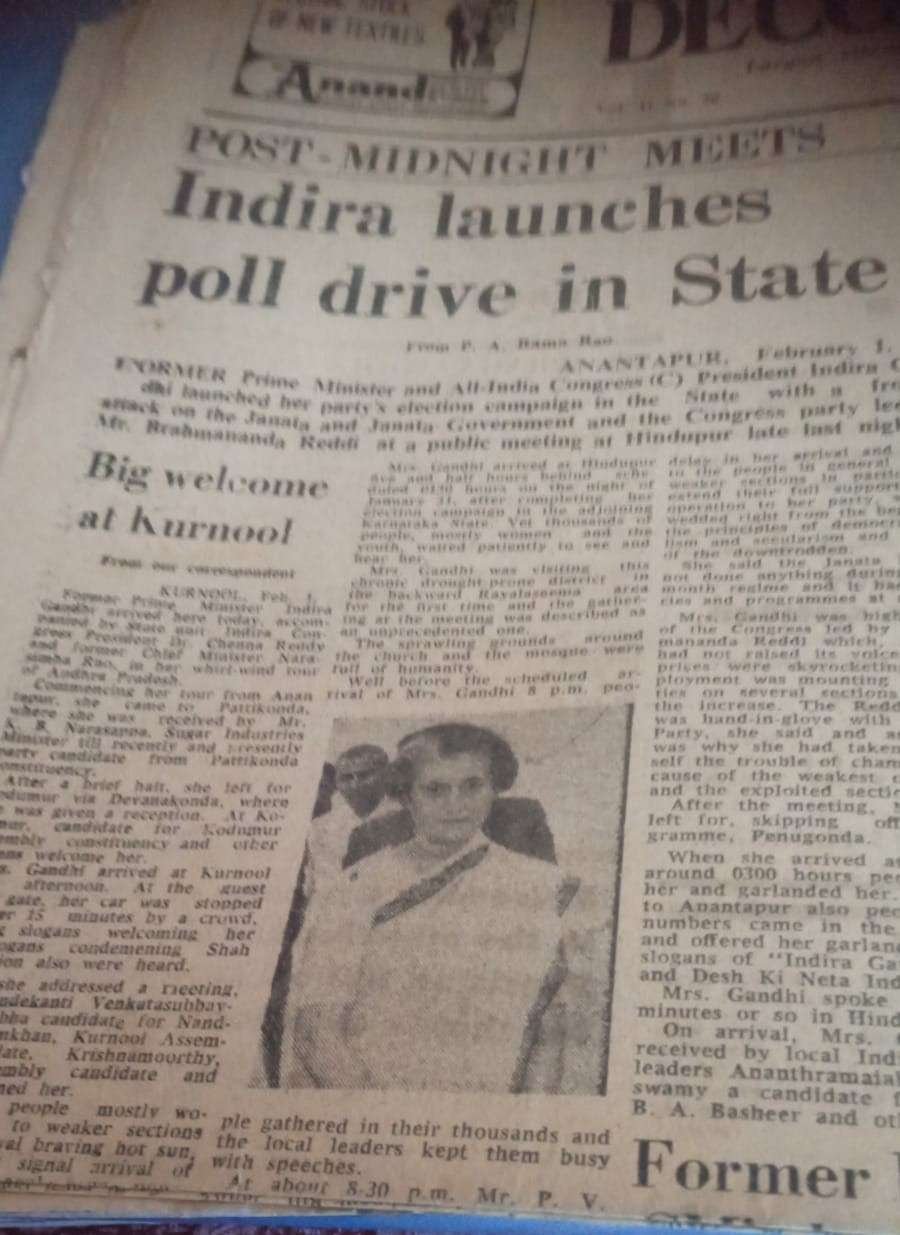
One day, the Editor of Deccan Chronicle asked me whether I would be willing to take up a particularly hectic and demanding assignment. I promptly replied that I was game for any strenuous challenge. He then showed me a letter received from the Andhra Pradesh Congress Committee (APCC), requesting the newspaper to arrange coverage of Congress president and former Prime Minister (then) Indira Gandhi’s election campaign in the State. The Editor chose me for the assignment.
It was on the eve of the 1978 General Elections. Mrs Gandhi had embarked on a whirlwind nationwide campaign to regain political power by defeating the Janata Party and the Brahmananda Reddy-led Congress faction, which had split from the parent party.
Having completed her campaign in Karnataka, she began her Andhra Pradesh tour at Hindupur on the night of January 31. She was scheduled to address a public meeting at 8 pm, but arrived only at 1.30 am the following day, a delay of five-and-a-half hours. This became something of a pattern throughout her tour.
APCC president Dr M. Channa Reddy, senior Congress leader P.V. Narasimha Rao, other party leaders and I reached Hindupur by the evening of January 31. We waited along with huge crowds for her arrival. In those days, there were no restrictions on the timings of political meetings, and electioneering often continued well into the early hours.
The PCC provided me with a car, and I covered Mrs Gandhi’s campaign continuously for six days across Rayalaseema, Nellore, Guntur and Khammam districts.
It was not merely a hectic assignment; it was physically exhausting. Mrs Gandhi campaigned for nearly 20 to 21 hours a day, addressing massive public meetings as well as impromptu roadside gatherings. Meetings continued until 3 or 4 am, only for the campaign to resume at 6 or 7 am after barely three or four hours of rest. On the first day, she addressed a public meeting at Penukonda at 3.45 am before calling it a day. P.V. Narasimha Rao translated her Hindi speeches into Telugu for the audience.
While her stamina and relentless campaigning were remarkable, keeping pace with her programme was an equally formidable challenge for me as a reporter.
I faced three major ordeals. The first was keeping up with her convoy. My car was positioned at the 13th place in the motorcade. Mrs Gandhi would alight from her vehicle close to the meeting venue, walk briskly through the crowds and address the gathering for 10 to 15 minutes before returning to her car. She walked remarkably fast despite the crowds surrounding her. By the time I got out of my car and raced towards the rostrum, her speech would often be halfway through or almost over. I then had to rush back to my vehicle to continue the journey.
The second challenge was writing and typing my reports. I carried a portable typewriter and typed my dispatches sitting inside the car itself, often between meetings and while the campaign was on the move.
The third, and perhaps the most cumbersome, task was transmitting the reports to the Deccan Chronicle office in Secunderabad. There were no mobile phones, laptops, internet connections or electronic transmission facilities in those days. Telegrams were the only practical means of sending press reports over long distances.
The Telegraph Department issued a ‘Telegraph Bearing Authority’ card to journalists authorised by their newspaper management. It functioned somewhat like an accreditation facility, allowing reporters to send telegrams without making individual payments. We had to type or write the reports in capital letters, mention the destination address, sign the dispatch and quote our Telegraph Authority number before handing it over at the nearest Telegraph office.
I generally typed my reports around 7 pm and then located the nearest Telegraph office to transmit them. Both activities consumed precious time, forcing me to miss three or four roadside meetings during the campaign. It was a constant balancing act between witnessing the proceedings, gathering information, filing the report and keeping up with the convoy.
Fortunately, the organisers made adequate arrangements for my stay wherever Mrs Gandhi halted for a few hours of rest in the early morning. I was also provided breakfast along with the VIPs before the day’s campaign resumed. These arrangements helped me maintain my health and stamina through those six exhausting days.
Looking back, it was an assignment that tested my physical endurance, professional commitment and resourcefulness. Today, journalists can file reports instantly from virtually anywhere. But in those days, reporting a high-profile political campaign involved chasing convoys, typing on portable machines inside moving cars and locating Telegraph offices to transmit dispatches. It was journalism in an entirely different era, demanding not just news sense but considerable physical effort and determination.