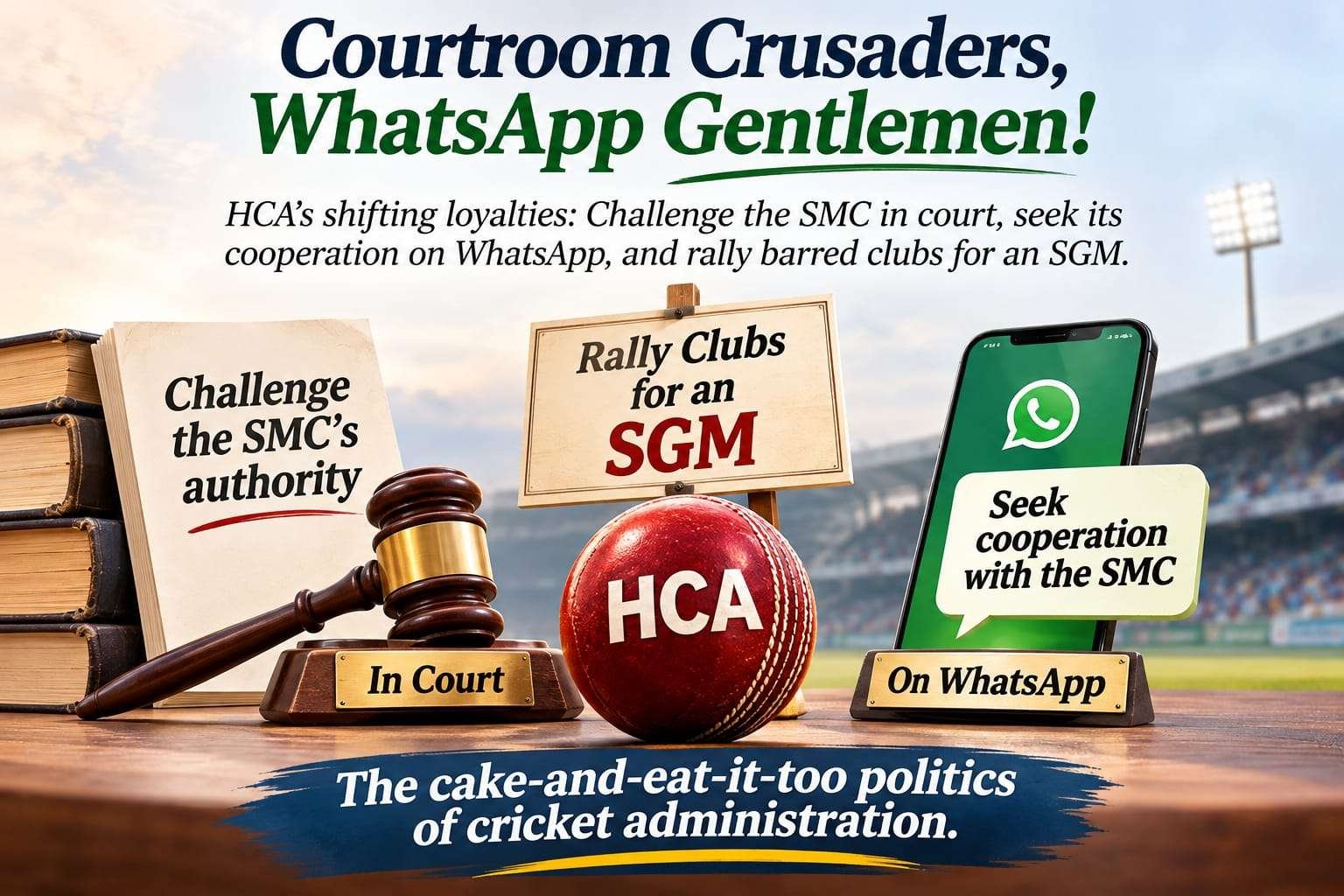
HCA’s shifting loyalties: Challenge the SMC in court, seek its cooperation on WhatsApp, and rally barred clubs for an SGM. The cake-and-eat-it-too politics of cricket administration.
Special Correspondent
There is a peculiar variety of statesmanship emerging in the Hyderabad Cricket Association (HCA). One moment, its protagonists are questioning the very authority of the High Court-appointed Single Member Committee (SMC), challenging its appointment and intervention in court. The next, they are transformed into ambassadors of cooperation, urging club secretaries to work with the very committee whose authority they have been contesting. Apparently, the principle is simple: challenge the referee when the decision does not suit you, but seek his blessings when the game is slipping out of your hands!
Take the recent WhatsApp message posted by Ravinder Singh, secretary of a club itself reportedly facing scrutiny following a complaint by senior Congress leader and former MP V. Hanumantha Rao. The message sounds remarkably reasonable, even statesmanlike. It invokes the High Court’s April directions, argues that the Apex Council can function with the SMC’s approval, and urges cooperation, regular meetings and an SGM to amend the HCA Constitution in accordance with the Lodha recommendations.
Beautifully worded. But there is just one inconvenient detail: the same individual has been associated with the legal challenge questioning the SMC’s appointment and its intervention in preventing an SGM without following the prescribed process.
So, which position should HCA members believe? The courtroom crusader or the WhatsApp gentleman?
The convenient discovery of cooperation
For months, the SMC was portrayed as an obstacle to the Apex Council’s functioning. Appeals and legal challenges followed, including proceedings questioning the committee’s authority and intervention. Yet, suddenly, the April High Court order is being interpreted as permitting the Apex Council to convene meetings and seek the SMC’s approval.
If that interpretation was always available, why was so much energy spent contesting the arrangement? Why not demonstrate cooperation from the beginning? And if the SMC’s authority is being questioned in court, on what moral or administrative ground are club secretaries now being asked to rally behind it?
One cannot have it both ways. Judicial supervision cannot be an inconvenience in the courtroom and a convenient administrative instrument on WhatsApp.
The SGM that went nowhere
The June 17 SGM request raises another uncomfortable question. The communication was addressed to the Secretary/President and reportedly carried the signature of Acting President Sardar Daljeet Singh himself, as one of the signatories. Yet, the procedural requirements under the HCA bye-laws were not completed before the matter became contentious. Even Daljit Singh is under the scanner of ‘conflict of interest’ clause.
The bye-laws prescribe the procedure for convening an SGM, including the role of the Secretary, the President’s concurrence, the specific business to be transacted and the stipulated notice period.
Why were these requirements not pursued to their logical conclusion then? Why the sudden enthusiasm now?
More importantly, the SGM is already part of the litigation. If the matter is before the High Court, should the parties not respect the judicial process instead of simultaneously building pressure through WhatsApp appeals to club secretaries?
Perhaps the objective is to appear cooperative to the SMC while continuing to contest its authority in court. A rather ingenious arrangement, if that is indeed the intention!

And what about the 57 barred clubs?
Here comes the biggest elephant in the HCA dressing room.
In July 2025, 57 clubs were kept out of the adjourned AGM, reportedly on the basis of legal advice. Yet, the June 2026 SGM request carries signatures from 32 clubs drawn from that very group.
What changed between their exclusion and their sudden rediscovery as important stakeholders? Were the reasons for their earlier exclusion examined and resolved? Have their membership credentials and eligibility been independently verified?
And that is not the end of the story. Another 20–25 clubs are reportedly under scrutiny over allegations of multiple control and conflict of interest. Some individuals associated with these clubs were also under the scanner, though not named, in the findings of Justice L. Nageswara Rao’s 2023 exercise.
Are these matters to be conveniently forgotten because an SGM is politically useful to certain office-bearers?
The 2023 findings were not decorative observations. They raised serious concerns about family control and multiple club ownership, with the possibility of stringent action, including expulsion of membership, in cases of violations. The prescribed reforms and related proposals have also remained pending with the Registrar of Societies.
Before demanding an SGM, should the HCA not first establish who is legitimately entitled to participate and vote?
A blank cheque called reform
What exactly are these clubs being invited to approve? Constitutional amendments in conformity with Lodha recommendations, we are told. But where is the draft? Who prepared it? Have members been allowed to examine the proposed changes?
An SGM without a publicly circulated draft is not democratic reform. It is an invitation to sign a blank cheque, potentially allowing vested interests to shape the future of an institution that has suffered enough from questionable administration.
The High Court’s directions cannot be reduced to a convenient formula for restoring old equations. The SMC’s mandate, the HCA Constitution, the Supreme Court’s directions and the interests of genuine cricket stakeholders must remain paramount.
The bill for double standards
There is also a larger question for the 32 club secretaries who signed the request. Did they examine the circumstances surrounding their clubs’ earlier exclusion? Were they informed about the pending scrutiny of club ownership and conflict-of-interest allegations? Do they understand that signing a representation does not automatically establish eligibility to participate in an SGM or future elections?
The verification process must answer these questions, not WhatsApp solidarity.
The HCA has witnessed enough controversies: barred clubs, competing claims to office, judicial interventions, forensic scrutiny, criminal investigations and repeated administrative uncertainty. Does anyone seriously want to return to that cycle?
Those who are facing allegations and legal challenges must understand that seeking cooperation from club secretaries cannot substitute for accountability. Nor can a sudden display of politeness erase previous positions or pending questions.
Time to walk the talk
The message to the SMC is straightforward: genuine cooperation must begin with transparency. Verify all clubs, including the 57 previously barred and the additional 20–25 reportedly under scrutiny. Establish legitimate membership and voting rights. Examine the findings of Justice Nageswara Rao. Publish the proposed constitutional amendments. Follow the HCA bye-laws and obtain all necessary judicial permissions before proceeding.
And those who have challenged the SMC’s authority must clarify their position instead of speaking in two voices.
You cannot question the umpire’s appointment, appeal against his decisions, and then ask him to facilitate your next innings!
In HCA, perhaps the time has come to distinguish between those genuinely interested in restoring cricket administration and those merely interested in restoring themselves to positions of influence.
Cooperation is not a WhatsApp post. Accountability is not a matter of convenience. And the HCA is certainly not anybody’s private club.
The questions raised here are based on available court orders, HCA records, the SGM representation and the reported findings concerning club control. Allegations and membership disputes remain subject to verification and judicial determination. Nothing in this article anticipates the outcome of pending proceedings.