



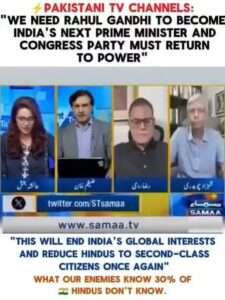
Pakistan’s media appears to have a curious political preference: a Congress revival in Bharat. There is nothing particularly surprising about it. Historically, sections of Pakistan’s political and media establishment have often appeared more comfortable with a Congress-led government in New Delhi than with a strong, assertive BJP government led by Narendra Modi.
But there is a fundamental reality that Pakistani television studios, political commentators and their Bharatiya admirers cannot change: Bharat’s government is chosen by Bharat’s voters, not by Pakistan’s television anchors.
That distinction becomes important whenever Pakistani media commentary is presented as though it offers some meaningful assessment of the Congress party’s prospects of returning to power. It does not. At best, it reflects Pakistan’s own strategic preferences and perceptions. At worst, it reveals a misplaced belief that what Pakistan wants somehow has a bearing on what Bharatiya voters will decide.
There have also been occasions when Congress leaders have made controversial remarks concerning Pakistan that subsequently became political ammunition in Bharat. Mani Shankar Aiyar’s remarks during his visit to Pakistan, for instance, triggered a major political controversy and were repeatedly cited by the BJP as evidence of an excessively accommodating approach towards Pakistan. Whatever the political context of such statements, they underline one enduring lesson: foreign applause is rarely a substitute for domestic political credibility.
The Congress faces a far more difficult challenge than anything Pakistani media can solve for it. Its problems are structural—organisational weakness in several States, leadership uncertainty, shrinking grassroots networks, factionalism and the continuing difficulty of presenting a coherent national alternative to the BJP-led National Democratic Alliance.
Its dependence on Opposition alliances is another indication of the changed political landscape. The Congress remains an important national political force, but being the principal opposition party is very different from possessing the organisational machinery and broad-based voter confidence necessary to govern Bharat.
More importantly, the party must address the trust deficit that has developed among a substantial section of the electorate. Merely opposing virtually every major initiative of the Modi government does not constitute an alternative political vision. Nor can politics built primarily around attacking the BJP, raising selective social issues or seeking narrow electoral constituencies automatically translate into a national mandate.
Elections in Bharat are ultimately decided by Indian voters—by their assessment of economic performance, welfare delivery, employment, infrastructure, national security, leadership, governance and, above all, trust. Pakistani television channels can cheer, speculate and campaign from their studios, but they possess zero votes in an Indian election.
The BJP, meanwhile, remains the principal beneficiary of a consolidated support base among large sections of the Hindu electorate, supplemented by its organisational strength and alliances. If the BJP succeeds in expanding its vote share substantially beyond its present level, the Opposition’s task of dislodging it will become considerably harder. The NDA’s geographical footprint across the States further demonstrates that the Congress is not merely fighting the BJP at the Centre; it is confronting a much broader political and organisational network.
That is the ground reality.
The Congress can certainly dream of returning to power. Democracy gives every political party the right to dream, rebuild and fight elections. But a dream becomes a political possibility only when it is backed by organisation, leadership, credibility and voter confidence.
Pakistan’s media may desperately want a Congress comeback. That is Pakistan’s preference. Whether Congress returns to power is Bharat’s decision—and Bharat’s voters alone will make it.

