
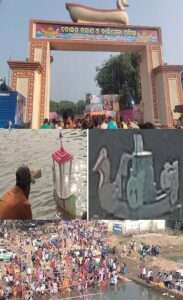
Every year, on the full-moon night of Kartik Purnima, thousands of people gather along the banks of the Mahanadi in Cuttack, Odisha, to float tiny handmade boats on the water. Made from paper, bamboo sticks, dried banana bark and pieces of cork, these little boats are more than colourful symbols of a festival. They carry the memory of an extraordinary maritime past.
The tradition is known as Boita Bandana, while the much larger festival surrounding it, Bali Yatra, has grown into one of Asia’s largest open-air fairs.
For most people, the festival is a beautiful remembrance of the ancestors who sailed from the shores of ancient Kalinga to distant lands. But there is another remarkable dimension to the tradition. The timing of Kartik Purnima is closely connected to the seasonal wind system that ancient sailors depended upon for their voyages across the Bay of Bengal and beyond.
Centuries ago, the merchant-mariners of Kalinga, traditionally remembered as Sadhabas, operated an extensive maritime trading network. Their voyages connected the eastern coast of India with Sri Lanka, Myanmar, the Malay Peninsula, Java, Sumatra and Bali. Historical evidence places maritime activity from this region at least as far back as the last centuries BCE and into the early centuries CE.
These were not voyages undertaken merely for adventure. They were carefully timed expeditions in which knowledge of the sea, winds, currents and seasons could determine whether a ship reached its destination safely.
One important piece of evidence comes from the Greco-Roman geographer Ptolemy, who wrote his Geography in the second century CE. He mentions a coastal place called Paloura, describing it as a departure point for ships heading towards “Khryse”, or the “Golden” lands, generally associated with Southeast Asia. Many scholars identify Paloura with Palur on the Odisha coast. The reference provides independent evidence that this stretch of India’s eastern coastline was connected to maritime routes leading towards Southeast Asia.
The key to these voyages was the monsoon.
From roughly late October through February, the northeast monsoon establishes a broad seasonal wind pattern favourable to voyages from the eastern coast of India towards Sri Lanka and Southeast Asia. This period follows the withdrawal of the southwest monsoon and represents an important seasonal transition.
It is around this hinge of the year that Kartik Purnima falls.
For ancient sailors, therefore, the festival’s timing was not simply a matter of religious or cultural symbolism. It coincided broadly with the beginning of a seasonal window that could make long-distance sailing eastward more practical.
Ships could ride favourable winds towards Sri Lanka and onward to the ports and islands of Southeast Asia. But the journey home presented a completely different challenge.
Sailors could not simply turn their vessels around whenever they wished. They had to understand the seasonal reversal of the monsoon. The southwest monsoon, broadly dominant from June to September, provided the wind pattern that could assist the return journey towards the Indian subcontinent.
In other words, successful maritime trade required something resembling an ancient logistics calendar: depart with the favourable winds, conduct trade, wait for the seasonal reversal and return with the winds from the opposite direction.
Getting that calculation wrong could mean prolonged delays, difficult sailing conditions or serious danger. The Bay of Bengal has always been a challenging body of water, with powerful weather systems and cyclonic conditions capable of turning an apparently routine voyage into a fight for survival.
Ancient Kalinga’s sailors did not possess modern weather satellites, numerical forecasting models or sophisticated meteorological instruments. Their knowledge was empirical—built through generations of observation, experience and practical seamanship. They learned to read the winds, clouds, currents, seasons and behaviour of the sea, and passed that knowledge from one generation of mariners to another.
That makes Boita Bandana particularly fascinating.
When a small boat is placed on the Mahanadi during Kartik Purnima today, it represents much more than a religious custom or a colourful festival ritual. It evokes a time when real boats, carrying real people and valuable cargo, left the Odisha coast and ventured thousands of kilometres across unpredictable seas.
The tiny boats of today are symbolic. The voyages they commemorate were very real.
And the choice of Kartik Purnima carries an extraordinary reminder of how closely ancient civilisation was connected to nature. Long before modern meteorology, Kalinga’s sailors understood something fundamental: on the open sea, knowing the wind was as important as knowing the way.
Boita Bandana, therefore, is not merely a festival of remembrance. It is a living tribute to India’s ancient maritime heritage—and to generations of sailors who learned to turn the rhythm of the monsoon into a pathway to the wider world.