



The much-hyped first-ever trilateral meeting of US President Donald Trump, Chinese President Xi Jinping and Russian President Vladimir Putin in Shenzhen may well make for spectacular television visuals, but whether it amounts to anything more than a diplomatic photo-op is anybody’s guess. Three leaders representing formidable military and economic powers sitting around one table does not automatically confer upon them the authority to dictate the future of the world. Nor can a new global order be scripted through the personal ambitions and geopolitical calculations of three individuals, however powerful they may consider themselves. The meeting, taking place on the sidelines of the Asia-Pacific Economic Cooperation (APEC) summit, has neither the character nor the inclusive representation necessary for any meaningful global settlement. Where are Bharat, the European Union and other major stakeholders whose economic, political and security interests are equally intertwined with the emerging international order? The world is no longer a playground for a handful of powerful nations to redraw geopolitical boundaries or decide the fate of smaller countries. Any attempt to project this gathering as another Yalta moment would be premature, if not downright presumptuous. More importantly, each of the three leaders arrives at Shenzhen carrying considerable domestic and international baggage. Trump, notwithstanding America’s economic and military might, is confronting the political consequences of the Republican setback in the November midterm elections, which has weakened his domestic political position. His handling of the Iran conflict has also raised serious questions about Washington’s ability to translate overwhelming military superiority into a decisive political outcome. A prolonged confrontation, uncertain exit strategy and mounting economic consequences hardly provide the backdrop for projecting an unchallenged American leadership. Xi Jinping, meanwhile, may be projecting China’s growing international influence, but he too has to contend with domestic political calculations ahead of the 21st Communist Party Congress scheduled for 2027. His ambitions to establish China as a principal architect of a multipolar world order must also contend with Washington’s technological restrictions, particularly over advanced semiconductor exports and artificial intelligence. The Nvidia chip controversy is not merely a commercial disagreement; it represents a much larger struggle over technological supremacy, national security and control over the future of AI. The contradiction is glaring: the two countries want economic cooperation even as they increasingly treat technology as a strategic weapon.
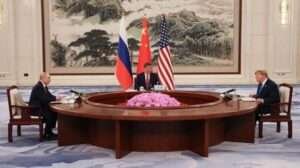
Putin, perhaps, has the most immediate diplomatic stakes in this gathering. Russia’s prolonged war with Ukraine, Western sanctions and growing dependence on economic partnerships with China have considerably complicated Moscow’s strategic choices. His close relationship with Xi is hardly a secret, and Beijing’s economic and diplomatic support has provided Moscow with considerable strategic space. Yet, can this trilateral meeting genuinely persuade Russia to end the Ukraine war? More importantly, can any meaningful settlement be contemplated without Ukraine and European stakeholders having a place at the negotiating table? A peace arrangement imposed over the heads of those directly involved would be neither sustainable nor legitimate. Putin’s repeated emphasis on a larger Eurasian partnership and his description of Bharat and China as important pillars of Eurasian cooperation also deserve attention. Bharat remains a longstanding strategic partner of Russia, even while maintaining independent and expanding relationships with the United States and other Western powers. But Moscow’s growing proximity to Beijing cannot be overlooked, particularly when India’s own security concerns with China remain unresolved. Russia may be keen to project Bharat as an indispensable partner, but New Delhi will not allow its strategic autonomy to be compromised by anybody’s geopolitical ambitions. The nuclear question adds another dimension. With the New START treaty between Washington and Moscow having expired in February 2026, any serious discussion on nuclear arms control would be welcome. But China must also be part of the broader conversation, even as Beijing has shown reluctance to enter an arrangement designed around two much larger nuclear arsenals. Grandstanding cannot substitute for verifiable commitments. No wonder Hillary Clinton has questioned the utility of the gathering, warning of its potential to become another photo-op rather than a meaningful diplomatic exercise. Her criticism may carry its own American political context, but the underlying question is legitimate: what concrete outcomes can emerge when the three leaders have such divergent priorities? Ultimately, Shenzhen may provide Trump an opportunity to project diplomatic relevance, Xi a platform to showcase China’s growing influence and Putin a chance to demonstrate that Russia is far from isolated. But that is not the same as producing peace, stability or a new international consensus. The world needs cooperation, not competitive ego trips; credible diplomacy, not choreographed handshakes; and inclusive decision-making, not exclusive power games. The three leaders may command enormous influence, but they do not own the world. A photo-op can make history’s headlines. It cannot, by itself, make history.

