



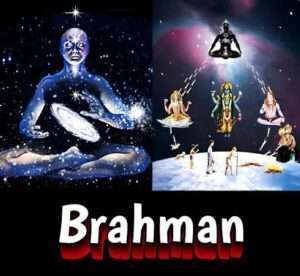
What if the ancient concept of Brahma—the cosmic observer who sees and understands the universe beyond the limitations of ordinary human perception—could be imagined through the lens of modern physics?
It may sound like an unusual question, but a fascinating thought experiment emerges when the ancient description of the four Yugas is viewed alongside Einstein’s theory of relativity and the phenomenon of time dilation.
Let us imagine an observer whom we shall call Brahma. He is not an ordinary observer on Earth. Instead, he occupies a hypothetical cosmic frame from which he observes the motion of the Earth. For convenience, we may associate this frame with the cosmological reference frame defined by the cosmic microwave background (CMB), against which the Solar System’s motion is measured at roughly 370 km per second.
Now comes the intriguing part.
Suppose, purely as a thought experiment, that the Earth—or the frame in which its inhabitants exist—were moving at different fractions of the speed of light during four successive cosmic ages.
Let the velocity during Satya Yuga be 0.992c, during Treta Yuga 0.986c, during Dvapara Yuga 0.968c, and during Kali Yuga 0.866c, where c is the speed of light.
Einstein’s special theory of relativity tells us that as the velocity of an object approaches the speed of light, time for that moving object passes more slowly relative to an observer in another inertial frame. The mathematical quantity involved is the Lorentz factor:
γ = 1 / √(1 − v²/c²)
Applying this equation to the four hypothetical velocities produces a remarkable pattern.
At 0.992c, the Lorentz factor is approximately 7.9.
At 0.986c, it is approximately 6.0.
At 0.968c, it is approximately 4.0.
And at 0.866c, it is approximately 2.0.
The ratios are therefore strikingly close to:
4 : 3 : 2 : 1.
In other words, relative to the hypothetical observer Brahma, a unit of elapsed time experienced by people moving at 0.992c would correspond to roughly four times the time experienced at 0.866c. Similarly, the corresponding ratios for the second and third velocities would be approximately three and two.
This creates an intriguing parallel with the traditional description of the four Yugas, in which Satya Yuga is described as four times the duration of Kali Yuga, Treta Yuga as three times, and Dvapara Yuga as twice the duration of Kali Yuga.
Could this be what the ancient tradition was metaphorically describing?
That is where the thought experiment becomes truly fascinating.
If Satya Yuga = 0.992c, Treta Yuga = 0.986c, Dvapara Yuga = 0.968c, and Kali Yuga = 0.866c, then relativity provides a mathematical mechanism through which time experienced by people in the respective ages could appear in the ratio 4:3:2:1 to an external observer.
The same reasoning could also offer an imaginative interpretation of the traditional claim that human beings lived progressively longer lives in the earlier Yugas. If biological ageing is assumed to proceed according to the passage of proper time experienced by the people themselves, then an external observer could see their clocks and biological processes running progressively slower as their relative velocity increased.
There is, however, an important scientific caveat.
Physics does not identify the CMB frame as an absolute or universally privileged frame. Special relativity has no preferred inertial observer. The CMB merely provides a convenient cosmological reference frame in which the universe appears broadly isotropic. Therefore, calling Brahma a “universal observer” is a philosophical interpretation, not a conclusion established by relativity.
Yet that qualification does not diminish the beauty of the thought experiment.
Perhaps the point is not to claim that the ancient sages secretly possessed Einstein’s equations. Nor should a numerical coincidence automatically be presented as scientific proof of the Yuga theory.
Rather, it invites an intriguing question: could an ancient description of cosmic time have been conceived from a perspective radically different from ordinary human time?
Modern physics has already taught us that time is not absolute. It depends upon motion and the observer’s frame of reference. Ancient Indian thought, meanwhile, has long imagined time on enormous cosmic scales and distinguished between human time and divine or cosmic time.
Seen in that light, Brahma need not be imagined merely as a deity sitting somewhere outside the universe with a gigantic clock. He can, in this thought experiment, represent the ultimate cosmic observer—a perspective from which the passage of time is radically different from what humans experience.
Whether that is merely a fascinating numerical coincidence or something that deserves deeper philosophical investigation is open to debate.
But one thing is certain: when relativity meets the Yugas, the ancient question of whose clock defines time suddenly becomes remarkably modern.




What the article is trying to do:
It takes the Vedantic concept of *Brahman / Sakshi* (Witness Consciousness) and maps it onto the modern scientific idea of an *Observer* in physics and consciousness studies.
1. Spiritual Significance
The idea is rooted in classical Indian philosophy, not sociology:
*- Advaita Vedanta:* Brahman is described as _Drashta_ (seer) and _Sakshi Chaitanya_ (witness consciousness). It is not a person, caste, or god who watches the world. It is the pure awareness in which the world appears. The Brihadaranyaka Upanishad (3.8.11) says: “It sees but cannot be seen.”
*- Distinction is crucial:* The article’s title uses “Brahmin” but the philosophical principle is “Brahman”. Brahmin is a social/varna identity. Brahman is a metaphysical principle. Conflating the two leads to social misreading of a spiritual concept. Spiritually, the universal observer is attainable/present in all beings, not exclusive to one group – the Gita calls it _kshetrajna_ present in all _kshetras_ (fields/bodies).
*- Strength of the argument:* It connects well with the Indian tradition of introspection – that consciousness is fundamental, not emergent.
*- Weakness:* If it presents Brahmin (the caste) as the universal observer, it moves from spirituality to caste essentialism, which is not supported by Upanishadic texts themselves.
2. Scientific Significance
This has to be evaluated separately:
*- Physics – Observer Effect:* In quantum mechanics, “observer” does not mean consciousness. It means any measurement interaction that collapses a superposition. A photon detector is an observer. The popular notion that “consciousness creates reality” is not standard physics – it’s an interpretation (von Neumann-Wigner interpretation) that most physicists do not hold.
*- Neuroscience / Consciousness Studies:* Modern science studies consciousness as a first-person experience. Concepts like meta-awareness, the default mode network, and witness consciousness in meditation have been studied in labs (e.g., research on mindfulness and open monitoring). The term “universal observer” has no operational definition in science – it cannot be measured, falsified, or tested.
*- Value:* The article has value as a philosophy of science piece. It raises a valid question: Is there a background awareness that is not reducible to brain activity? That’s an open question in the “hard problem of consciousness.”
*- Limitation:* It is an analogy, not evidence. Spiritual witness = scientific observer is a metaphorical bridge, not a causal proof.
Neutral Summary:
Dimension What holds up What doesn’t
**Spiritual** Brahman as Sakshi is a coherent, well-documented concept in Vedanta. It is universal by definition. Equating Brahman with Brahmin caste is philosophically inaccurate.
**Scientific** It inspires interesting questions about consciousness and observation. It is not a scientific theory. No empirical test shows a universal Brahman observer.