



Indian cities seem to repeat the same story every monsoon—a few hours of heavy rain, waterlogging on roads, vehicles stuck in traffic jams, flooded underpasses, water entering homes and shops, and the administration scrambling for relief and evacuation efforts. Rapidly developing metropolitan areas like Delhi-NCR and Gurugram are examples of this. The question is, are floods in these cities solely the result of excessive rainfall? The answer is no. Urban flooding is a crisis born out of the interaction of natural rainfall and human disruption. While changing weather has certainly increased the risk, poor urban planning and weak governance have exacerbated the situation.
Urban flooding occurs when rainwater exceeds the city’s drainage, groundwater infiltration, and natural or artificial water storage capacity. In rural areas, water has the space to spread and seep into the ground through fields, ponds, and natural channels, but increasing concretization in cities blocks natural waterways. As a result, even heavy rainfall over a short period can cause widespread waterlogging.
The primary reason for Indian cities becoming flood-prone is changing rainfall patterns. Climate change is increasing the frequency of heavy rainfall over short periods of time in many areas. Drainage systems designed based on historical rainfall averages are unable to handle such intense rainfall. The intense monsoon rains in Delhi-NCR are a case in point. The problem isn’t just the total amount of rainfall, but also the excessive concentration of rainfall over a short period of time.
Another major reason is rapid concretization. Cities like Gurugram have seen rapid expansion of residential colonies, high-rise buildings, commercial complexes, and roads over the past few decades. Ground that previously absorbed rainwater is now covered with cement and asphalt. This reduces groundwater recharge and increases surface runoff. When large amounts of water flow simultaneously to roads and drains, the drainage system quickly fails.
Encroachment on natural drains and waterways also exacerbates urban flooding. Urban development often ignores the fact that every watercourse has its own natural flow area. Narrowing drains, covering them, or building on their banks obstructs water flow. Similarly, the disappearance of ponds, lakes, and wetlands robs cities of their natural water storage areas. The degradation of wetlands and water bodies in Delhi-NCR points to this problem.
Weak and unorganized stormwater drainage systems further exacerbate the problem. In many cities, the capacity of drains has not been increased to meet local needs and current rainfall conditions. In many places, sewer and stormwater drainage systems are interconnected, causing both systems to be overwhelmed during heavy rains. Furthermore, plastic and other solid waste clogs drains. This means that as much as rain is a major problem, so too is the waste we ourselves dump into the drainage system.
Therefore, it’s not appropriate to consider urban flooding solely as a natural disaster. It’s also a failure of governance. In cities, responsibilities for roads, building construction, drainage, land use, environment, and disaster management are often divided among different agencies. When an area becomes waterlogged, assigning responsibility becomes difficult. Lack of coordination leads to one department building a road, another constructing a drain, and a third granting land use permission, but planning doesn’t consider the entire catchment area as a single unit.
Flood risk and catchment areas are not adequately addressed in urban master plans. Despite existing regulations governing construction in low-lying areas, floodplains, and around water bodies, they are not effectively enforced. Unauthorized construction and encroachment gradually destroy natural waterways. Pre-disaster risk reduction should be a priority, rather than focusing on post-disaster relief and rescue.
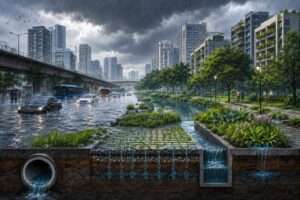
Building climate-resilient cities requires first considering the city as a natural watershed, not just a collection of buildings and roads. The concept of a “sponge city” can be useful for this. Its aim is to capture, absorb, and reuse rainwater within the city, rather than letting it drain rapidly. Permeable surfaces, rain gardens, rainwater harvesting, and local water harvesting structures can be developed in parking areas, sidewalks, and other suitable locations.
At the same time, “blue-green infrastructure” must be integrated into urban planning. Ponds, lakes, wetlands, rivers, streams, urban forests, and green spaces are not just aesthetically pleasing; they are the city’s natural flood-fighting system. Their conservation and restoration help retain water, infiltrate the ground, and regulate temperatures.
Stormwater drainage design capacities will also need to be adjusted to account for future climate conditions. Instead of relying on outdated rainfall data, it’s essential to incorporate updated climate models and extreme rainfall projections into planning. GIS-based flood-risk maps can be developed to determine which areas should limit construction and where additional water storage capacity needs to be developed.
It is also essential to provide local bodies with financial resources, technical expertise, and adequate decision-making power. Each city should develop a comprehensive Urban Flood Risk Management Plan, integrating drainage, land use, water bodies, waste management, and disaster management. Clear accountability should be established between municipal bodies and relevant agencies.
Ultimately, extreme rainfall cannot be completely prevented, but it can be significantly reduced from becoming an urban disaster. This requires integrating meteorology and climatology with urban planning. Natural water bodies must be protected, concretization must be balanced, and administrative accountability must be strengthened. Cities must transform from being mere drains of rainwater, to being cities that manage rainwater wisely. The path to combating urban flooding in the era of climate change lies not in more pumps and more relief, but in better planning, stronger local governance, and an urban system that is in harmony with nature.

