



Sabarimala, Sati and the Civilising Mission
Ranjana Kumari has for years argued for women’s right to worship at Sabarimala. In an earlier interview, she specifically invoked a woman’s right to offer prayers at the temple. In 2016, she argued that judicial rulings opening temples to women should extend to other temples, explicitly including the Ayyappa temple at Sabarimala. Following the Supreme Court’s 2018 judgment opening Sabarimala to women of all ages, she welcomed the broader constitutional direction of the ruling.
There is an obvious question here that polite discourse somehow never asks:
What does Christianity think of praying to Ayyappa?
Again, there is no need for speculation. The Catholic Catechism states that the First Commandment prohibits honouring other gods, condemns polytheism and regards idolatry as involving false pagan worship. Protestant Christianity is similarly opposed to murti worship. The theological principle is straightforward: worship belongs to the Biblical God alone.
So why would institutions emerging from this religious world support an activist ecosystem concerned with expanding a Hindu woman’s “right to pray” to Ayyappa?
Since when did Christian institutions develop an enthusiasm for making murti worship more inclusive?
Perhaps the contradiction becomes clearer when the issue is understood not merely as prayer, but as authority.
Who gets to define Hindu practice?
Who decides which Hindu traditions are legitimate, which are discriminatory and which must be altered by courts, governments or activist intervention?
Sabarimala is particularly useful in this debate because an indigenous religious practice can be stripped of its own categories and reconstructed entirely within imported ones.
Men versus women.
Exclusion versus equality.
Patriarchy versus liberation.
Once the vocabulary is fixed, the verdict is almost built into the vocabulary itself.
But Sabarimala is not a municipal auditorium from which women were arbitrarily excluded. It is a particular sacred tradition centred on Ayyappa as a naisthika brahmachari, or lifelong celibate. The traditional restriction concerned women within a particular age group, not women as an undifferentiated sex.
Hindu temples are not interchangeable branches of a centrally governed Church. They represent different devas and devis, different vows, different rituals and different sacred environments.
That diversity matters.
Nature differentiates. Hindu traditions often reflect those differences.
The imported ideological machine, however, tends to homogenise first and judge afterwards.
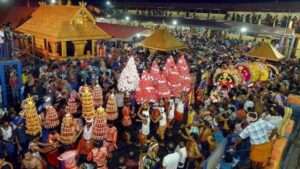
The Missionary Learns Gender Studies
This method feels familiar.
The nineteenth-century missionary encountered a murti and already possessed the category required to understand it: idol.
He encountered a deva and saw a false god.
He encountered ritual and saw superstition.
The indigenous category hardly mattered because the missionary’s theology had already supplied the conclusion.
The modern handmaiden encounters Sabarimala and arrives with her categories already prepared:
Patriarchy.
Discrimination.
Inequality.
Different catechism.
Same intellectual move.
The old missionary was at least refreshingly candid. He carried a Bible and told Hindus that their religion was false.
The modern civilising mission is considerably more sophisticated. It arrives through NGOs, international foundations, gender workshops, academic departments, rights discourse and media amplification.
“Your gods are false” has poor public relations today.
“Your traditions are oppressive” travels much better through a grant proposal.
This is not merely a rhetorical parallel. The use of the Indian woman as moral justification for intervention has a long colonial history.
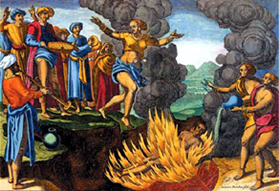
Sati and the Hindu Savage
Sati supplied perhaps the most successful template.
The word itself underwent a colonial transformation. In Sanskrit, sati means a virtuous woman; it did not originally name the practice of widow self-immolation. Oxford scholar David Brick has noted this semantic shift. Yet “sati” eventually became globally synonymous with widow burning and, by extension, with Hindu civilisation itself.
The actual historical picture was more complicated than the stereotype.
Colonial records for the period between 1815 and 1824 reported 6,632 cases across the Bengal, Madras and Bombay Presidencies, with about 90 per cent recorded in Bengal. A Cambridge historical study has concluded that the practice was “far from universal or common”.
Yet repetition accomplished what statistics could not.
The exceptional became typical.
The regional became civilisational.
More importantly, there was no single, consistent sanction across traditional Dharmaśāstra discussions for widow burning. Where sati was endorsed, the scriptural conception could present it as a choice rather than an obligation. Apararka explicitly described it as optional and provided for a widow who changed her mind. Medhatithi went further and rejected sati as prohibited suicide.
This does not tell us the circumstances surrounding every historical death. Nor does it diminish the horror of a widow being coerced onto a funeral pyre.
It tells us something else: the normative tradition cannot simply be reduced to a story of Hindu men systematically murdering widows.
Nevertheless, missionary discourse successfully transformed a rare, regionally concentrated and scripturally contested practice into an iconic representation of how Hindu civilisation supposedly treated women.
The woman’s religious agency had to disappear for the colonial story to work.
She had to become a passive victim because the civilising mission required someone to rescue.
Lata Mani’s feminist study Contentious Traditions is significant precisely here. It examines how women themselves were marginal to the colonial debate while sati became a battlefield over Hindu tradition, missionary evangelism, colonial authority and the meaning of civilisation. Mani also observed the prominence of missionary descriptions of sati in fundraising literature directed at British audiences.
Women provided the terrain.
The native woman supplied the moral warrant for the civilising mission.
And that template has not disappeared.
It has merely acquired a modern vocabulary.

