



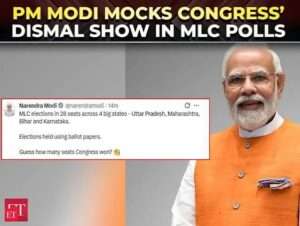
The Congress has discovered an inconvenient truth: elections can be lost even without Electronic Voting Machines (EVMs). Its candidates have drawn a blank in the Legislative Council elections across four states, dealing a political blow to Rahul Gandhi’s relentless campaign against alleged “vote chori”. When the ballot paper, rather than the EVM, delivers an embarrassing verdict, whom will the Congress blame next? The biennial elections to 28 Legislative Council seats across Uttar Pradesh, Bihar, Karnataka and Maharashtra were held on October 23, with counting beginning on October 27. The Congress failed to secure a victory in the results reported by October 28, while the BJP-Janata Dal (Secular) alliance swept all four seats in Karnataka, where the Congress is in power. The BJP and Samajwadi Party also registered victories in Uttar Pradesh, while Bihar witnessed wins for the BJP, Rashtriya Janata Dal, Jan Suraaj Party and independents. Counting was still underway in several constituencies, including Maharashtra, when the results were reported. The irony is delicious. The very party that has questioned the credibility of the Election Commission of India and demanded the resignation of Chief Election Commissioner Gyanesh Kumar now faces an electoral reality check in contests conducted through ballot papers. If EVMs were the alleged villains in the Congress narrative, these results raise an obvious question: what is the excuse when the machines are nowhere in the picture? Rahul Gandhi has repeatedly projected “vote chori” as a national democratic emergency. His party has taken to the streets, questioned electoral processes and sought to mobilise opposition parties against the Election Commission. Yet, the latest MLC results have exposed the limitations of a political strategy that appears to place greater emphasis on questioning the referee than improving the team’s performance. Of course, these elections do not establish that every allegation concerning electoral processes is false. Nor do contests involving graduates and teachers necessarily mirror the mood of the entire electorate. But they do demonstrate that changing the voting method does not automatically change the Congress’s electoral fortunes. Allegations require evidence; defeats require introspection. Neither can be wished away through slogans. Karnataka is particularly embarrassing for the Congress.
The BJP-JD(S) alliance won all four seats, including Bengaluru Teachers’, which the JD(S) wrested from the Congress. The ruling party’s failure to win even one constituency raises uncomfortable questions about its organisation and its ability to retain support among educated and professional voters. A party governing a state cannot indefinitely blame its opponents or the electoral machinery for every setback. The results also come amid questions over the Congress’s internal leadership and its standing among INDIA bloc partners. The Samajwadi Party has its own political ambitions in Uttar Pradesh, while Mamata Banerjee’s Trinamool Congress has repeatedly demonstrated that it will not automatically defer to Congress leadership. An opposition alliance cannot become a durable political alternative merely by uniting against Prime Minister Narendra Modi. It needs a credible agenda, organisational strength and electoral victories. The timing is awkward, too. The INDIA bloc is preparing for a November 1 rally at Delhi’s Ramlila Maidan against alleged vote theft and the Election Commission. Meanwhile, the Chamber of Trade and Industry has urged Rahul Gandhi to postpone the gathering until after Diwali, warning that traffic restrictions and disruption could hurt businesses during the crucial festive shopping period. Traders have sought a meeting with him to press their case. There is a legitimate public interest in peaceful political protest. But political parties must also consider the livelihoods of traders and workers whose businesses depend on the festive season. A movement claiming to defend democracy should not ignore the economic concerns of ordinary citizens. For Congress, the immediate challenge is not merely to explain the ballot-paper defeats. It must confront a deeper question: why are its political narratives failing to translate into electoral support? If the party believes its allegations are justified, it must substantiate them. If it wants voters to trust it, it must offer more than accusations. Prime Minister Narendra Modi has every reason to take political satisfaction from the Congress’s setback. But the larger lesson is for the principal Opposition party. Democracy does not guarantee victory to any party; it guarantees an opportunity to compete. The ballot paper has delivered its message. The Congress would do well to read it before preparing its next protest. After all, when the machine is blamed for defeat, and the ballot paper produces the same result, perhaps the problem is not the voting instrument. Perhaps it is the political instrument.

