



One is a stormy petrel on television; the other is a cyclone over the Bay of Bengal. One raises the temperature in studios; the other raises water levels, wind speeds, and anxiety along the coast.
Meet Arnab and Arnob. They sound almost identical, but their arenas could not be more different. One unleashes verbal tempests on panelists; the other needs no microphone or prime-time slot to make itself felt.
If they ever appeared on the same programme, the cyclone might be the quieter guest. For once, stormy debate would have a meteorological meaning.
A name by committee
A television personality builds a brand through broadcasting, argument and controversy. A cyclone receives its name through a regional system established before the storm develops.
Arnob – not Goswami – is the cyclone’s official spelling. Bangladesh contributed the name to the regional list for tropical cyclones over the North Indian Ocean, which includes the Bay of Bengal and the Arabian Sea. A country does not name a storm simply because it is expected to make landfall there.
The naming arrangements are coordinated through the World Meteorological Organization and the United Nations Economic and Social Commission for Asia and the Pacific’s Panel on Tropical Cyclones.
The panel has 13 member countries, including India and Bangladesh, which contribute names to a shared list.
For the North Indian Ocean, the India Meteorological Department serves as the Regional Specialized Meteorological Centre. It monitors tropical systems, determines when naming criteria are met, assigns the next applicable name and issues forecasts and warnings.
The name is used only when a system reaches the prescribed threshold for a named tropical cyclone. A depression is not automatically given a cyclone name; it must strengthen to the relevant category.
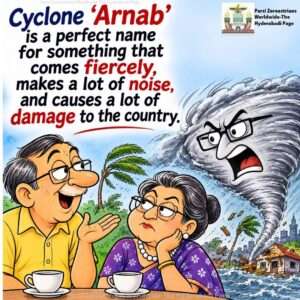
So nobody watches a developing storm and declares, ‘This one looks particularly argumentative. Let’s call it Arnob!’ Bangladesh contributed the name; it did not name the storm because it might hit India.
No personal vendetta
The system makes storms easier to identify, distinguish and remember, especially when warnings cross borders. Names are selected in advance, not as tributes to individuals.
The spelling matters too. Arnob is the form in the official naming list and should not be silently changed to Arnab. The record confirms the spelling and Bangladesh’s contribution; it does not make the cyclone a tribute to any television personality.
Weather versus rhetoric
A cyclone’s fury is measured in wind speeds, rainfall, storm surges and destruction. Satellites, weather stations and scientific models track its path.
The television Arnab operates in another atmosphere, forecasting political fortunes and the collapse of somebody else’s argument. His instruments are a microphone, a panel and a verbal gust capable of blowing a discussion far from its original subject.
One storm obeys physics; the other thrives on ratings. But the comparison has a limit. A cyclone is an impersonal natural hazard.
Those facing its fury deserve timely warnings, effective rescue operations and public support – not jokes at their expense. The humour lies in the name, not in the suffering.
After the storm
Cyclone Arnob’s landfall and weakening will be recorded in meteorological bulletins. The television Arnab will presumably continue generating his own weather system whenever the cameras roll.
A cyclone often weakens after moving inland or over cooler waters, though wind shear, dry air and other conditions can alter its intensity.
One has a name assigned under a regional system, a scientific trajectory and an eventual end. The other has a programme schedule.
And if the next cyclone bears another familiar name, viewers may wonder whether it is approaching the coast – or merely preparing for prime time.

